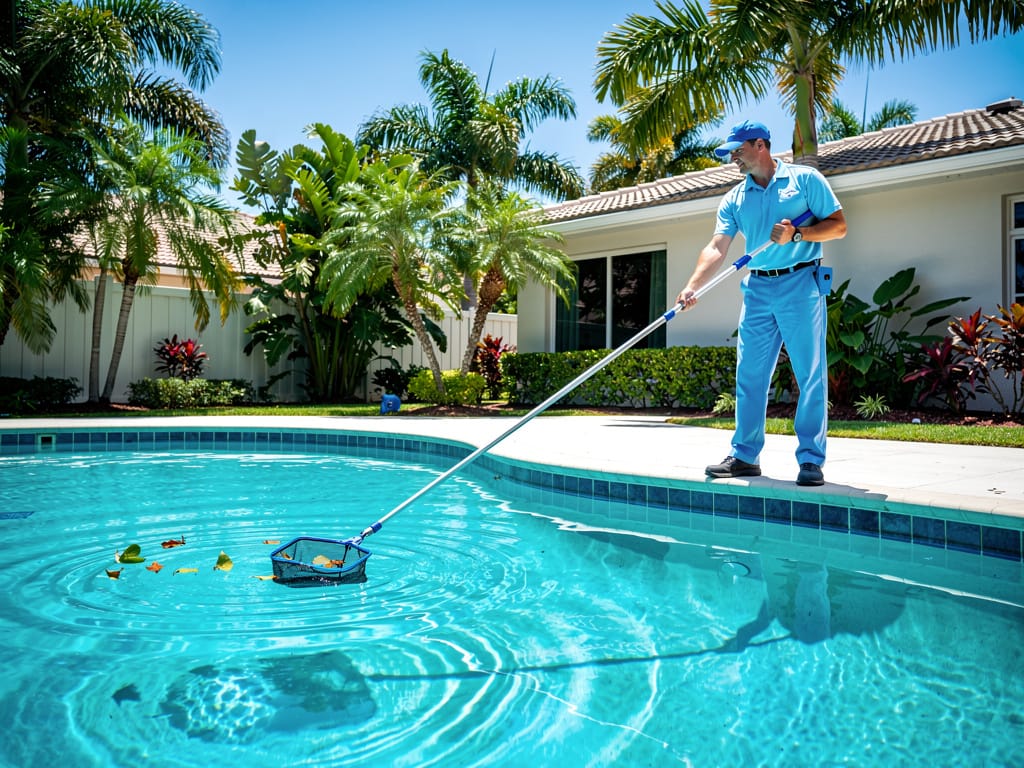
Quick Answer: A complete weekly pool maintenance visit in Pompano Beach, FL includes: surface skimming, brushing all walls and steps, floor vacuuming, skimmer and pump basket emptying, a full 5-point water chemistry test with adjustment, filter check or backwash when needed, and a written service report. For HOA communities like Palm Aire — which has over 10 sub-associations — the documentation component is not optional.
Not all weekly pool service in Pompano Beach is equal. The scope of tasks completed on each visit varies significantly between providers, and the items most likely to be cut are often the ones that matter most for long-term pool health. This guide defines what a proper weekly visit should include — and what to look for to confirm your current service is delivering full value.
The Complete Weekly Service Checklist for Pompano Beach Pools
Physical Cleaning Tasks
1. Surface Skimming
All floating debris is removed from the water surface: leaves, insects, pollen, palm fronds, seed pods, and any material blown in since the last visit. In Pompano Beach’s neighborhoods with mature vegetation — Crystal Lake, Rock Island, areas along Sample Road — leaf and organic debris can be substantial even midweek. The surface skimmer basket is also checked and emptied.
2. Wall, Step, and Bench Brushing
Every interior surface must be physically brushed at every visit. In Pompano Beach’s summer heat (water temps 85–92°F), algae spores can attach to unbrished surfaces and establish a visible colony within 4–6 days. Brushing weekly disrupts the attachment cycle before algae becomes a treatment problem. This includes behind ladders, in corners and coves, and around return jets — areas commonly missed by inadequate technicians.
3. Floor Vacuuming
Settled debris, dead algae cells, and fine silt accumulate on the pool floor. Circulation alone doesn’t remove floor-settled material. Manual vacuuming (or verified automatic vacuum operation) at every visit ensures the floor stays clear. In Pompano Isles and other waterfront properties, wind-driven silt can settle rapidly.
4. Pump Strainer Basket Emptying
The pump strainer basket catches material that passes the skimmer. A full pump basket reduces water flow, stresses the pump motor, and can cause the pump to overheat or cavitate. Emptied at every visit.
5. Waterline Tile Check
The waterline tile is inspected for calcium scale and algae staining at every visit. In Pompano Beach’s hard water, calcium scale at the waterline builds faster than in soft-water areas. The technician brushes visible buildup; heavier deposits requiring acid or pumice treatment are flagged for a separate service appointment.
Water Chemistry Tasks
6. Full 5-Point Chemistry Test
Every visit must include testing all five primary parameters:
- pH (target 7.4–7.6; monitored for Pompano Beach’s characteristic upward drift)
- Free chlorine (target 2–4 ppm)
- Total alkalinity (target 80–100 ppm for South Florida)
- Calcium hardness (target 200–300 ppm; Broward hard water monitoring)
- Cyanuric acid (target 30–50 ppm; tested monthly minimum or when algae recurs)
A service that tests only chlorine and pH is incomplete — all five parameters interact and must all be within range for the pool to function correctly.
7. Chemical Adjustment Based on Readings
Chemicals are added only in response to actual test readings — not a fixed preset dose. For Pompano Beach pools, typical weekly adjustments include liquid chlorine (most visits) and muriatic acid for pH (most visits in summer). Alkalinity, calcium, and CYA adjustments are made as needed based on monthly trending, not every visit.
Equipment Tasks
8. Filter Pressure Check and Backwash When Needed
Filter gauge is read at every visit. When pressure rises 8–10 psi above the clean baseline (typically every 2–4 weeks in Pompano Beach’s high-use conditions), the filter is backwashed (sand/DE) or cleaned (cartridge). A technician who never backwashes is not monitoring filter pressure — and your pool is being filtered by a progressively dirtier medium.
9. Equipment Inspection
A visual and functional inspection at every visit includes: pump (flow rate, no leaks, no unusual noise), motor (running cool, no bearing sounds), filter (no cracks, pressure normal), heater (error codes, ignition function), and salt system (cell output, salt level reading). For Pompano Beach’s coastal properties, the technician should specifically look for early corrosion on motor housing, electrical connections, and stainless fittings — the salt-air environment makes this inspection more important than at inland pools.
Documentation
10. Service Report After Every Visit
A written service report — paper, email, or app notification — should be delivered after every visit and must include: date and time, all 5 chemistry readings, chemicals added with quantities, filter pressure, equipment status, and any notes or alerts. For Pompano Beach HOA communities (Palm Aire’s multiple sub-associations, Cypress Head, Ramblewood Estates), this documentation is your evidence of compliant professional service if an HOA inquiry arises.
HOA-Specific Considerations for Pompano Beach Pool Service
Palm Aire Country Club encompasses more than 10 individual sub-HOAs, each potentially with its own pool maintenance standards and documentation requirements. Some sub-associations require:
- Licensed contractor (CPCO) documentation on file with the HOA
- Service reports available upon request
- Specific chemistry parameter ranges maintained (some HOAs specify pH and chlorine minimums)
- Annual or semi-annual HOA inspection cooperation
A pool company that doesn’t routinely service HOA communities in Palm Aire may be unfamiliar with these requirements. Ask before signing any contract whether they currently service properties in your specific sub-HOA and whether their service report format satisfies documented maintenance requirements.
For complete, documented weekly pool maintenance in Pompano Beach, FL — with written service reports, licensed technicians, and experience in Palm Aire and surrounding HOA communities — call Fort Lauderdale Pool Service at (954) 501-2754. See our Pompano Beach service page.
Frequently Asked Questions
How long should a weekly pool service visit take in Pompano Beach?
A thorough weekly service visit for a standard 15,000–20,000 gallon residential pool in Pompano Beach should take 45–75 minutes. Pools with spas, water features, or significant debris load (common in Pompano Beach’s mature landscaping neighborhoods) may take 60–90 minutes. Visits consistently under 20–25 minutes almost certainly indicate that some tasks are being skipped.
Does weekly pool service in Pompano Beach cover salt cell cleaning?
Salt cell cleaning (needed every 2–3 months in Pompano Beach’s hard water) is typically a separate service item — not included in the weekly visit fee. Confirm with your pool company how they handle salt cell cleaning: whether it’s included in a maintenance plan or billed separately at $65–$100 per cleaning. Either model is acceptable; what matters is clarity in writing before you sign.
What documentation should my pool service company provide for Palm Aire HOA compliance?
For Palm Aire or other Pompano Beach HOA communities that require documented maintenance, your service company should provide: written service reports after every visit (date, chemistry readings, chemicals added, equipment notes), a copy of their Florida DBPR Pool/Spa Contractor license upon request, and proof of liability insurance. Confirm all three are available before signing a service agreement.
How often should a pool filter be backwashed in Pompano Beach?
When filter pressure rises 8–10 psi above the clean baseline — typically every 2–4 weeks in Pompano Beach’s year-round, high-debris-load conditions. During hurricane season, when organic debris is elevated after storm events, backwash frequency may increase. A technician who backwashes on a fixed calendar schedule rather than based on pressure readings is not doing it correctly.
Why do some pool companies offer different service packages in Pompano Beach?
Service packages typically differ in three ways: (1) whether chemicals are included or billed separately; (2) whether service reports are standard or an add-on; and (3) the specific tasks included (cleaning-only vs. full service). For Pompano Beach HOA communities, full-service plans with documented chemistry reports are the appropriate choice. Chemical-only or cleaning-only plans leave gaps that become visible as maintenance problems or HOA compliance issues.