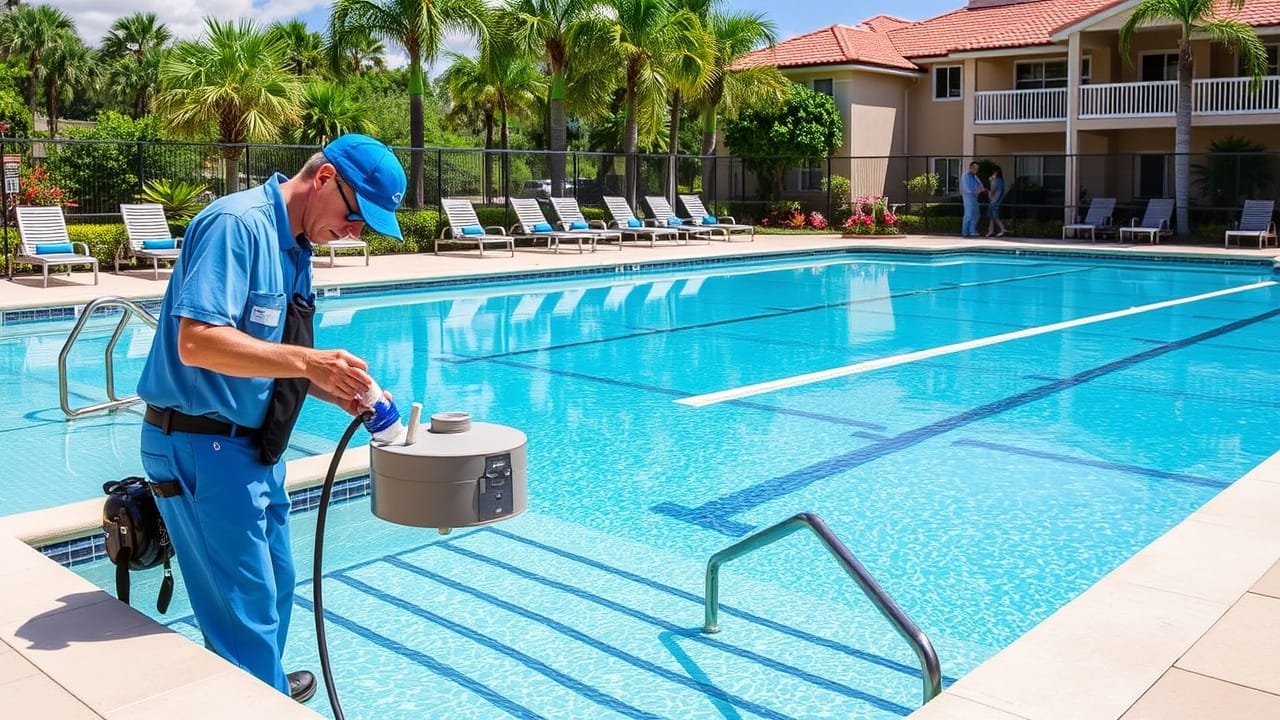
Tamarac is a northwest Broward city built largely between the 1960s and 1980s, with a distinctive demographic character — it has one of the highest concentrations of active adult (55+) communities in the county, a significant number of HOA-governed condominium and villa developments, and a pool stock that reflects the age and character of its housing. Many Tamarac pools are in communities where the pool is a shared amenity managed by an HOA rather than a private residential installation. Where individual homeowners do have private pools, those pools often carry the maintenance history of long-term single-ownership or a succession of owners over 40–50 years. This guide covers what Tamarac pool owners and HOA pool managers need to know about maintaining pools in this specific market context.
Tamarac Pool Chemistry: Northwest Broward Conditions
Tamarac’s water supply comes from Broward County’s municipal system, with chemistry characteristics similar to northwest Broward generally: calcium hardness in the 260–340 ppm range — slightly higher than central Broward markets — alkalinity at the upper end of ideal range, and a water profile that creates scale-formation pressure under Florida’s evaporation rates. Northwest Broward tap water running harder than coastal and central county averages is the same dynamic that drives calcium management priorities in Coral Springs and Coconut Creek. In Tamarac’s older pool stock, years of inadequate calcium management have in many cases produced visible scale on waterline tile, salt cell deposits that have reduced chlorine output, and plaster surfaces that have become progressively more porous as calcium carbonate has deposited and migrated into the plaster matrix.
Active LSI monitoring — calculating the Langelier Saturation Index at each visit and adding acid as needed to keep the water chemistry from trending scale-forming — is the baseline requirement for Tamarac pool service. Providers who don’t test calcium hardness and alkalinity at each visit, and don’t understand LSI management, are leaving Tamarac pools vulnerable to the specific deterioration pattern this market’s water chemistry produces.
Tamarac Neighborhoods and Pool Profiles
Active Adult and HOA Communities
Tamarac has a large concentration of active adult communities — developments like Mainlands of Tamarac, Woodlands, and others that were built specifically for 55+ residents beginning in the late 1960s and 1970s. Community pools in these developments are typically the centerpiece of social life, heavily used by residents for whom the pool is a primary amenity, and subject to higher bather load per pool size than typical residential pools. High bather load introduces organic material — sunscreen, body oils, perspiration — that consumes chlorine aggressively and creates combined chlorine (chloramine) buildup that requires regular breakpoint chlorination to clear.
These community pools are also subject to Broward County Health Department commercial pool regulations. Chemistry logs must be maintained and available for inspection, turnover rate requirements must be met, and the operational documentation standard is higher than residential pool maintenance. HOA boards in Tamarac’s active adult communities need a service provider who understands commercial pool compliance, not just residential chemistry management.
Private Residential Pools in Established Neighborhoods
Beyond the HOA communities, Tamarac has single-family residential neighborhoods where private pools built in the 1970s and 1980s serve individual homeowners. These pools share the age-related characteristics of Broward’s older residential stock: plaster surfaces on second or third resurfacing, equipment that has been replaced piecemeal, and in many cases single-speed pumps that have never been upgraded to variable-speed alternatives. Long-term homeownership in Tamarac’s residential sections means some of these pools have had relatively consistent maintenance — but the accumulated effects of 40+ years of moderately hard water on surfaces and equipment are present regardless of how attentive the maintenance has been.
Newer Development Along Commercial Corridors
Redevelopment along Tamarac’s commercial corridors — particularly near Commercial Boulevard and University Drive — has introduced some newer residential construction with more modern pools. These pools have variable-speed equipment and current-generation saltwater systems, and their maintenance profile is more typical of a standard modern residential account. The contrast with the older community stock is significant — a technician moving between a 1970s community pool and a 2010s residential pool in the same day in Tamarac needs to shift mental models between them.
Seasonal Pool Maintenance in Tamarac
Dry Season: Equipment Inspection and Scale Management
Dry season in Tamarac is the time for salt cell descaling — particularly important given northwest Broward’s harder water supply — equipment inspections ahead of the summer demand season, and surface assessments for the older pool stock. For community pools in Tamarac’s HOA developments, dry season is also the window for any necessary resurfacing or structural maintenance that would require pool closure, as the lower winter use period minimizes disruption to residents.
Rainy Season: Bather Load and Chemistry Management
Tamarac’s active adult community pools see their heaviest use during summer months when residents are most active and the weather drives pool use. Rainy season in northwest Broward brings 3–6 inches of weekly rainfall that dilutes chemistry while simultaneously bather load peaks — a dual demand that requires frequent chemistry monitoring and proactive adjustment. Salt cell output calibration at the start of rainy season is essential for community pools, where the combined demand from dilution and heavy bather load can outpace a cell running at its dry-season setting within days of summer’s onset.
Pool Services Available in Tamarac
Fort Lauderdale Pool Service provides residential and community pool service throughout Tamarac. Our Fort Lauderdale Pool Service team understands northwest Broward’s water chemistry conditions and the specific demands of Tamarac’s HOA community pool market. Full service details are available on our Tamarac pool service page.
Weekly Residential Pool Maintenance
Full chemistry panel, chemical adjustment, brushing, basket emptying, equipment inspection, and digital service reporting for residential accounts. For Tamarac’s older residential pools, we include LSI calculation and calcium hardness management as a baseline service component — not an add-on — given the scale-formation pressure of northwest Broward water.
HOA and Community Pool Service
We service community pools in Tamarac’s active adult and HOA developments with the commercial-grade documentation required for Broward County Health Department compliance. Service frequency for community pools is calibrated to bather load — higher use periods require more frequent chemistry checks to maintain safe and balanced conditions. We provide chemistry logs formatted for health department review and coordinate with HOA management for access, scheduling, and compliance reporting.
Salt Cell Descaling and Calcium Scale Treatment
Northwest Broward’s harder water makes salt cell descaling and waterline tile cleaning higher-priority services in Tamarac than in coastal markets. We descale salt cells on a schedule calibrated to the calcium hardness of each account’s fill water, and recommend tile cleaning intervals based on visible scale accumulation rather than a fixed calendar — some accounts need annual cleaning, others semi-annual based on their specific water conditions and pool use.
Equipment Repair and Variable-Speed Upgrades
We service all major equipment brands and handle variable-speed pump installations — a meaningful upgrade for Tamarac’s older residential pools still running single-speed equipment. For community pools, we have experience with commercial-grade filtration systems including multi-tank DE filter banks and large-volume cartridge systems.
Common Pool Problems in Tamarac
Combined Chlorine in High-Bather-Load Community Pools
Community pools in Tamarac’s active adult developments that see heavy regular use build up combined chlorine (chloramines) from the organic material bathers introduce. High combined chlorine causes the characteristic chlorine smell that pool users associate with “too much chlorine” — paradoxically, it’s actually a sign of inadequate free chlorine relative to organic demand. The fix is breakpoint chlorination — bringing free chlorine to a level that oxidizes all combined chlorine and resets the pool to free-chlorine dominance. We include breakpoint chlorination assessment in community pool service reviews and apply it proactively when combined chlorine trends upward rather than waiting for resident complaints about odor.
Calcium Scale on Community Pool Tile
Community pools in Tamarac’s older developments often have significant calcium scale accumulation on waterline tile — years of moderately hard northwest Broward water evaporating and leaving mineral deposits. Beyond aesthetics, heavy calcium scale harbors algae and bacteria in its porous surface, making it harder to maintain sanitary conditions through chemistry alone. We assess scale severity and recommend the appropriate removal approach — bead blasting for heavy accumulation, acid washing for surface deposits.
Salt Cell Underperformance in Older Residential Pools
Tamarac’s residential pools on saltwater systems that were installed in the early-to-mid 2000s are now running cells that are 15–20 years old. Salt cells have a rated service life of 3–7 years depending on brand and maintenance — cells running beyond that range typically show reduced output and may not generate enough chlorine to maintain safe levels even when the automation panel shows normal status. We test actual chlorine output (not just panel status) for aging salt cell accounts and provide honest assessments of when cell replacement becomes more cost-effective than continued service on a failing cell.
Frequently Asked Questions About Pool Service in Tamarac
Does our HOA community pool need different service than a residential pool?
Yes, significantly. Community pools have commercial documentation requirements under Broward County Health Department regulations, higher bather load that increases chlorine demand and combined chlorine buildup, and turnover rate requirements that must be met under Florida pool code. A service provider for a community pool needs to understand commercial compliance, not just residential chemistry management. We provide the documentation, reporting, and compliance support that HOA-managed pools in Tamarac require.
How often does a Tamarac pool need professional service?
Weekly service is the standard for both residential and community pools. Community pools with heavy use may require twice-weekly chemistry checks during peak summer periods. Northwest Broward’s harder water chemistry makes consistent weekly monitoring especially important for calcium hardness and LSI management — missed visits allow scale-formation conditions to develop that compound over time.
What does pool service cost in Tamarac?
Weekly full-service maintenance for residential pools in Tamarac runs $115–$165/month, in line with the northwest Broward market. Community pool contracts are priced based on pool size, visit frequency, and compliance documentation requirements — contact us for a community pool assessment and proposal. Equipment repairs are billed separately for all account types.
Does Fort Lauderdale Pool Service cover Tamarac?
Yes. We service residential pools and HOA community pools throughout Tamarac. Our technicians are familiar with northwest Broward’s water chemistry conditions, Tamarac’s active adult community pool compliance requirements, and the equipment profiles common in the city’s older pool stock.
Get Professional Pool Service in Tamarac
Fort Lauderdale Pool Service provides residential and community pool maintenance throughout Tamarac. We understand northwest Broward’s harder water chemistry conditions, the specific compliance requirements of Tamarac’s active adult HOA community pools, and the equipment demands of the city’s older pool stock. Whether you’re an HOA board managing a community pool that needs compliant professional service, or a residential homeowner dealing with persistent scale or chemistry issues, we’re ready to help.
Contact us today for a free water quality assessment and a quote for Tamarac pool service.