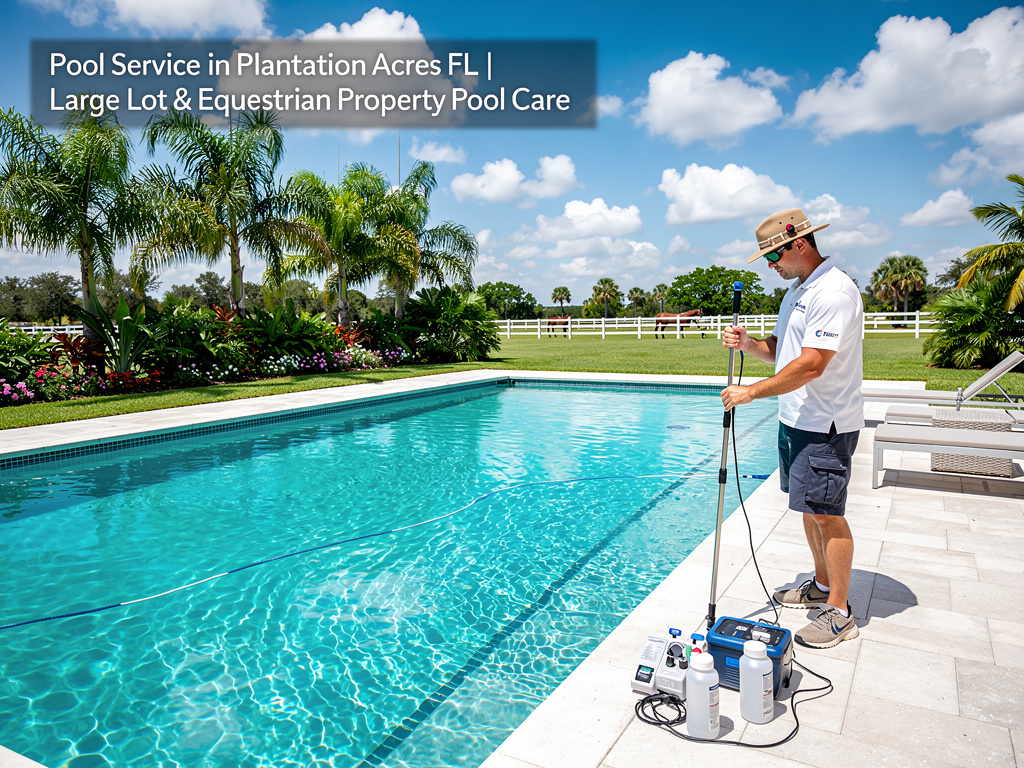
Pool Service in Plantation Acres: A Different Challenge
Plantation Acres occupies a unique position in Broward County — a semi-rural enclave within a major city, where lots run one to several acres, horses graze in backyards, and the density of the surrounding suburban grid gives way to a different pace of living. For pool owners in the Acres, that unique character translates into unique pool service requirements that most companies aren’t built for.
Well Water Chemistry: The Plantation Acres Difference
A significant portion of Plantation Acres properties use private wells rather than the City of Plantation’s municipal water supply. Well water chemistry in South Florida is dramatically different from municipal water and requires a different approach to pool startup, refilling, and ongoing maintenance.
Iron and Staining
South Florida well water frequently contains elevated iron — typically 0.3–2.0 ppm or higher. When iron-laden well water is introduced to a chlorinated pool, oxidation reactions can stain surfaces brown, orange, or rust-colored within hours. Plantation Acres pool owners who use well water to refill after a drain or backwash without proper sequestrant treatment often discover staining within 24–48 hours. Preventing this requires:
- Testing well water for iron and manganese before adding to pool
- Adding a sequestrant (metal chelator) to the pool before introducing well water
- Filling slowly and re-testing water chemistry after refill
Calcium Hardness Variability
Well water in Plantation Acres often has higher calcium hardness than municipal water, which can contribute to scale formation on tile lines, inside plumbing, and on pool equipment over time. Monthly calcium hardness testing is recommended for Acres properties on well water.
pH Starting Point
Well water pH in Broward County varies considerably. Unlike municipal water, which is chemically adjusted to a consistent range, well water may arrive at pH 6.5 or pH 8.0 depending on the aquifer and your specific system. Always test well water pH before adding significant volumes to the pool.
Larger Pools and Lot Footprints
Plantation Acres homes routinely feature larger-than-average pools — some exceeding 25,000–35,000 gallons compared to the Broward average of 12,000–18,000 gallons. This changes the math on:
- Chemical quantities: A 30,000-gallon pool requires roughly double the chemicals of a 15,000-gallon pool
- Service time: Larger pools take longer to vacuum and brush thoroughly
- Shock treatment costs: Green pool recovery on a large Acres pool can run $400–$600+
- Equipment sizing: Undersized pumps or filters relative to pool volume are common on older Acres properties
Monthly service rates for Plantation Acres pools typically run $155–$200+ depending on pool size, well water complexity, and debris load from surrounding landscape and equestrian areas.
Equestrian Environment Considerations
Properties with horses have elevated organic contamination risk near pools. Manure, hay, and animal traffic near pool areas contribute:
- Elevated phosphate levels (from organic runoff)
- Higher bacterial load if animal areas are close to pool
- Dirt, sand, and debris tracked in more frequently
Plantation Acres pool service should include more frequent phosphate testing — potentially every 2–3 weeks for properties with active horse pastures adjacent to pool areas.
Finding the Right Service Company for Plantation Acres
Before hiring, ask any prospective pool company explicitly:
- Do you have current clients in Plantation Acres?
- Are you experienced with well water chemistry and iron sequestration?
- Can you service larger pools (20,000+ gallons) on your standard route?
- Do you test phosphates on every visit or on a schedule?
A company that hesitates or gives vague answers to the first two questions is not the right fit for Plantation Acres. The learning curve is steep — and your pool’s finishes, equipment, and water quality pay the price when a company learns on your property.