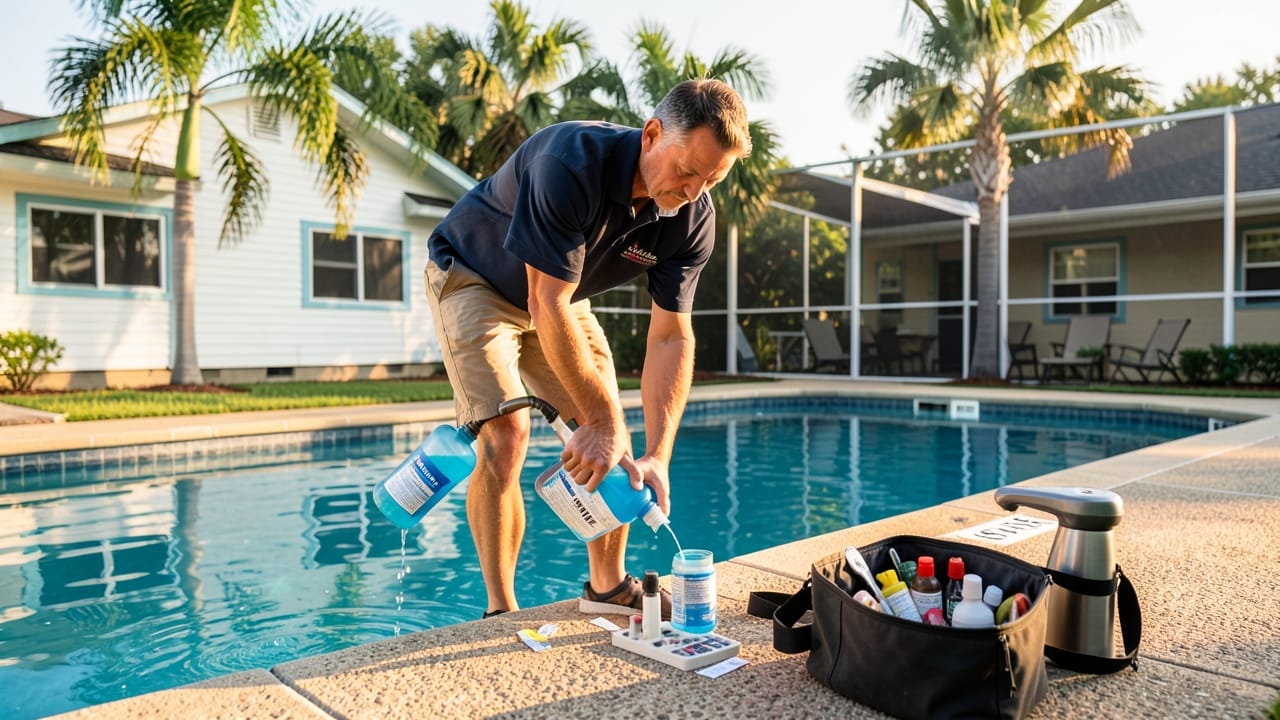
Lauderhill is a central Broward city with a housing stock built primarily in the 1960s and 1970s, a dense residential character, and pools that reflect decades of variable ownership and maintenance histories. Like neighboring Lauderdale Lakes, Lauderhill sits in the middle of the county with no coastline access and a pool market that’s defined more by the economics and demographics of an established urban community than by the premium pricing of resort-adjacent or estate markets. That context matters for understanding what pool maintenance in Lauderhill actually requires: consistent execution of sound chemistry practices, honest equipment assessments for aging infrastructure, and service providers who understand how to get the best results from older pool stock rather than simply recommending wholesale replacement on every account.
Lauderhill Pool Chemistry: Central Broward Conditions
Lauderhill’s municipal water supply has the central Broward chemistry profile: calcium hardness in the 230–300 ppm range, alkalinity trending high, and a water character that favors calcium scale formation under South Florida’s evaporation-driven concentration cycle. The specific challenge for Lauderhill’s older pool stock is the cumulative effect of decades of inadequate LSI management — pools that have run slightly scale-forming for years accumulate calcium deposits on surfaces and equipment that compound over time, making each subsequent service year harder to manage than the last if the underlying chemistry issue isn’t addressed.
CYA over-stabilization is also more common in Lauderhill’s older pool stock than in newer markets. Pools that have relied on trichlor tablets as the primary chlorine source for 20+ years, without periodic partial drains to reset CYA levels, can accumulate cyanuric acid well above the 80–100 ppm threshold where it starts significantly reducing effective sanitization. We test CYA at baseline for every new Lauderhill account and at every quarterly chemistry review, because addressing CYA creep before it becomes a functional sanitization problem is less disruptive than correcting it after the pool starts showing algae despite adequate free chlorine readings.
Lauderhill Neighborhoods and Pool Profiles
Established Residential Sections
Lauderhill’s residential core along N. State Road 7, Oakland Park Boulevard, and the cross-streets between them represents the city’s primary single-family housing stock — homes built from the 1960s through the late 1970s with pools of comparable age. These pools have histories: some well-maintained through multiple ownership generations, others showing the cumulative effects of deferred maintenance and reactive-only service patterns. The surface conditions in this pool stock range from recently replastered and in excellent condition to original plaster well past its service life, with every point in between represented. Equipment ranges from recently upgraded variable-speed installations to 20-year-old pumps and filters still running on original specifications.
Multifamily and Community Pool Properties
Lauderhill has a significant multifamily housing component — apartment complexes, condominium developments, and townhome communities, many of which include community pools. These pools are commercial properties under Broward County Health Department regulations: documented chemistry logs, turnover rate compliance, and operational standards that differ from residential maintenance. Community pool service in Lauderhill requires a provider who understands commercial compliance requirements, not just residential chemistry management.
Newer Development Near Sawgrass Expressway
Newer residential and mixed-use development along the Sawgrass Expressway corridor has introduced modern pool installations to the western sections of Lauderhill. These pools have variable-speed equipment, saltwater systems, and in some cases automation — a different service profile from the older sections of the city, with fewer corrective issues and more focus on optimizing what’s already in place.
Seasonal Pool Maintenance in Lauderhill
Dry Season: Chemistry Reset and Equipment Assessment
Dry season is the window for addressing accumulated chemistry issues in Lauderhill’s older pool stock. CYA that’s drifted high over summer’s heavy stabilizer use can be corrected with a partial drain before the next rainy season dilution cycle begins. Equipment that’s been running under summer demand can be inspected and assessed while chemistry pressure is low. Surface condition assessments for older plaster tell the story of what next year’s maintenance will look like — and whether resurfacing is approaching on the service horizon.
Rainy Season: Consistent Chemistry Defense
Central Broward’s rainy season brings the standard weekly dilution cycle that challenges all inland pools. For Lauderhill’s older pool stock — particularly accounts with aging salt cells or aging single-speed circulation systems — rainy season is when deferred maintenance shows up as chemistry failures. A salt cell that’s running at 60% of rated output because it’s scaling internally can barely keep a pool balanced during dry season clean conditions; rainy season’s additional demand tips it into visible failure. We test actual cell output rather than relying on automation panel status for all aging salt cell accounts.
Pool Services Available in Lauderhill
Fort Lauderdale Pool Service provides residential and community pool maintenance throughout Lauderhill. Our Fort Lauderdale Pool Service team understands central Broward’s water chemistry and the specific maintenance demands of Lauderhill’s older pool infrastructure. Full service details are available on our Lauderhill pool service page.
Weekly Pool Maintenance
Full chemistry panel, chemical adjustment, brushing, basket emptying, equipment inspection, and digital service reporting. For Lauderhill accounts starting from inconsistent maintenance histories, we perform a baseline chemistry assessment and equipment inspection to establish accurate starting conditions before entering the standard weekly service cycle.
Community and HOA Pool Service
Commercial-grade community pool service with Broward County Health Department compliant documentation. Chemistry logs, turnover rate verification, and coordination with property management. We service community pools in Lauderhill’s multifamily and HOA developments and provide the regulatory documentation required for compliant operation.
Equipment Diagnostics and Repair
Genuine equipment diagnostic capability for Lauderhill’s older pool stock — salt cell output testing, pump performance assessment, filter media evaluation, and automation system work. We provide honest assessments of equipment condition and prioritized recommendations for what needs immediate replacement versus what can be monitored through the next service cycle.
CYA Reset and Chemistry Remediation
For Lauderhill pools with over-stabilized water — CYA above 80–100 ppm from years of trichlor tablet use — we manage the partial drain and chemistry reset process to bring stabilizer levels back to functional range. This is a one-time correction that significantly improves the effectiveness of ongoing chemistry management going forward.
Common Pool Problems in Lauderhill
Algae Despite Adequate Chlorine Readings
The most common Lauderhill pool complaint we hear from homeowners switching service providers: the pool keeps turning green even though the technician says chlorine is fine. In most cases, this is a CYA over-stabilization problem — the free chlorine test shows an adequate number, but excessive CYA has tied up the chlorine so tightly that its actual sanitizing power is a fraction of what the number suggests. High phosphate levels compounding the algae-growth environment are the second most common cause. We test both at baseline for every new account.
Gradual Circulation Loss
Older single-speed pumps in Lauderhill’s residential pools often show gradual circulation decline that’s easy to miss without comparative data over time. An impeller that’s slowly eroding, a basket that’s partially restricting suction, or motor windings beginning to fail can each reduce pump output by 20–30% before the effect is obvious. The result: chemistry that looks correct but doesn’t stay correct, and a pool that trends toward algae during the high-demand rainy season. We note pump flow observations at each visit to catch decline trends before they result in visible chemistry failures.
Surface Porosity and Stain Resistance Decline
Lauderhill’s older plaster surfaces develop increasing porosity as the calcium carbonate matrix thins over decades. Porous plaster holds staining more aggressively, provides more attachment surface for algae, and responds less well to standard chemical treatment. We’re honest about surface condition when we observe it — a pool whose recurring algae and staining issues trace back to plaster porosity needs resurfacing, not just more aggressive weekly treatment.
Frequently Asked Questions About Pool Service in Lauderhill
How often does a Lauderhill pool need professional service?
Weekly service is the standard. Central Broward’s year-round heat and rainy season chemistry dilution means pool chemistry shifts within seven days during most of the year. Monthly service is inadequate for maintaining proper balance in this climate.
What does pool service cost in Lauderhill?
Weekly full-service maintenance in Lauderhill typically runs $110–$155/month for standard residential pools. Equipment repairs are billed separately. Community pools are priced based on size, visit frequency, and compliance requirements.
Does Fort Lauderdale Pool Service cover Lauderhill?
Yes. We service residential and community pools throughout Lauderhill and are familiar with central Broward’s chemistry conditions and the equipment and surface challenges of Lauderhill’s older pool stock.
My Lauderhill pool is always green — how do we fix it for good?
Recurring algae despite regular service is a diagnostic problem, not a chemical dosing problem. The root cause is almost always one of: CYA over-stabilization reducing effective chlorine, high phosphate levels feeding algae growth, a scaling salt cell producing less chlorine than the panel indicates, or circulation failure creating stagnant zones where algae establishes. We identify the actual cause before recommending any treatment change — treating the symptom without fixing the cause produces temporary results followed by the same green water two weeks later.
Get Professional Pool Service in Lauderhill
Fort Lauderdale Pool Service provides weekly maintenance, equipment repair, and chemistry remediation services for residential and community pools throughout Lauderhill. We understand central Broward’s water chemistry conditions and the specific maintenance demands of Lauderhill’s older pool stock. Whether you’re dealing with recurring algae, suspected CYA over-stabilization, aging equipment, or simply want consistent professional service that actually gets ahead of chemistry problems rather than just reacting to them, we’re ready to help.
Contact us today for a free water quality assessment and a quote for Lauderhill pool service.