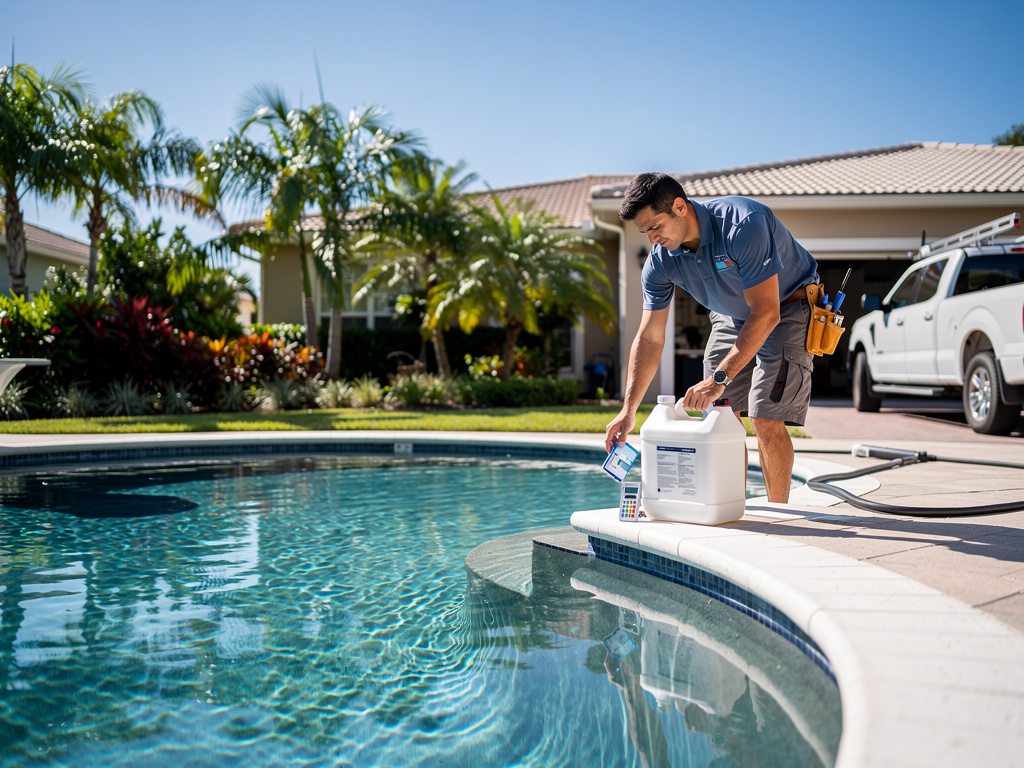
Pool Service for Horse Properties in Davie — Managing Broward’s Equestrian Capital
Davie earned its title as the Equestrian Capital of Broward County through decades of deliberate preservation of its rural horse-keeping character. The town’s zoning allows horses on properties throughout much of its area, and working equestrian properties — with stables, paddocks, riding arenas, and the full infrastructure of horse keeping — exist alongside suburban residential development in a way unique in South Florida. For property owners who keep horses and maintain pools on the same land, the intersection of equestrian activity and pool chemistry creates maintenance challenges that standard residential pool service isn’t designed to address.
The Phosphate Problem: What Equestrian Activity Does to Pool Chemistry
Understanding Phosphate Sources on Horse Properties
Phosphorus compounds — phosphates — are present in high concentrations in the organic matter associated with horse keeping: manure, urine, hay and feed, and the decomposing organic material that accumulates around active equestrian facilities. In a suburban backyard, phosphate input to the pool comes primarily from landscaping runoff, bather cosmetics, and airborne debris — manageable levels that quarterly testing and occasional phosphate remover addresses. On a Davie horse property, phosphate input is an order of magnitude higher and continuous.
The pathway from stable to pool is multiple: rain events carry phosphate-rich runoff across property surfaces toward low-lying pool areas. Wind carries organic particles from hay, feed, and surface material across large properties. Foot traffic from equestrian areas to pool decks carries residue that enters the water. On large Davie properties where the stable is 200 feet from the pool, these input pathways are attenuated but not eliminated. On smaller properties where equestrian and recreational areas overlap, input is more direct and continuous.
Phosphate’s Role in Algae Growth
Phosphate at levels above 100-200 ppb is the primary algae nutrient in pool water. Algae requires phosphate to grow — without it, even lower chlorine levels can maintain a clear pool. With elevated phosphate, algae can establish at chlorine levels that would prevent growth in a phosphate-depleted pool. The practical consequence for Davie’s equestrian property pools: chronic algae problems, recurring green tinge despite seemingly adequate chlorine, and persistent cloudiness that additional chlorine treatment doesn’t resolve. These symptoms look like chlorine management problems but are actually phosphate management problems.
Testing and Treatment Protocol
Quarterly phosphate testing using a liquid reagent test (not dip strips, which are insufficiently sensitive for this application) establishes the phosphate baseline and monitors trajectory between treatments. When levels exceed 200 ppb — the threshold where algae risk increases materially — lanthanum-based phosphate remover (such as PHOSfree or Natural Chemistry products) is applied to reduce phosphate to near-zero. On active Davie horse properties, this quarterly treatment may need to be monthly during high-activity seasons or after significant rain events that generate runoff across the property.
Large-Lot Pool Management Beyond Phosphates
Davie’s equestrian properties often have pools built to match the scale of their surroundings — 20,000-gallon pools are not unusual on two-acre Davie properties, and larger installations exist on significant equestrian estates. Managing these pools requires chemistry calibrated to their actual volume: all dosing calculations based on the pool’s specific gallonage, not on the suburban average that providers without large-pool experience routinely apply. Vacuuming schedules need to account for the debris load generated by proximity to equestrian activity — weekly vacuuming is typically appropriate for Davie horse-property pools, with mid-week basket maintenance between visits.
Fort Lauderdale Pool Service provides professional pool maintenance for Davie’s equestrian properties, including phosphate testing and management, large-volume pool chemistry calibration, and the debris management frequency appropriate for horse-property environments. Contact us for a site assessment.