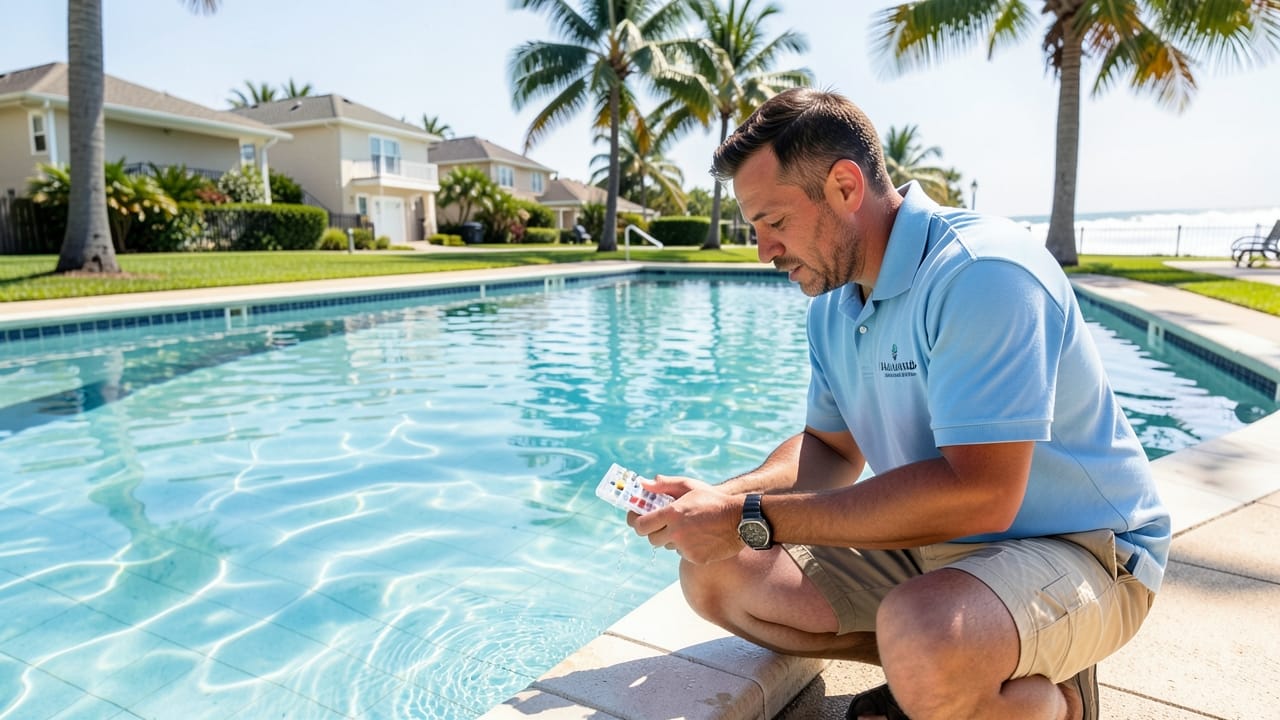
Why Pool Service in Hallandale Beach Demands a Different Approach
Hallandale Beach sits at the southern tip of Broward County, sandwiched between the Atlantic Ocean and the Intracoastal Waterway, and that geography shapes every aspect of pool ownership here. Salt air drifts inland from the beach year-round, accelerating corrosion on equipment, rails, and deck hardware at rates that inland communities simply do not experience. The city’s dense mix of oceanfront high-rises, Intracoastal-front estates in Golden Isles, and compact single-family blocks near US-1 means pool equipment often lives in tight, poorly ventilated spaces that trap heat and humidity — a recipe for premature pump and motor failure.
Add Broward County’s subtropical climate — average highs near 90F from June through September, humidity routinely above 80%, and a rainy season that dumps 40-plus inches between May and October — and you have conditions that push algae growth, chemical imbalance, and filter strain to their limits. Fort Lauderdale Pool Service has spent years learning exactly how Hallandale Beach pools behave, and that local knowledge is the difference between a pool that is always swim-ready and one that perpetually disappoints.
Hallandale Beach Neighborhoods: What Your Location Means for Your Pool
Golden Isles
The finger islands of Golden Isles are among the most pool-intensive addresses in all of South Florida. Nearly every home on these deep-water lots has a pool, and most pools face the Intracoastal directly. Salt spray from passing vessels, afternoon sea breezes, and high water tables create a uniquely corrosive environment. Saltwater chlorinator cells in Golden Isles tend to scale faster than elsewhere, and stainless steel fittings show rust staining within months if not treated with a sacrificial zinc anode. We adjust our service protocol in Golden Isles to include more frequent cell inspections and a quarterly corrosion-prevention treatment on all metal surfaces.
Three Islands
Three Islands shares the Intracoastal exposure of Golden Isles but tends toward slightly larger lots and more mature landscaping. Overhanging trees — sea grapes, buttonwoods, and the occasional coconut palm — shed debris constantly, and pool skimmers in Three Islands require emptying twice as often as inland pools during windy periods. We schedule Three Islands accounts with debris-heavy service windows and carry extra skimmer baskets to swap on the spot when they are overwhelmed.
Diplomat and Beachside Corridor
The oceanfront corridor along AIA — from the Diplomat Resort south to the county line — is dominated by high-rise condominiums and resort-style properties. These pools run nearly 365 days a year under heavy commercial-style bather loads, even when managed by HOA or condo boards. Cyanuric acid stabilizer levels in heavily used pools tend to climb throughout the season, requiring periodic partial drain-and-refill to restore chemical responsiveness. If your building’s pool has seen resistant algae or sluggish chlorine performance, accumulated stabilizer is usually the culprit.
Village of Kings Creek and Westside Neighborhoods
West of US-1, Hallandale Beach transitions to older single-family neighborhoods and townhome communities built primarily in the 1960s through 1980s. Many pools in this area were constructed with older plumbing that does not meet current standards for pump efficiency. We frequently identify opportunities to upgrade single-speed pumps to variable-speed models in these neighborhoods — a change that typically pays for itself in electricity savings within 18 to 24 months and qualifies for FPL rebates.
Southridge and Near-Airport Zone
The residential blocks south of Hallandale Beach Boulevard and east of I-95 are dense, with many older pools that have been through multiple owners. Filter media in this area often has not been replaced in years, and we frequently find sand filters running with media so worn it passes fine debris back into the pool. A proper media replacement or conversion to glass filter media makes an immediate visible difference in water clarity.
The Broward Climate and Your Pool Chemistry
Rainy Season Dilution and pH Swings
South Florida’s rainy season — roughly May through October — brings daily afternoon storms that can dump two inches or more in a matter of hours. Each rain event dilutes your pool chemistry, drops the pH (rainwater is slightly acidic), and potentially introduces phosphates from runoff. Phosphates are a primary algae nutrient, and pools in Hallandale Beach that are not treated with a phosphate remover after heavy rain events are significantly more susceptible to algae blooms within 48 to 72 hours.
We monitor pool water after every significant rainfall and are prepared to adjust chemistry accordingly. During active storm periods in June through August, we often add a mid-week check for our weekly-service clients to catch chemistry issues before they escalate.
UV Intensity and Chlorine Burn-Off
Hallandale Beach’s latitude and clear-sky days mean pool surfaces receive intense UV radiation, particularly from April through October. UV destroys free chlorine rapidly — an unprotected outdoor pool can lose 50 to 90 percent of its free chlorine within a few hours of direct sun exposure. Stabilizer (cyanuric acid) is essential to slow this burn-off, but it must be kept within the 30 to 80 ppm range. Above 100 ppm, stabilizer begins to lock chlorine, reducing its disinfecting effectiveness even when free chlorine reads normal on a test strip.
We use a professional-grade photometer — not strips — to measure all six critical water parameters at every service visit. It is the only way to catch stabilizer creep, total dissolved solids buildup, and calcium hardness issues before they become expensive problems.
Saltwater Pool Considerations in Coastal Hallandale
Saltwater chlorination systems have become the default choice for new pools in Hallandale Beach, and for good reason: they eliminate the need to handle and store chlorine tablets, and the softer water is gentler on eyes and skin. But saltwater pools are not maintenance-free. The salt cell must be inspected for calcium scale buildup every 500 hours of operation, the salt level must be maintained between 2,700 and 3,200 ppm, and the cell itself typically needs replacement every three to five years. We track cell run-hours for every saltwater pool we service and flag upcoming maintenance proactively.
Essential Pool Services for Hallandale Beach Homeowners
Weekly Maintenance Service
Our standard weekly service for Hallandale Beach pools includes:
- Full photometer water analysis (free chlorine, pH, alkalinity, calcium hardness, cyanuric acid, TDS)
- Chemical adjustment as needed
- Skimmer and pump basket emptying and cleaning
- Pool surface brushing (walls, steps, and tile line)
- Debris netting — surface, steps, and floor as needed
- Filter pressure check and backwash when pressure rises 8 to 10 PSI above clean operating pressure
- Equipment visual inspection — pump, motor, valves, salt cell, heater
- Written service report emailed after every visit
Weekly service is the most cost-effective way to maintain a Hallandale Beach pool, because it prevents the chemistry cascades and algae outbreaks that turn into expensive remediation jobs. A single severe algae treatment can cost more than two months of weekly service.
Equipment Repair and Replacement
We hold a valid Florida Certified Pool/Spa Contractor (CPC) license, which means we can perform all electrical, plumbing, and mechanical repairs on your pool system. Common repairs in Hallandale Beach include:
- Pump and motor replacement: The humid, salt-laden coastal air accelerates bearing wear and winding corrosion. We stock all major brands and can typically complete a pump replacement same-week.
- Salt cell replacement and cleaning: We service all major SWG brands — Pentair IntelliChlor, Hayward AquaRite, Jandy TruClear.
- Filter media replacement: Sand, D.E., and cartridge. We also offer conversion to glass filter media, which outperforms sand and requires less frequent backwashing.
- Variable-speed pump upgrades: Replaces inefficient single-speed motors with Pentair IntelliFlo or Hayward EcoStar — qualifies for FPL rebates up to $100.
- Automation installation: Pentair IntelliConnect and Hayward OmniLogic smart pool controllers for smartphone control of pump speed, lighting, heater, and valves.
- Leak detection and repair: Structural and plumbing leak identification using pressure testing.
Algae Treatment and Remediation
Hallandale Beach pools are disproportionately susceptible to algae due to coastal phosphate loading and the sheer number of pool hours logged in the hot season. When green, yellow (mustard), or black algae takes hold, we use a systematic remediation process:
- Brush all surfaces thoroughly to break the algae protective coating
- Superchlorinate to 20 to 30 ppm using calcium hypochlorite shock
- Add a professional-grade algaecide (polyquat or copper-based, depending on algae type)
- Run the filter continuously for 24 to 48 hours
- Backwash or clean filter media to remove dead algae
- Apply phosphate remover to eliminate the nutrient source
- Follow-up test to confirm eradication before returning to normal chemistry
Black algae deserves special mention: it is actually a cyanobacterium with a waxy protective layer that anchors into plaster and grout. Standard treatment will not fully eradicate it — it requires aggressive brushing with a steel brush, direct application of trichlor tablets to affected areas, and sustained elevated chlorine levels.
Pool Opening, Seasonal Prep, and Resurfacing
Hallandale Beach pools do not close the way northern pools do — the water never freezes. But seasonal transitions still matter. In early spring, when snowbird residents return to pools that may have been lightly serviced for months, we offer a startup service that includes a full equipment inspection, water chemistry reset, and filter cleaning. We also work with a licensed plastering contractor for full resurfacing projects when plaster age or condition warrants it.
HOA and Condo Pool Management in Hallandale Beach
A significant portion of Hallandale Beach’s residential pool inventory is HOA or condo-association owned. These pools present different management challenges: higher bather loads, regulatory requirements for commercial pool facilities, and the need for documentation that satisfies both the Broward County Health Department and the association’s liability insurance carrier.
We provide commercial pool service contracts for HOA and condo clients that include:
- Three-times-per-week service visits (industry standard for heavily used community pools)
- Full digital log of every service visit — water chemistry, chemical additions, equipment status
- Annual state health inspection preparation
- Emergency response within four hours for health department-triggering events
- Annual equipment inspection report for insurance documentation
Many Hallandale Beach HOAs have found that outsourcing pool management to a licensed contractor is significantly more cost-effective than employing an in-house maintenance person, particularly when factoring in liability, chemical storage regulations, and the cost of equipment repairs the employee is not licensed to perform.
Choosing the Right Pool Service Company in Hallandale Beach
Florida requires pool service companies to hold a valid Certified Pool/Spa Contractor (CPC) license for any work beyond cleaning. Before signing a service contract, verify the company’s license at the Florida Department of Business and Professional Regulation’s online lookup tool. An unlicensed contractor cannot legally repair your pump or heater, and work performed by an unlicensed contractor may void your homeowner’s insurance for related claims.
Ask potential service providers whether they carry general liability and workers’ compensation insurance, whether they use a photometer or test strips for water chemistry, whether they provide written service reports, and what their response time is for equipment emergencies.
Pool Service Pricing in Hallandale Beach
Weekly pool service in Hallandale Beach typically ranges from $120 to $200 per month, depending on pool size, equipment complexity, and service frequency. This range reflects labor, chemicals, and basic equipment maintenance included in most residential service contracts. For multi-property owners — a common profile in Hallandale Beach given the investment property density — we offer volume discounts for three or more properties under a single account.
Frequently Asked Questions: Pool Service in Hallandale Beach
How often should I have my pool serviced in Hallandale Beach?
Weekly service is the standard for residential pools in Hallandale Beach. The coastal climate, high UV, and long swim season create conditions where water chemistry can shift significantly within seven days. Bi-weekly service is viable only for pools with minimal use and strong automation, and it carries higher risk of chemistry drift and algae development.
My pool turns green every summer. Why?
In Hallandale Beach, summer green algae almost always comes down to one of three causes: stabilizer over 100 ppm (which locks chlorine), phosphate levels that have not been managed through the rainy season, or a service schedule that cannot keep up with the heavy summer bather load. A professional water chemistry audit will identify which factor is driving the problem.
Is saltwater better than a traditional chlorine pool in coastal Hallandale Beach?
For most Hallandale Beach homeowners, yes. Saltwater systems eliminate the cost and handling of chlorine tablets, produce softer-feeling water, and automate chlorine generation to match demand. The trade-off is higher upfront equipment cost (typically $1,500 to $2,500 installed) and the need for professional cell maintenance every 500 hours of operation.
How do I know if my pool has a leak?
Use the bucket test: fill a bucket with pool water, mark the level inside and outside (water line on the pool wall), leave both for 24 hours. If the pool drops more than the bucket, you have a leak beyond normal evaporation. In South Florida, evaporation accounts for roughly 1/4 inch per day in hot weather. Losses beyond that warrant a professional pressure test.
Can I run my pool pump less to save electricity?
Yes, strategically. With a variable-speed pump, you can run at low speed (600 to 1,200 RPM) for 12 to 14 hours and achieve the same daily turnover as a single-speed pump at roughly one-quarter of the electrical draw. FPL’s Smart Saver rebate program currently offers up to $100 for qualifying VSP installations.
What chemicals should I add between service visits?
For weekly-service clients, you should not need to add anything between visits under normal conditions. If your pool sees heavy daily use, a mid-week chlorine shock may be helpful. We orient all new clients on what to watch for — unusual color, foam, strong odor — and how to reach us between visits if something looks wrong.
Schedule Your Hallandale Beach Pool Service
Fort Lauderdale Pool Service serves all of Hallandale Beach — from Golden Isles and Three Islands to the beachside corridor and the westside neighborhoods. Our technicians are familiar with the specific equipment, chemistry challenges, and HOA requirements that define pool ownership in this city. See our full Hallandale Beach pool service page for service area details and current availability, or contact us to schedule a free water chemistry analysis for new clients.
We service Broward County’s coastal cities year-round and have availability for new weekly service clients throughout Hallandale Beach. A clean, clear, properly balanced pool is not a luxury in South Florida — it is a reasonable expectation, and it is what we deliver on every visit.