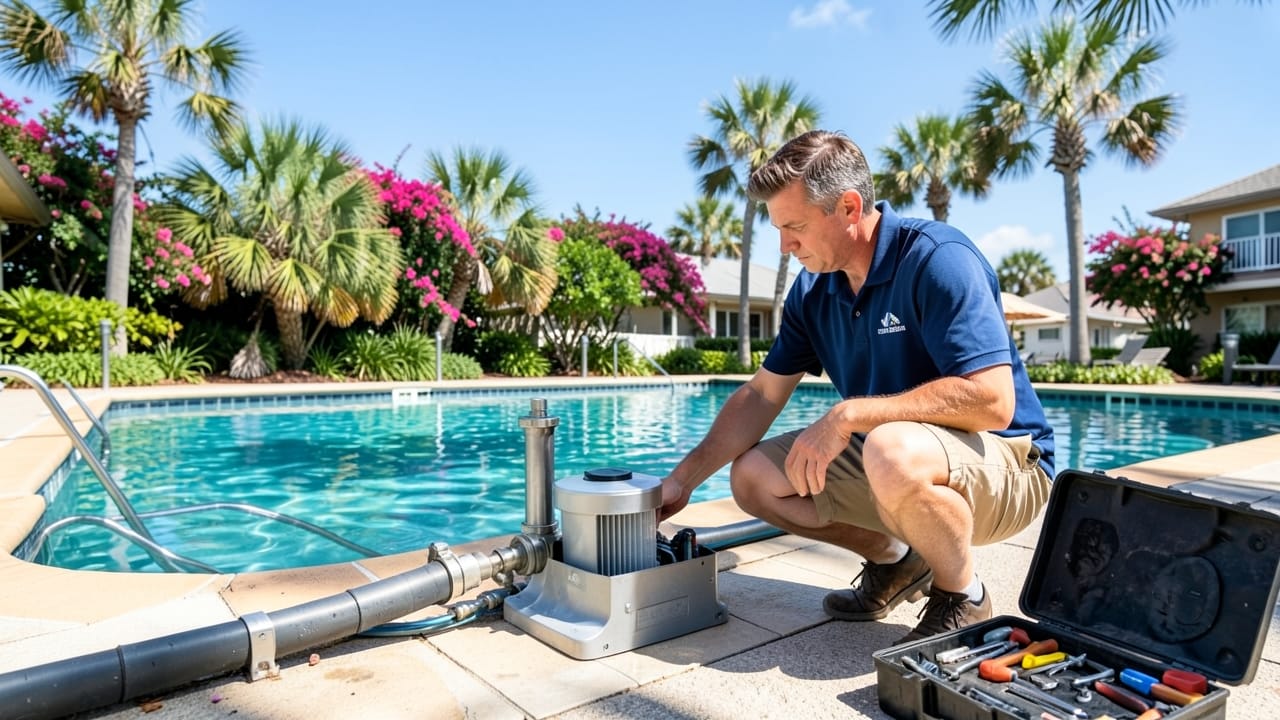
Pool Service in Deerfield Beach: What Every Homeowner Should Know
Deerfield Beach occupies a stretch of Broward County’s northern coastline where the Atlantic Ocean, the Intracoastal Waterway, and the Hillsboro River all converge within a few miles of each other. That coastal geography is the single most important factor in understanding how pools behave here. Salt air saturates the atmosphere as far as a mile inland, marine-grade corrosion is a year-round concern, and the city’s mix of beachfront condos, Intracoastal estates, canal-front homes, and inland single-family neighborhoods creates a wide range of pool maintenance demands under one postal code.
Broward County’s subtropical climate intensifies every maintenance challenge: water temperatures climb above 90 degrees Fahrenheit for weeks at a stretch in summer, driving rapid algae growth and accelerating chemical demand; the May-through-October rainy season delivers relentless phosphate loading from stormwater runoff; and UV radiation at this latitude consumes stabilized chlorine faster than most homeowners anticipate. Fort Lauderdale Pool Service has serviced Deerfield Beach pools for years and understands the city’s specific equipment patterns, neighborhood chemistry profiles, and HOA requirements. This guide covers what you need to know to make an informed decision about your pool service provider.
Deerfield Beach Neighborhoods: Pool Conditions by Zone
Cove at Deerfield and Intracoastal-Front Homes
The neighborhoods along the Intracoastal Waterway — including the Cove community on the western shore — feature pools that face the same salt-spray exposure as oceanfront properties, with the added challenge of boat wakes that can push debris into open pool areas and raise water table levels near pools during heavy rain. Saltwater chlorinator cells in Intracoastal-adjacent homes scale faster than inland installations, and we schedule these accounts for cell inspection every 90 days rather than the standard six-month interval. Sacrificial zinc anodes on any metal components — handrails, ladders, light housings — are essentially mandatory in these locations to prevent accelerated galvanic corrosion.
Hillsboro Shores and Beachside Corridor
The oceanfront strip along AIA from Hillsboro Beach through downtown Deerfield Beach is a mix of high-density condominiums, resort properties, and single-family beach homes. These pools run nearly year-round and often see peak bather loads during winter months when seasonal residents return. Cyanuric acid stabilizer accumulation is the primary chemistry problem in high-use coastal pools — when stabilizer climbs above 80 to 100 ppm, it chemically bonds with chlorine and significantly reduces its disinfecting effectiveness, a condition sometimes called chlorine lock. We test stabilizer levels at every service visit and proactively recommend a partial drain-and-refill when levels approach the upper limit, preventing the chemistry reset from becoming an emergency.
Century Village and Quiet Waters Neighborhoods
The large planned communities in Deerfield Beach’s interior — Century Village with its mix of condominiums and shared amenities, and the Quiet Waters area with its single-family and townhome developments — represent a very different pool environment from the coastal strip. These pools are generally sheltered from salt spray, but they face different challenges: older plumbing in Century Village-era construction (1970s through 1990s) that may not meet current efficiency standards; large community pools that require commercial-grade service frequency and documentation; and the heavy tree canopy in residential areas around Quiet Waters that generates debris loads during wind events.
Deerfield Beach Highlands and Westside Residential
The residential blocks west of US-1 and Powerline Road tend toward older single-family construction with pools built in the 1960s through 1980s. These pools often have single-speed pumps that are wildly inefficient by modern standards — a 1-HP single-speed pump running 8 hours a day can cost $80 to $120 per month in electricity alone, compared to $20 to $35 for a variable-speed pump running the same turnover. Filter media in this area is frequently overdue for replacement: DE filter grids that have been in service for 7 or more years typically show tears or channeling that bypass fine debris, and sand filter media beyond 5 years loses its angular edge and passes particles it should capture.
Pioneer Park and Downtown-Adjacent Neighborhoods
The neighborhoods around downtown Deerfield Beach and Pioneer Park blend older residential construction with newer infill development. Pools here range from well-maintained newer builds to older vessels that have gone through multiple owners without systematic maintenance records. When we take on a new client in this area, we always perform a baseline equipment audit — testing pump and motor performance, inspecting filter media condition, checking plumbing for evidence of slow leaks, and documenting the state of the salt system if present. That baseline becomes the foundation for a maintenance plan that extends equipment life and prevents the surprise repairs that occur when deferred maintenance catches up with a system.
Broward County Climate: The Seasonal Pool Calendar for Deerfield Beach
Winter and Spring (December Through April)
Deerfield Beach’s mild winters — daytime highs in the 70s, occasional overnight lows dipping to the low 60s — mean pools remain usable year-round for most residents, though water temperatures below 65 degrees Fahrenheit will discourage casual swimming. Seasonal residents returning in November and December often find pools that have been on reduced service schedules since Labor Day, with chemistry that has drifted and equipment that needs attention after months of lighter use. A spring startup inspection is valuable: full water chemistry reset, equipment check of pump bearings and seal, filter media inspection, and salt cell descaling if applicable.
Evaporation rates in winter are lower than summer, but pools still lose roughly 1/4 inch of water per day through evaporation alone. If your pool is losing more than 1/2 inch per day in cooler months, a structural or plumbing leak is almost certainly present.
Summer (May Through September)
South Florida summer is the most demanding season for pool chemistry. Water temperatures at or above 84 degrees Fahrenheit dramatically accelerate bacterial growth and chlorine consumption — a pool that requires 2 ppm of chlorine to stay clear in January may need 4 to 6 ppm to maintain safety in August. Combined with daily UV radiation burning off free chlorine and afternoon rainstorms diluting the chemistry, summer in Deerfield Beach can turn a well-maintained pool green within 72 hours of a service visit if the chemistry base is not correctly established.
Our summer service protocol for Deerfield Beach pools includes a higher baseline chlorine target (maintaining 3 to 5 ppm free chlorine rather than the cooler-season target of 2 to 3 ppm), proactive phosphate testing after any rain event exceeding half an inch, and more frequent filter pressure checks to catch the faster-than-average debris and contaminant accumulation that summer brings.
Hurricane Season (June Through November)
Hurricane and tropical storm preparation is a legitimate pool maintenance concern in Deerfield Beach. Before a storm, the right actions are to turn off all automated systems (timers, automation controllers, salt cells) at the breaker, remove all loose pool equipment and furniture, and do NOT drain your pool — a drained pool can “float” out of the ground if the water table rises during heavy rain, a catastrophic and expensive failure. After a storm, the immediate priorities are removing debris before it sinks and stains the surface, testing and restoring chemistry (storm runoff dramatically affects pH and introduces phosphates), and inspecting equipment for electrical damage before powering systems back on.
Pool Services for Deerfield Beach Homeowners
Weekly Maintenance Service
Our weekly service for Deerfield Beach includes everything needed to keep a residential pool clean, clear, and chemically balanced:
- Six-parameter photometer water test: free chlorine, combined chlorine, pH, total alkalinity, calcium hardness, cyanuric acid (stabilizer)
- Chemical dosing as needed: chlorine (liquid or tablet), pH adjusters, alkalinity increaser, calcium chloride, shock treatment, phosphate remover
- Skimmer and pump basket clearing and cleaning
- Surface brushing: walls, steps, ledges, and tile grout line
- Debris netting: surface, steps, and floor
- Filter pressure check; backwash or rinse when pressure rises 8 to 10 PSI over baseline
- Equipment visual inspection: pump, motor, salt cell, heater, automation controller, timers, valves
- Digital service report emailed same day as each visit
The value of weekly service is consistency: minor chemistry shifts are corrected before they cascade into algae blooms; equipment problems are caught at the early-warning stage before they become emergency repairs; and the pool is reliably ready to swim without the homeowner having to think about it.
Equipment Repair and Upgrades
As a Florida-licensed pool contractor, we perform all equipment repairs — electrical, plumbing, and mechanical — without subcontracting. Commonly requested work in Deerfield Beach includes:
- Variable-speed pump installation: Replacing single-speed motors with Pentair IntelliFlo or Hayward EcoStar VSP. Typical energy savings: 65 to 80 percent vs. single-speed equivalent. FPL Smart Saver rebate currently available up to $100 per qualifying installation.
- Salt chlorinator installation and cell service: New SWG system installation; salt cell cleaning, testing, and replacement for Pentair IntelliChlor, Hayward AquaRite, Jandy TruClear, Zodiac, and other major brands.
- Filter media replacement: Sand media replacement (standard or glass media upgrade); DE filter grid and manifold replacement; cartridge filter cleaning and element replacement.
- Heater service and replacement: Gas heater and heat pump service, burner cleaning, ignitor replacement, heat exchanger inspection. We stock Pentair MasterTemp and Hayward HeatPro heat pump parts.
- Automation and smart controls: Pentair IntelliConnect, Hayward OmniLogic, and Jandy iAquaLink installation for smartphone control of all pool functions.
- Leak detection: Structural and plumbing pressure testing; dye testing for confirmed shell cracks; repair or licensed plumber referral depending on scope.
Algae Treatment and Prevention
Green algae, mustard algae, and black algae each require a different treatment protocol, and misidentifying the algae type is one of the most common reasons amateur treatments fail. Green algae — the most common type in Deerfield Beach pools — responds well to superchlorination (20 to 30 ppm shock), aggressive brushing, and a 24-hour continuous filter run, followed by a phosphate removal treatment to deny future growth its primary nutrient.
Mustard algae is resistant to normal chlorine levels and typically requires a quaternary ammonium algaecide in addition to elevated chlorine. It has a tendency to reinfect from pool toys, brushes, and swimwear that have been in the contaminated water — these must all be treated before returning to the pool.
Black algae (actually a cyanobacterium) is the most difficult type to eradicate. Its protective waxy coating and root-like holdfasts that penetrate plaster make it highly resistant to chemical treatment alone. Proper black algae treatment requires chipping or scraping the cap off each colony, direct application of granular trichlor to exposed colonies, sustained hyperchlorination, and often acid washing or replastering to achieve full eradication. If your pool has chronic black algae, we will advise you honestly about whether spot treatment can control it or whether surface work is needed to eliminate it permanently.
Pool Renovation and Replastering
Pool plaster in South Florida’s aggressive climate typically lasts 8 to 12 years before it becomes rough, discolored, or structurally compromised. Common signs that replastering is needed include a persistently rough surface that tears swimwear or irritates skin, brown or gray staining that does not respond to acid washing, visible pitting or delamination, or calcium carbonate nodules (calcium deposits that have broken through the plaster surface). We work with a licensed plastering subcontractor for full replastering projects and advise clients on finish options: standard white marble plaster, quartz aggregate (more durable, speckled appearance), and pebble finishes (most durable, wide color range).
Community and HOA Pools in Deerfield Beach
Century Village and the other large planned communities in Deerfield Beach have some of the most heavily used community pools in Broward County. These pools typically run 12 or more hours a day, service bather counts that far exceed what a residential system is designed for, and are subject to Broward County Health Department inspection and Florida Department of Health commercial pool regulations.
Managing a community pool is a significantly different job than managing a residential pool. The chemistry requirements are stricter (commercial pools must maintain 1 to 10 ppm free chlorine and pH between 7.2 and 7.8 under Florida law), the documentation requirements are real (service logs must be maintained and available for inspection), and the consequences of failure — a health department closure order — are highly visible and damaging to the community’s reputation.
Our HOA and commercial pool service contracts include:
- Three-times-per-week service visits as the industry standard for high-bather-load pools
- Complete digital service logs for every visit — compliant with Florida commercial pool documentation requirements
- Pre-inspection preparation to ensure full compliance before the Broward County Health Department annual inspection
- Four-hour emergency response for any health-code-triggering event (fecal accident, major chemistry exceedance, pump failure)
- Annual equipment condition report for HOA board use in capital planning
What to Ask Before Hiring a Pool Service Company in Deerfield Beach
Florida’s pool service industry is regulated, but enforcement is imperfect, and unlicensed operators are common. The most important question to ask any pool service company is whether they hold a current Florida Certified Pool/Spa Contractor (CPC) license. Verification is free and takes 30 seconds at the Florida DBPR license lookup. Without a CPC license, a company cannot legally repair your pump, replace your filter, or do any work beyond basic cleaning — and if damage occurs, you may have no recourse with your homeowner’s insurance.
Beyond licensing, evaluate potential service companies on whether they test water with a photometer (not strips), whether they provide a written report after every visit, whether their technicians are identified employees (not anonymous contractors), and whether they have a clear, written policy on what emergency repairs they will and will not perform under your service agreement.
We are fully licensed, fully insured, and have been maintaining Broward County pools long enough to see what deferred maintenance looks like when it fails. Our clients get transparency about what their pool needs, not just a clean pool that hides developing problems.
Frequently Asked Questions: Pool Service in Deerfield Beach
How much does pool service cost in Deerfield Beach?
Residential weekly pool service in Deerfield Beach typically ranges from $120 to $200 per month. The variation reflects pool size, equipment complexity, and what is included in the contract. Contracts that appear cheaper but exclude chemicals or charge extra for backwashing often cost more in practice. A clear all-inclusive contract with a fixed monthly rate is worth more than a low-headline-price agreement with hidden add-ons. Community and HOA pool service pricing is determined by pool size, visit frequency, and required documentation — contact us for a custom commercial quote.
Is it safe to swim in a pool after a storm in Deerfield Beach?
Not immediately. A typical South Florida thunderstorm introduces phosphates from runoff, drops the pH, dilutes chlorine, and can overwhelm the filter with debris. After any significant storm, wait until a professional has tested and re-balanced the chemistry before swimming. If the pool has visibly changed color or has significant debris, keep people out of it until it has been treated and re-tested. As a rule of thumb: if the bottom of the pool is not clearly visible, the water is not safe to swim in.
How long does it take to clear a green pool?
For mild green algae in a pool with functioning filtration, a professional treatment typically achieves clear water within 24 to 72 hours. Severe algae blooms with poor water visibility can take 3 to 5 days. The variables are filtration capacity, initial algae concentration, and whether the underlying chemistry issue (typically high phosphates or elevated stabilizer) is also addressed. Treating algae without fixing the cause guarantees it will return.
Do I need to add anything to my pool between weekly service visits?
Under normal use conditions with weekly service, no. If your pool gets unusually heavy use — a pool party, a week with the grandchildren, a rainy week that significantly diluted the chemistry — you may benefit from a mid-week chlorine shock. All our new service clients receive an orientation on what to watch for between visits and how to reach a technician if something urgent comes up before the scheduled service day.
How often does a salt cell need to be replaced?
A properly maintained salt chlorinator cell in Deerfield Beach’s coastal environment typically lasts 3 to 5 years. Cells that are regularly descaled, operated within the correct salt range (2,700 to 3,200 ppm), and not allowed to run at maximum output continuously tend to reach the higher end of that range. We track cell run-hours and output voltage for every saltwater pool we service and flag cells that are showing degraded performance before they fail completely, giving you time to plan for replacement rather than facing an emergency.
What is the best pool surface for South Florida’s climate?
Quartz aggregate finishes (such as Pebble Tec, NPT StoneScapes, or similar) significantly outperform standard white marble plaster in South Florida’s aggressive environment. The quartz mineral content is harder than calcite (the primary component of white plaster), more resistant to etching from chemical fluctuations, and better at concealing the minor staining that occurs over time in any outdoor pool. The upfront cost is roughly 20 to 30 percent more than standard plaster, but the extended lifespan (typically 15 to 20+ years vs. 8 to 12 for plaster) makes it cost-competitive over the life of the pool.
Schedule Your Deerfield Beach Pool Service
Fort Lauderdale Pool Service covers all of Deerfield Beach — from the Intracoastal communities and the beachside corridor to Century Village, Quiet Waters, and the westside neighborhoods. We are familiar with the specific equipment, chemistry patterns, and community pool regulations that define pool ownership in this city. Visit our Deerfield Beach pool service page for service area details and current openings for new weekly service clients.
We maintain availability for new residential accounts throughout Deerfield Beach and offer same-week start for new clients who have an urgent chemistry issue or equipment problem. A clean, balanced, professionally serviced pool is not complicated — it just requires the right protocol applied consistently. That is what we provide on every visit.