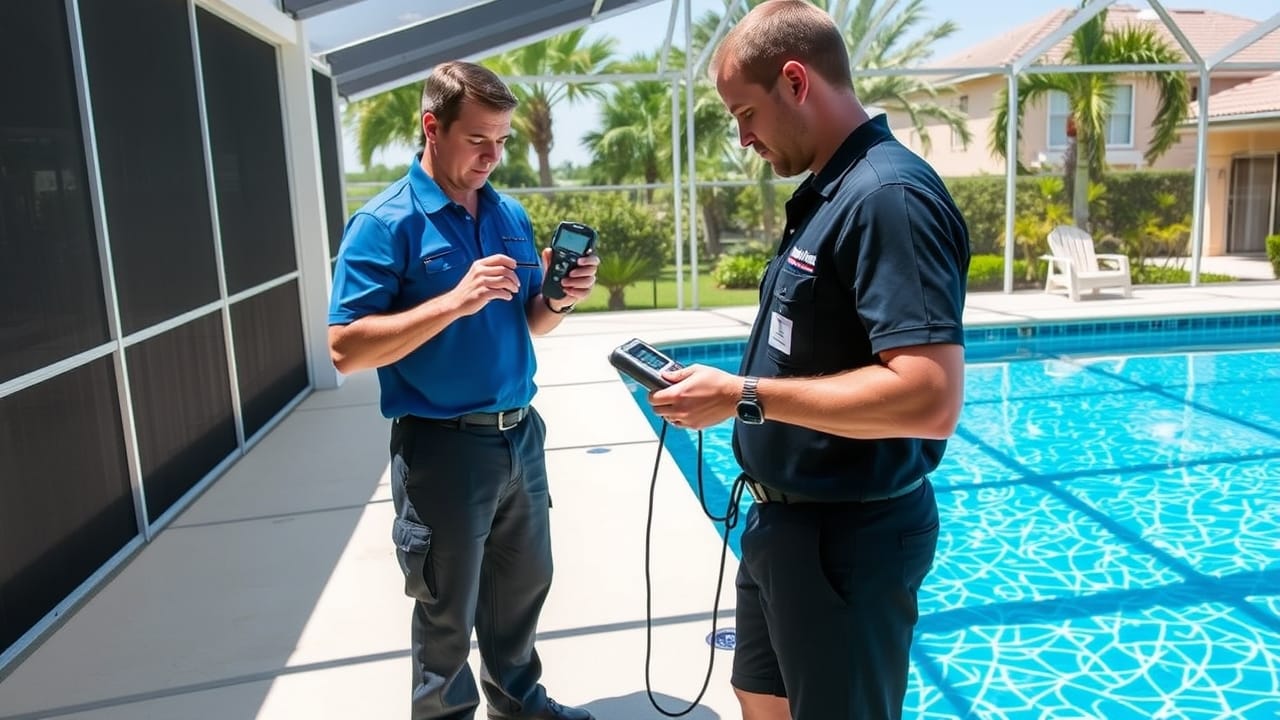
Coral Springs homeowners take their pools seriously — and for good reason. With temperatures regularly climbing into the low 90s from May through October and a humidity level that rarely lets up, a well-maintained pool isn’t a luxury in Coral Springs; it’s a functional necessity. But keeping a pool chemically balanced, equipment-ready, and algae-free in Broward County’s climate takes more than a weekly skim and a bag of chlorine. This guide covers everything Coral Springs pool owners need to know: the specific environmental pressures your pool faces, how professional maintenance differs from DIY, what seasonal challenges look like in northwest Broward, and how to choose a service provider who actually understands this market.
Why Coral Springs Pools Face Unique Maintenance Challenges
Coral Springs sits in the northwest corner of Broward County, bordered by the Sawgrass Expressway to the south and the Everglades conservation areas to the west. That western proximity matters for pool chemistry in ways most homeowners don’t expect. The municipal water supply that flows through Coral Springs taps run notably harder than water in coastal communities like Fort Lauderdale or Pompano Beach — calcium hardness levels between 280 and 360 ppm are common, compared to the 150–220 ppm range on the barrier island.
Hard water is the enemy of pool surfaces, tile grout, and heat exchanger coils. When calcium-saturated water evaporates — which it does constantly under a South Florida sun — it leaves mineral deposits behind. In a Coral Springs pool, these deposits accumulate on the waterline tile as white or gray scale, inside plumbing lines as narrowing calcium buildup, and inside salt chlorinator cells as a chalky coating that reduces efficiency. A technician who services Boca Raton oceanside pools all week may not immediately recognize how aggressively the chemistry needs to be managed in a Coral Springs pool until the damage is already visible.
The solution is active management of the Langelier Saturation Index — a measure of how scale-forming or scale-dissolving your water is. An LSI of 0.0 is perfectly balanced. In Coral Springs, where calcium hardness and total alkalinity both run high from the tap, achieving a neutral LSI requires intentional acid additions that a coastal service provider might not factor in. We monitor LSI at every visit for Coral Springs accounts specifically because the consequences of letting it drift positive — surface etching, equipment damage, and cloudy water — are substantially more expensive than the prevention.
Coral Springs Neighborhoods and What They Mean for Your Pool
Coral Springs is one of the most deliberately planned cities in Broward County, built out in phases from the late 1960s through the 1990s under the original Coral Ridge Properties master plan. That history created distinct neighborhood characters that translate directly into pool service considerations.
The Isles, Cypress Run, and Wyndham Lakes
These established communities in the eastern and central sections of Coral Springs were built in the late 1970s and 1980s. Many pools in these neighborhoods are original — meaning they may have plaster surfaces that have been resurfaced once or twice over 35–40 years, original return lines that have experienced decades of Florida freeze-thaw cycling (rare, but not impossible in January), and equipment that has been upgraded piecemeal rather than replaced as a system. Service in these neighborhoods often involves more diagnostic work: a pump that cycles oddly, a filter that needs cleaning more frequently than normal, or a salt system that’s working harder than it should because the cell hasn’t been descaled in two seasons.
Eagle Trace, Heron Bay Area, and Westside
The western communities adjacent to Heron Bay Boulevard and the Sawgrass Preserve were largely built in the 1990s through early 2000s, and they tend to feature larger lots, more mature tree canopies, and pools with screen enclosures. Screen enclosures reduce direct debris load dramatically — leaves and pollen that blow straight into an open pool get filtered out — but they create their own issues. Screened enclosures trap moisture, which elevates humidity around the equipment pad and accelerates corrosion on electrical connections, pump motors, and automation panels. We check electrical connections and equipment mounting hardware specifically in screened pools because the corrosion pattern is different from open-air installations.
Ramblewood, Maplewood, and the Central Grid
The central residential grid neighborhoods — named with the classic Coral Springs woodsy naming convention — are primarily 1970s and 1980s single-family homes on modest lots with pools that have seen multiple ownership changes. These properties often have outdated single-speed pumps (pre-variable-speed era) that run constant cycles, higher-than-necessary energy costs, and filtration systems that are technically functional but not optimized for 2020s efficiency standards. Homeowners in these neighborhoods are often surprised by how much their electricity bill drops after switching to a variable-speed pump — the energy savings frequently offset the equipment cost within 18–24 months in Florida’s year-round operating season.
Wyndham at Coral Springs and the Northeast Communities
Newer construction in northeast Coral Springs, including communities along Sample Road and toward the Margate border, tends to feature more modern pools with saltwater systems, in-floor cleaning technology, and LED lighting already installed. These pools have lower baseline maintenance needs but higher diagnostic complexity when something goes wrong — saltwater automation panels and in-floor head systems require technicians who actually understand the equipment, not just someone with a chemical test kit and a brush.
The Real Cost of Pool Ownership in Coral Springs
One of the most common points of confusion for Coral Springs homeowners — especially those new to pool ownership — is the total cost of keeping a pool properly maintained. The sticker price of a weekly service plan is visible. The cost of not maintaining the pool properly shows up later, often in larger and more painful line items.
Here’s what the actual math looks like in Broward County’s northwest suburbs:
- Professional weekly service: Typically $120–$175/month in the Coral Springs market, depending on pool size and equipment complexity. This covers chemistry, brushing, skimming, filter checks, and equipment inspection.
- Chemical-only monthly cost (DIY): $60–$110/month in chemicals, test strips/kits, and occasional shock treatments — but this assumes you’re consistently testing twice a week, adjusting correctly, and catching problems before they become problems.
- Green pool remediation: $250–$600 for a single algae bloom event, not including the week of elevated chemical use and circulation required to return the pool to balance. A pool that goes green once per year due to inconsistent care costs more annually than a professional service plan.
- Equipment repair from deferred maintenance: A filter that’s never backwashed damages the pump. A salt cell that’s never descaled stops generating chlorine. A heater that’s running in chemically unbalanced water corrodes internally. The cascading cost of neglected maintenance in Coral Springs pools regularly exceeds $1,500–$3,000 in equipment repairs within 3–5 years of deferred service.
The calculus is straightforward: professional service isn’t an expense against DIY maintenance. It’s an insurance policy against equipment failure, surface damage, and the loss of pool enjoyment during South Florida’s peak swimming season.
Seasonal Pool Maintenance in Coral Springs: Month by Month
Unlike pool markets in northern states where “closing” the pool is a real seasonal event, Coral Springs pools run 52 weeks a year. But there are distinct seasonal shifts that require adjusted maintenance approaches.
November Through February: The “Easy” Months
Broward’s dry season brings cooler temperatures, lower UV intensity, reduced evaporation, and dramatically less algae pressure. Pool chemistry tends to hold longer between adjustments, and chlorine demand drops. This is the season for equipment servicing — inspecting heater heat exchangers before the rare cold snap that might push Coral Springs residents toward actually using it, descaling salt cells, and addressing any surface issues that require replastering before the summer season ramps up. Don’t let the lower maintenance pressure of dry season become an excuse for skipping visits — calcium deposits form slowly and quietly during winter and emerge as visible scale by April.
March Through May: Transition and Surge Preparation
Spring in Coral Springs brings three simultaneous forces: increasing water temperature, rising pollen loads from local oak and pine canopy, and the beginning of afternoon thunderstorm activity. Water temperature rising above 80°F dramatically accelerates algae growth — the same chlorine demand that was adequate in January suddenly isn’t enough in April. Pollen accumulation creates a biological substrate that feeds algae growth while also causing filtration pressure spikes. We adjust chemical dosing upward in March for all northwest Broward accounts specifically because the transition window is when algae blooms most commonly hit clients who are still running winter-calibrated chemistry.
June Through October: Peak Season Management
South Florida’s rainy season dumps 3–6 inches of rain per week on Coral Springs during peak months, and every heavy rain event changes the pool chemistry. Rain dilutes chlorine, drops cyanuric acid levels, and can introduce phosphates and organic material from the surrounding landscape. Pools near the Sawgrass Preserve or adjacent to larger lots with mature tree canopy see more organic load than pools in compact subdivisions. Peak season in Coral Springs requires more frequent chemistry checks, higher baseline chlorine feed rates for salt systems, and vigilance around phosphate levels — phosphates are the fertilizer algae needs, and high-phosphate water turns green faster than any other chemistry variable.
Hurricane and tropical storm prep is also a real consideration for any pool in Broward County. Pre-storm, we balance pool chemistry toward the higher end of acceptable ranges (knowing rain dilution is coming), secure or remove loose equipment accessories, and confirm automation systems are set appropriately. Post-storm, we priority-dispatch to remove debris loads before they stress the filtration system and to re-balance chemistry after significant dilution events.
Pool Services Available in Coral Springs
Fort Lauderdale Pool Service covers the full range of pool care needs for Coral Springs homeowners. Our Fort Lauderdale Pool Service team has been maintaining pools throughout northwest Broward County, and our Coral Springs technicians know the specific water chemistry challenges, equipment patterns, and neighborhood conditions that define this market. A complete breakdown of our services and coverage areas is available on our Coral Springs pool service page.
Weekly Pool Maintenance
Our standard weekly maintenance program includes full water chemistry testing (pH, free chlorine, total chlorine, alkalinity, calcium hardness, cyanuric acid, and salt level for saltwater pools), chemical adjustment to bring all parameters into optimal range, surface brushing of walls and floor, basket emptying (pump and skimmer), visual equipment inspection, and a service report left for the homeowner. For Coral Springs accounts, we also include LSI calculation and acid additions as needed to prevent calcium scale formation — this isn’t an add-on; it’s a standard part of northwest Broward service because the water chemistry makes it necessary.
Equipment Service and Repair
We service and repair all major equipment brands including Hayward, Pentair, Jandy, and Zodiac. Common service calls in Coral Springs include variable-speed pump programming and troubleshooting, salt chlorinator cell cleaning and replacement, filter media replacement (sand, DE, or cartridge), automation system programming and sensor replacement, and heat pump or gas heater service. We carry common replacement parts on our service trucks to minimize return visit delays on straightforward repairs.
Algae Treatment and Green Pool Remediation
A green pool in Coral Springs during the rainy season can progress from tinted to fully opaque within 72 hours if chlorine demand outpaces the salt system’s output. Our remediation protocol involves heavy shock treatment, algaecide application, brushing to break the algae from surfaces, and filter cycling until the water clears. We follow up within 48–72 hours to verify the kill is complete and to check that filter pressure has returned to normal — algae blooms leave behind dead organic material that temporarily elevates filter pressure, and confirming clearance is essential before returning to a standard maintenance schedule.
Pool Opening and Closing (Seasonal Adjustments)
In Coral Springs, “pool opening” typically means returning from low-use or minimal-maintenance periods — either after a vacancy period during rental transitions or after a homeowner’s extended travel. We perform a full inspection, chemical rebalancing, equipment check, and filter service to bring the pool back to swim-ready condition. We also handle pre-season equipment inspections in March before peak use begins.
Tile Cleaning and Calcium Removal
Given the high-calcium water supply in Coral Springs, waterline tile cleaning is a service we perform more frequently for northwest Broward accounts than for coastal pools. We use bead blasting for heavy calcium deposits and acid washing for surface calcium scale — both non-destructive when applied correctly, both damaging if applied incorrectly with the wrong media or concentration. We assess each tile surface individually before recommending the approach.
HOA Pools in Coral Springs: Community Pool Considerations
Coral Springs has a high concentration of HOA-governed communities, many of which include community pools as amenities. Community pools in Coral Springs face a distinct set of challenges compared to residential pools:
- Bather load variability: A community pool that sees 5 swimmers on a Tuesday may see 50 on a Saturday afternoon. Bather load adds organic material (sunscreen, body oils, perspiration) that dramatically increases chlorine demand. Chemistry that’s balanced for light use can drop to unsafe levels within hours of heavy use.
- Health department compliance: Broward County requires commercial pool operators to maintain documented chemistry logs. Non-compliant pools face fines and mandatory closure orders. We provide digital service reports for all community accounts that satisfy Broward County Health Department documentation requirements.
- Commercial filtration sizing: Community pools are typically equipped with commercial-grade filters and pumps operating on turnover requirements (the entire pool volume must cycle through filtration in a set time period per code). We service commercial filtration systems including multi-tank DE filter banks, commercial cartridge systems, and large-volume sand filters.
- Seasonal surges: Community pools in Coral Springs see significant use spikes during school breaks — winter break, spring break, and summer — requiring adjusted chemical dosing schedules and more frequent service visits during peak periods.
We serve several HOA communities in Coral Springs and understand both the operational requirements and the budgeting structures that govern HOA maintenance contracts.
Choosing a Pool Service Company in Coral Springs: What to Look For
The Coral Springs pool service market has a wide range of providers, from individual operators with a truck and test kit to full-service companies with dedicated equipment technicians. How do you evaluate them?
Florida Contractor Licensing
Florida requires pool service technicians to hold a Certified Pool/Spa Operator (CPO) certification or work under a licensed pool contractor for chemical treatment work. Repair and construction work requires a separate Certified Pool Contractor (CPC) license. Ask any service company you’re considering whether their technicians are CPO-certified and whether their repair work is performed under a licensed contractor. An unlicensed repair creates liability exposure for the homeowner if something goes wrong.
Local Knowledge of Northwest Broward Chemistry
Ask specifically whether the company tests calcium hardness and monitors LSI. A provider who only tests the “basics” — pH and chlorine — without monitoring calcium hardness and alkalinity is going to leave Coral Springs pools vulnerable to scale formation. This is a differentiating question because many cut-rate service operations don’t invest in the fuller chemistry panel that northwest Broward water actually requires.
Digital Reporting
Reputable service companies provide digital service reports after each visit — a log of what was tested, what the results were, what chemicals were added, and what was observed. This protects the homeowner (you have a record of service performed) and protects the provider (they have documentation of what was done). If a service company can’t provide digital or written reports, they can’t demonstrate accountability for their work.
Equipment Repair Capability
Many pool service companies in Coral Springs provide chemical maintenance only and subcontract equipment repairs. This isn’t inherently a problem, but it creates delays and coordination friction when something breaks. A company with in-house equipment repair capability — or at minimum a trusted, named subcontractor they work with regularly — can resolve equipment issues faster and with less administrative overhead.
References in Coral Springs Specifically
A provider with references in Coconut Creek isn’t the same as a provider with references in Coral Springs. The water chemistry differences, the equipment patterns, and the neighborhood conditions are distinct. Ask for references from current Coral Springs clients — not just Broward County clients generically.
Common Pool Problems We See in Coral Springs
After maintaining pools throughout northwest Broward County, these are the issues that come up most consistently in Coral Springs:
Calcium Scale on Tile and Surfaces
As discussed above, Coral Springs’ hard municipal water makes calcium scale a chronic issue rather than an occasional one. Pools that go 2+ years without tile descaling often require bead blasting to remove the accumulated deposits. We recommend annual tile cleaning for most Coral Springs pools and semi-annual for pools that run warmer or have higher bather loads.
Salt Cell Scaling and Reduced Chlorine Output
Saltwater pools in Coral Springs see their chlorinator cells scale up faster than coastal pools due to the higher calcium content in the water. A cell that’s not descaled regularly shows reduced chlorine output — the pool appears to have a chemistry problem when it actually has an equipment problem. We inspect and descale salt cells on a schedule calibrated to Coral Springs water chemistry, not the generic manufacturer recommendation written for national-average water hardness.
Phosphate-Fueled Algae in Rainy Season
Phosphates enter the pool from rain runoff, bird droppings, decomposing leaves, and some municipal water sources. High phosphate levels (above 500 ppb) make algae growth aggressive — the pool can go green even when chlorine levels look correct, because algae fueled by high phosphate can outpace a salt system’s chlorine output during a rainy week. We test phosphate levels quarterly and apply phosphate remover as needed for accounts that show recurring algae issues despite correct chlorine chemistry.
Variable-Speed Pump Programming
Variable-speed pumps are now required by Florida energy code for new pool construction, but many Coral Springs pools were retrofitted with them from single-speed originals. Incorrectly programmed VSPs — running at the wrong RPM for filtration, circulation, or cleaner operation — are surprisingly common. A pump running too slow for filtration creates cloudy water; a pump running too fast for the cleaner cycle damages the cleaner head. We audit VSP programming on all new accounts and correct speed schedules that are outside proper operational ranges.
Automation System Faults
Coral Springs’ humidity and occasional ground flooding during heavy rain events accelerates corrosion in automation panel electronics. We see Jandy AquaLink and Hayward OmniLogic panels with corroded relay boards and moisture-damaged sensors more frequently in northwest Broward than in drier inland Florida markets. Annual inspection of automation panels and proper weatherproofing of wire connections significantly extends panel lifespan.
Frequently Asked Questions About Pool Service in Coral Springs
These are the questions Coral Springs homeowners most frequently ask when evaluating pool service options:
How often does a Coral Springs pool need professional service?
Weekly service is the standard for residential pools in Coral Springs. In the rainy season (June–October), some pools with heavy debris loads or high bather use benefit from twice-weekly visits to manage chemistry that’s fluctuating with frequent rain dilution. Monthly service is not adequate for a Florida pool — chemistry changes too quickly in South Florida’s heat and humidity to maintain proper balance on a monthly check schedule.
Can I maintain my Coral Springs pool myself?
Technically yes — DIY pool maintenance is legal and some homeowners do it successfully. The challenge in Coral Springs specifically is the water chemistry complexity. You need to be testing twice a week minimum, understanding LSI and calcium hardness management, and staying ahead of phosphate levels. If you’re willing to invest the time and learn the chemistry properly, DIY is viable. But most homeowners underestimate the time commitment and the cost of getting it wrong — a single algae remediation event or a damaged salt cell from poor chemistry management typically costs more than a year of professional service.
What causes green pool water in Coral Springs?
The most common causes of green water in Coral Springs pools are chlorine depletion (often from salt cell scaling reducing output), high phosphate levels feeding algae growth, or heavy rain dilution events that drop chlorine and cyanuric acid simultaneously. Less commonly, a circulation failure — pump issues, clogged impeller, filter bypass — allows stagnant zones where algae can establish. We diagnose the actual cause before treating, because throwing chlorine at a phosphate problem without addressing the phosphate just temporarily masks it.
How much does pool service cost in Coral Springs?
Weekly maintenance service in Coral Springs typically runs $120–$175/month depending on pool size, equipment complexity, and whether the account requires additional services like phosphate treatment or more frequent salt cell descaling. This price range reflects the full-service weekly maintenance program — chemistry, brushing, baskets, equipment inspection, and digital reporting. Chemical-only plans (where the homeowner handles brushing and skimming) run lower. Equipment repairs are billed separately at standard hourly rates plus parts.
Do you service HOA community pools in Coral Springs?
Yes. We service both residential and community pools throughout Coral Springs and the surrounding northwest Broward communities. HOA community pool contracts include the enhanced service and documentation required for commercial pool compliance under Broward County Health Department regulations.
What’s the best time of year to resurface a Coral Springs pool?
November through February — Broward’s dry season — is the optimal window for resurfacing. Lower temperatures mean the new plaster cures more slowly and evenly, reducing the risk of surface imperfections. The drier weather reduces the chance of rain interrupting the plastering process, and homeowners sacrifice less swimming time during the months when the pool sees the lightest use anyway.
Ready to Get Your Coral Springs Pool on a Professional Service Plan?
Fort Lauderdale Pool Service maintains residential and community pools throughout Coral Springs and northwest Broward County. We understand the specific water chemistry challenges of this market — the hard water, the calcium scale pressure, the phosphate dynamics during rainy season — and our service protocols are calibrated for northwest Broward, not generic South Florida averages. Whether you’re dealing with a recurring algae problem, aging equipment that needs a diagnostic, or simply want professional weekly service that keeps your pool swim-ready year-round, we’re here to help.
Contact us today to schedule a free water quality assessment and get a quote for weekly Coral Springs pool service.