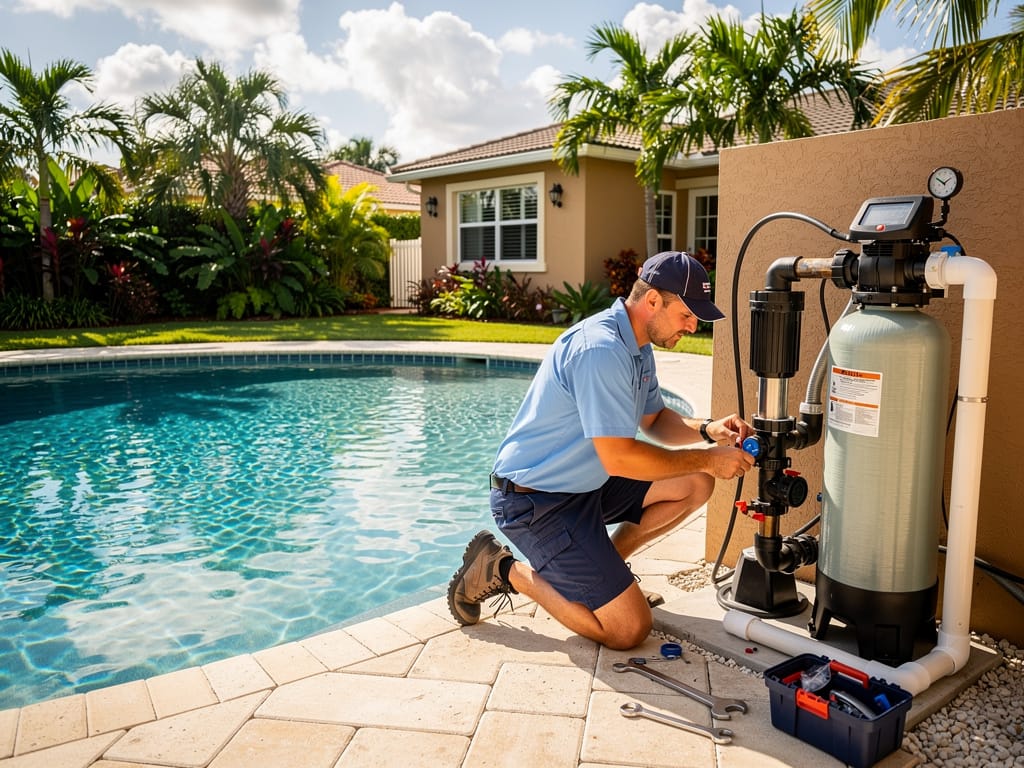
Quick Answer: The most common pool pump warning signs in Pompano Beach, FL are: the pump hums but doesn’t move water (capacitor failure), reduced water flow at return jets (clogged impeller or air leak), water leaking at the pump base (shaft seal), and grinding or screeching noise (bearing failure). Coastal salt air in Pompano Beach accelerates motor housing and seal corrosion — making equipment inspection more important here than in inland Broward cities.
Your pool pump works harder in Pompano Beach than almost anywhere else in the country — 365 days a year, in heat and humidity, exposed to coastal salt air that accelerates the wear that would take years longer in a drier, inland climate. When pump problems develop, Pompano Beach homeowners need to recognize the early signs, understand what’s wrong, and make a repair-vs.-replace decision quickly. In South Florida heat, a failed pump creates unsafe pool conditions within 24 hours.
Why Pompano Beach Pool Pumps Fail Earlier Than Inland Pools
Three factors specific to Pompano Beach push pump failure timelines earlier than the national average:
Year-round continuous operation: Pompano Beach pumps run 8–12 hours per day, 365 days per year — 3,000–4,400 operating hours annually. Seasonal pools in the Northeast run 1,000–1,500 hours per year. This means a Pompano Beach pump accumulates “lifetime hours” at 2–3x the rate of northern pools, and the standard 8–12 year lifespan in cooler climates may translate to 6–9 years in Pompano Beach.
Coastal salt air: Salt-laden air from the Atlantic and Intracoastal corrodes motor housing, shaft seals, and electrical connections. The mechanical seal where the motor shaft enters the pump wet end is particularly vulnerable — salt air accelerates rubber seal degradation and causes corrosion on the seal seat. Motor housing vents, which allow air to cool the motor, also allow salt air to reach internal components.
Heat stress on motors: Pool pump motors in Pompano Beach operate in ambient temperatures of 90–100°F+ in summer — conditions that accelerate capacitor degradation and bearing wear compared to the 70–80°F ambient temperatures where motor lifespans are rated.
The 5 Warning Signs Pompano Beach Homeowners Need to Know
1. The Pump Hums But Doesn’t Move Water
Cause: Failed start capacitor
The capacitor provides the electrical burst that starts the motor spinning. When it fails, the motor receives power (hums) but can’t generate the torque to start rotating. This is the single most common pump failure in South Florida — heat stress destroys capacitors faster than any other factor. It’s also one of the most straightforward repairs.
Pompano Beach repair cost: $85–$150 all-in
What to do now: Turn off the pump immediately. A motor attempting to start against a failed capacitor draws high current and overheats rapidly — it can burn out the motor windings in minutes if left running.
2. Low Water Flow at Return Jets
Cause: Clogged impeller, air leak in suction line, or dirty filter
Weak return jets or reduced suction at the skimmer indicates reduced pump output. Start by checking the strainer basket and filter pressure. If both are clear, the next suspects are:
– Clogged impeller: Debris bypassed the strainer basket and lodged in the impeller vanes. Common in Pompano Beach after storm events with elevated debris.
– Air leak in suction plumbing: A cracked fitting or degraded O-ring on the suction side draws air into the flow, reducing effective pump output. Air leaks in South Florida are common at heat-cycling joints that expand and contract with daily temperature swings.
Pompano Beach repair cost: $75–$175
3. Water Leaking at the Pump Base
Cause: Failed mechanical shaft seal or loose union fittings
Dripping water beneath the pump indicates a seal failure. The most common source is the mechanical shaft seal — the rotating seal where the motor shaft enters the pump wet end. Shaft seals in Pompano Beach’s salt-air environment degrade faster than inland pumps, and running dry (if the pump loses prime) causes immediate seal damage.
Pompano Beach repair cost: $100–$250 for seal; $75–$125 for union fittings
4. Grinding, Screeching, or Rattling Noise
Cause: Failed motor bearings
A healthy pool pump motor hums smoothly. Grinding, screeching, or rattling indicates bearing failure — the ball bearings that allow the motor shaft to spin freely. Bearing failure is progressive; it will worsen until the motor seizes entirely. In Pompano Beach’s coastal environment, salt air can penetrate motor housing and accelerate bearing corrosion.
Pompano Beach repair cost: $200–$400 (motor replacement typically more economical than in-motor bearing replacement)
5. The Pump Runs But Pool Chemistry Won’t Balance
If your pump appears to be running normally but chemicals don’t respond as expected — pH won’t stabilize, algae keeps appearing despite adequate chlorine — reduced flow rate may be the underlying cause. A pump with a partially clogged impeller can run at 50% of rated flow while appearing to operate normally. A flow rate measurement or pressure differential test identifies this.
Pump Repair vs. Replace in Pompano Beach
| Situation | Recommendation |
|---|---|
| Under 6 years old, isolated failure (capacitor, seal, fitting), repair under $250 | Repair |
| 6–9 years old, second repair in 18 months, or motor replacement needed | Evaluate: repair cost vs. 3-year replacement timeline |
| 9+ years old, multiple failures, or repair cost exceeds $400 | Replace — ideally upgrade to variable speed |
Variable speed pump note: Florida law (FAC 64E-9) requires variable speed pumps for new residential pool pump installations. Variable speed pumps use 30–60% less energy than single-speed pumps. In Pompano Beach’s year-round operation (3,000–4,400 hours annually), energy savings of $250–$500 per year make the $800–$1,400 installed cost pay back within 2–4 years.
For pool pump repair and replacement in Pompano Beach, FL — including same-day emergency response for pump failures — Fort Lauderdale Pool Service serves Palm Aire, Pompano Isles, Crystal Lake, and surrounding areas. Call (954) 501-2754 or see our Pompano Beach service page.
Frequently Asked Questions
How does coastal salt air in Pompano Beach affect pool pump lifespan?
Salt-laden air accelerates corrosion on motor housing, shaft seals, and electrical connections. Mechanical shaft seals — already wear items in any climate — degrade faster in coastal Pompano Beach due to salt’s effect on rubber seals and metal seal seats. Regular inspection catches early corrosion before it becomes a failure event; neglecting inspection means failures come sooner and with less warning than at inland pools.
How long should a pool pump last in Pompano Beach?
Single-speed pumps typically last 6–9 years in Pompano Beach with regular maintenance — shorter than the 8–12 year national average, due to year-round operation (3,000–4,400 hours annually vs. 1,000–1,500 for seasonal pools) and coastal salt-air exposure. Variable speed pumps have longer-rated service lives. Regular equipment inspection extends service life by catching wear items before they cause cascading damage.
My pool pump hums but won’t start — what should I do?
Turn off the pump immediately. A motor attempting to start against a failed capacitor draws high current and can burn out the motor windings within minutes if left running. Check that the pump basket has water in it (not air-locked), then call your pool company for a capacitor test and replacement. This is one of the most common and least expensive pump repairs — $85–$150 in Pompano Beach.
How much does pool pump repair cost in Pompano Beach, FL?
Repair costs in Pompano Beach: capacitor replacement $85–$150; impeller clearing $75–$125; shaft seal replacement $100–$250; union fitting repair $75–$125; full motor replacement $200–$400. Full pump replacement (variable speed) runs $800–$1,400 installed. Always get a written quote before authorizing work; pricing varies significantly between providers.
Should I replace my Pompano Beach pool pump with a variable speed model?
If you’re replacing a failed single-speed pump, yes. Florida law requires variable speed pumps for new residential installations. In Pompano Beach’s year-round operation, VSD energy savings of $250–$500 annually pay back the $800–$1,400 installed cost within 2–4 years. VSDs also extend pool equipment life by allowing lower-speed continuous operation rather than high-speed intermittent operation.