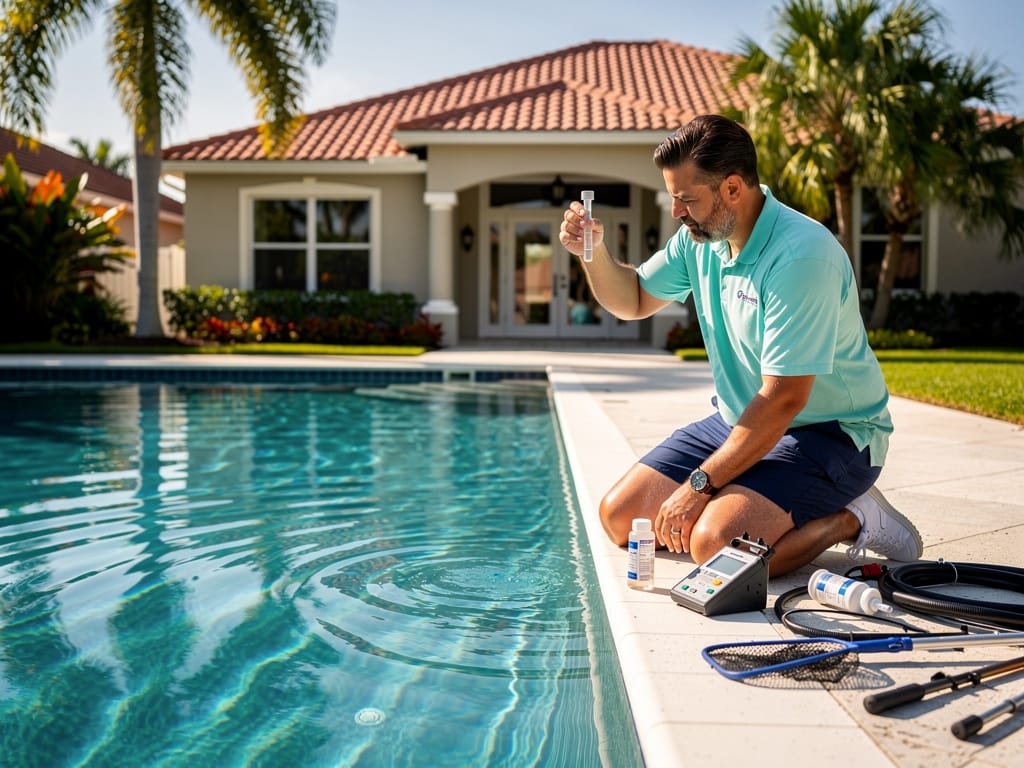
Quick Answer: Pompano Beach pools require pH 7.4–7.6, free chlorine 2–4 ppm, total alkalinity 80–120 ppm, calcium hardness 200–400 ppm, and cyanuric acid 30–50 ppm — tested and adjusted weekly. Broward municipal water in Pompano Beach runs harder than Florida’s average, meaning calcium scaling on salt cells and tile builds faster than in soft-water regions. Coastal salt air adds a second mineral load unique to this area.
Pool chemical balancing in Pompano Beach requires understanding the specific water chemistry challenges that don’t apply in inland cities. Broward’s municipal water supply, the coastal salt environment, and South Florida’s UV intensity create a combination that demands consistent, knowledgeable weekly attention. This guide covers every chemical parameter your Pompano Beach pool needs, with specific attention to the factors that make this city different from surrounding areas.
The 5 Core Parameters — and Pompano Beach’s Specific Challenges for Each
1. pH (Target: 7.4–7.6)
pH controls chlorine effectiveness. At pH 7.5, approximately 50% of free chlorine is in its active sanitizing form (hypochlorous acid). At pH 8.0, this drops to 10% — effectively leaving your pool unprotected despite adequate chlorine levels.
Pompano Beach pH challenge: Warm water naturally outgasses dissolved CO2, driving pH upward. In Pompano Beach’s average water temperature of 85–90°F during summer, pH rise between weekly service visits is extremely predictable. Coastal properties near the Intracoastal may also see pH variation from wind-driven salt water interaction. Muriatic acid is added at most weekly visits to correct pH back to the 7.4–7.6 range.
2. Free Chlorine (Target: 2–4 ppm)
Free chlorine is the active sanitizer. “Free” means it’s available to sanitize — not “combined” (already reacted with bather waste or contaminants).
Pompano Beach chlorine challenge: UV index 10–11 (Extreme) during peak summer means un-stabilized chlorine can be depleted within 2–4 hours of direct sunlight. With proper CYA stabilizer at 40–50 ppm, this is reduced but chlorine demand still runs 2–3x higher than northern US pools. Coastal salt-air particles can also introduce small amounts of minerals that consume chlorine. Liquid chlorine is the preferred supplemental form — it adds no CYA, allowing more precise control of the stabilizer level.
3. Total Alkalinity (Target: 80–120 ppm)
Total alkalinity (TA) buffers against pH swings. Without adequate TA, pH bounces dramatically in response to rain, bather load, or chemical additions. The ideal range for South Florida pools is 80–100 ppm — slightly lower than the standard range because Pompano Beach water’s natural tendency is toward pH rise, and lower TA gives pH slightly more room to move before needing correction.
4. Calcium Hardness (Target: 200–400 ppm)
Calcium hardness measures dissolved calcium in the water. Water below 150 ppm calcium becomes “hungry” and leaches calcium from plaster surfaces, causing etching and degradation. Water above 500 ppm deposits scale on surfaces, tile, and equipment.
Pompano Beach calcium challenge: Broward County municipal water runs 150–275 ppm calcium — a moderate to moderately high starting point. Coastal salt air introduces calcium chloride particles that gradually increase calcium levels in exposed pools. Combined with the scaling tendency of hard water at Pompano Beach’s warm temperatures, calcium scaling on salt cell plates, heat exchanger fins, and waterline tile is a common and specifically Pompano Beach-relevant maintenance item.
5. Cyanuric Acid / Stabilizer (Target: 30–50 ppm in summer; 20–40 ppm in “winter”)
CYA protects chlorine from UV degradation. Without it, South Florida’s Extreme UV can destroy most of a pool’s free chlorine within hours. With too much CYA (above 80 ppm), chlorine effectiveness drops dramatically — a phenomenon called CYA inhibition or “chlorine lock.”
Pompano Beach CYA challenge: Pools using trichlor tablets as the primary chlorine source accumulate CYA with every tablet. Over one or more seasons, CYA can rise above 80 ppm without the homeowner being aware. The fix is a partial drain to dilute CYA. This is why good Pompano Beach pool companies test CYA at least monthly (not just when problems appear) and use liquid chlorine to supplement tablet systems — liquid chlorine adds no CYA, giving more control over the stabilizer level.
Saltwater Pool Chemical Parameters Specific to Pompano Beach
Saltwater pools in Pompano Beach need the same 5 core parameters plus:
- Salt level (target 2,700–3,400 ppm): Check monthly. Coastal Pompano Beach pools lose salt from splash-out and backwash — the same atmospheric salt that causes corrosion issues doesn’t significantly contribute to pool salt levels.
- Salt cell output: Monitor the percentage output displayed on the control unit. In Pompano Beach’s hard water, salt cells scale faster than in soft-water areas — usually every 2–3 months for cleaning, versus 3–4 months for inland pools. Scaled cells produce less chlorine than the display indicates, leading to seemingly unexplained algae growth.
- Salt cell inspection: At every quarterly cleaning, inspect the cell plates for corrosion damage — another item specific to coastal Pompano Beach where salt-air accelerates plate wear.
Hard Water and Pompano Beach: Why Your Pool Scales Faster
Hard water — water with elevated dissolved calcium and magnesium — is a specific challenge in Pompano Beach. The Langelier Saturation Index (LSI) combines pH, total alkalinity, calcium hardness, and water temperature to predict whether water will deposit scale or etch surfaces. In Pompano Beach’s warm, hard water:
- The LSI runs naturally positive (toward scale) most of the year at normal chemistry levels
- This is why calcium scaling on tile, salt cell plates, and heat exchangers accumulates faster than in cooler or softer-water areas
- The management approach: keep calcium hardness at the lower end of the acceptable range (200–300 ppm), maintain pH at 7.4–7.5 rather than 7.6, and plan for annual tile acid cleaning
For professional pool chemical balancing service in Pompano Beach, FL — including hard water management and salt cell maintenance for Palm Aire, Crystal Lake, and Pompano Isles communities — Fort Lauderdale Pool Service tests all 5 parameters at every weekly visit and provides written records. Call (954) 501-2754 or see our Pompano Beach service page.
Frequently Asked Questions
Why does my Pompano Beach pool form scale on the tile and salt cell?
Calcium scaling in Pompano Beach pools is primarily driven by three factors: Broward’s hard municipal water (150–275 ppm calcium), warm water temperatures (which increase calcium’s tendency to precipitate out of solution), and coastal salt air that introduces additional mineral particles. The solution is keeping pH at 7.4–7.5 (not 7.6+), calcium hardness at the lower end of the acceptable range, and scheduling salt cell cleaning every 2–3 months rather than the standard 3–4 month interval for inland pools.
What is the ideal CYA level for a Pompano Beach pool?
30–50 ppm in summer (when UV is most intense) and 20–40 ppm in winter (November–March, when UV pressure is lower). CYA levels above 80 ppm reduce chlorine effectiveness dramatically — if your pool keeps turning green despite adequate chlorine, high CYA is a likely cause. Test CYA monthly; the only way to reduce it is a partial drain-and-refill.
How does coastal salt air affect pool chemistry in Pompano Beach?
Atmospheric salt in Pompano Beach’s coastal air contributes mineral particles that gradually increase total dissolved solids (TDS) in exposed pools. More practically, salt-air accelerates corrosion on salt cell plates, light fixtures, and metal equipment — not the pool water chemistry per se, but the equipment that maintains it. This is why coastal Pompano Beach pools need more frequent equipment inspections and salt cell cleaning than inland Broward pools.
Does heavy rain affect pool chemistry in Pompano Beach?
Significantly, yes. Rain is essentially distilled water — it dilutes all pool chemicals simultaneously. A 2-inch rain event can drop free chlorine by 1–1.5 ppm and lower total alkalinity and calcium hardness measurably. In Pompano Beach’s wet season (June–September), significant rain events are frequent, making between-visit chemistry monitoring more important than in drier climates.
Should Pompano Beach saltwater pools use liquid chlorine or tablets?
Both have a role. Trichlor tablets provide a slow background chlorine dose but add CYA with every tablet. Liquid chlorine provides an immediate boost with no CYA addition. The best approach for Pompano Beach saltwater pools: use the salt system as the primary chlorine source, supplement with liquid chlorine when needed, monitor CYA monthly, and avoid over-relying on trichlor tablets to prevent CYA accumulation above 80 ppm.