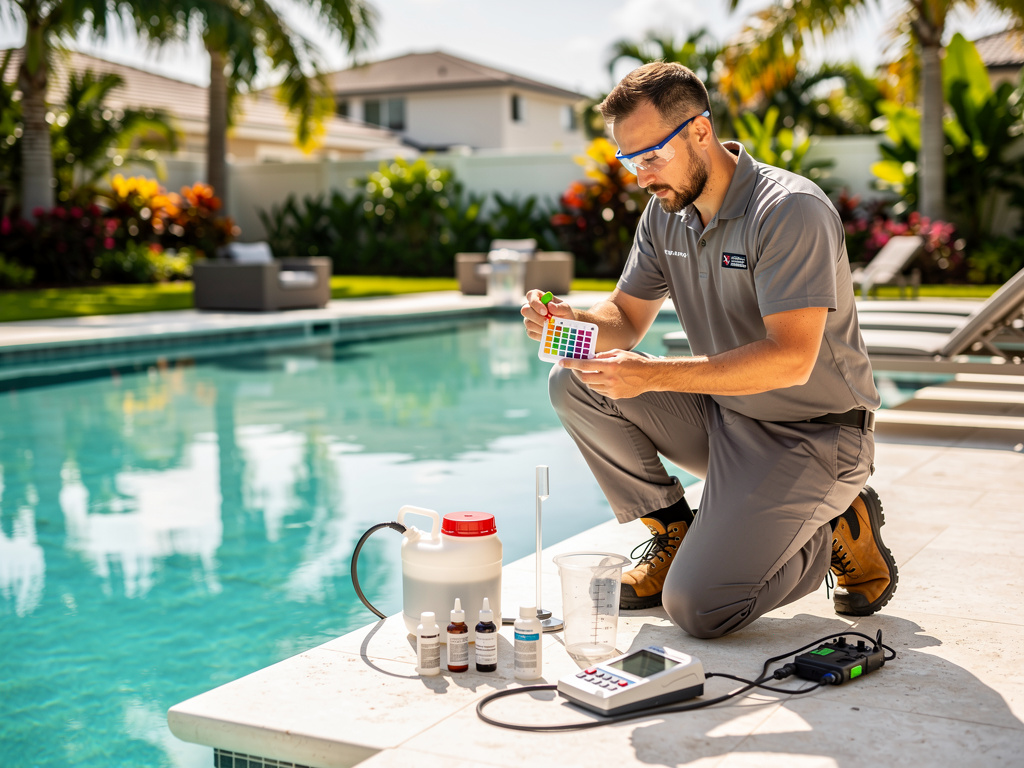
Pool Chemical Balancing in Pembroke Pines FL: Chemistry for a Large, Diverse Suburban City
Pool chemistry management in Pembroke Pines FL serves the same South Florida environment as every Broward County pool — but the city’s range from older established neighborhoods with accumulated chemistry challenges to newer western developments with modern salt systems creates a chemistry management picture that varies meaningfully by property. The chemistry targets are consistent across the city; the specific management emphasis differs based on pool age, equipment, and history.
The Chemistry Foundation: Parameters That Govern Everything
pH: Sanitizer Effectiveness and Surface Protection
pH between 7.2 and 7.6 — 7.2-7.4 specifically for Pembroke Pines’ many salt pools — governs how effective free chlorine actually is at sanitizing pool water. At the acidic end of this range (pH 7.2), approximately 65% of free chlorine is in the active hypochlorous acid form that kills pathogens and algae. At pH 7.8, only about 20% is active. Pembroke Pines’ afternoon rainstorms during June-October push pH downward with each event; weekly correction keeps the pool in the sanitizer-effective range. For central and eastern PP’s older plaster pools, pH below 7.2 becomes surface-aggressive — acidic water extracts calcium from plaster, accelerating the deterioration that leads to expensive replastering.
CYA: Essential Stabilizer With a Dangerous Ceiling
Cyanuric acid at 30-50 ppm stabilizes chlorine against South Florida’s UV degradation — without it, outdoor chlorine in Pembroke Pines’ sunshine degrades within hours. This is necessary. The problem is accumulation: CYA never leaves pool water naturally. Pools that have used trichlor tablets — which contain both chlorine and CYA — for years without significant draining are at risk of CYA above 80 ppm, the threshold where stabilizer-bound chlorine becomes ineffective as a sanitizer. This is the most commonly misdiagnosed green pool cause in Pembroke Pines’ older neighborhoods: the pool reads adequate free chlorine, receives repeated shock treatments, yet continues to struggle with algae — because the CYA is preventing the chlorine from actually working.
Calcium Hardness: Protecting Pembroke Pines’ Older Pools
For central and eastern PP’s older plaster pools, calcium hardness at 250-350 ppm is the surface protection priority. Water below 200 ppm is chemically hungry for calcium — it extracts it from whatever surface it contacts, including pool plaster. Consistent calcium management at 250-350 ppm reduces this extraction, protecting the remaining plaster life and pushing out the $5,000-$8,000 resurfacing cost.
Fort Lauderdale Pool Service provides complete chemistry management for Pembroke Pines FL pools — from CYA correction in older neighborhoods to salt system chemistry for western PP’s newer homes. All chemicals included. Contact us for a service assessment.