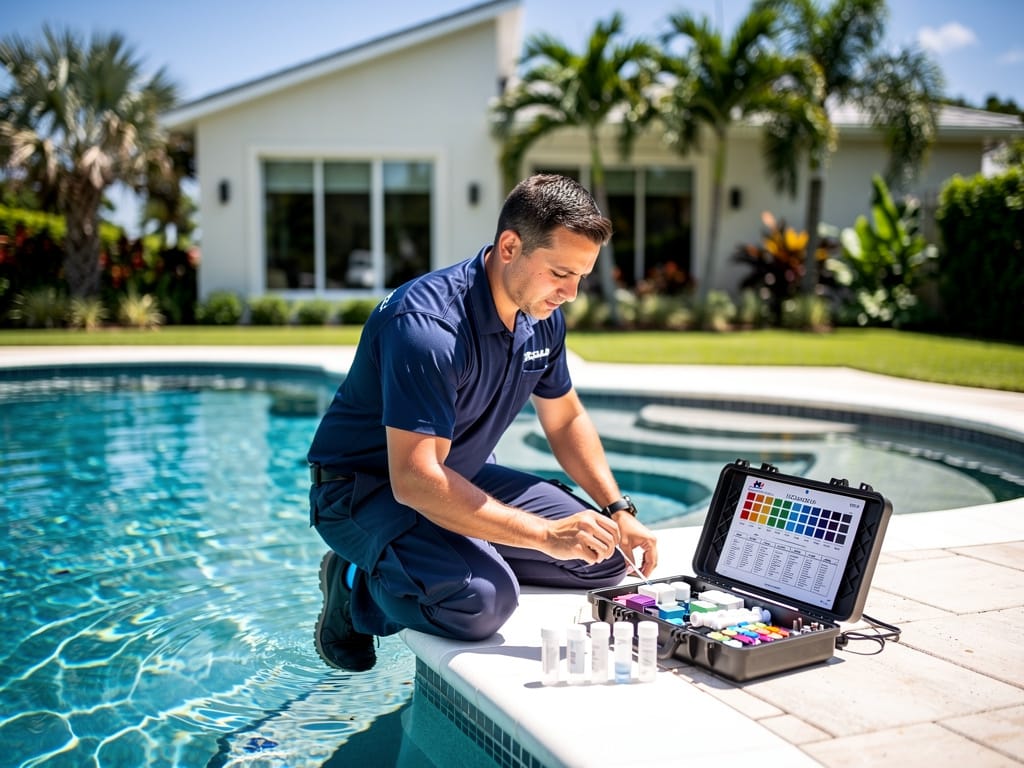
Pool Chemical Balancing in Parkland — Elite Chemistry for Estate Pool Systems
Chemistry management for Parkland’s estate pool systems operates at a level of precision and scale that distinguishes professional estate pool service from standard residential maintenance. The combination of large water volumes, premium surface materials, integrated spa systems, and the investment value at stake creates a chemistry management requirement that rewards genuine expertise and detailed systematic monitoring.
The Estate Scale Chemistry Challenge
Volume-Proportional Chemistry Management
The most fundamental challenge in Parkland estate pool chemistry is scale. A Heron Bay pool at 60,000 gallons is not a bigger version of a 15,000-gallon residential pool — it is a qualitatively different management challenge. Every chemistry parameter is less responsive per unit of chemical input, because the same product dose that moves pH 0.5 units in a small pool moves pH 0.12 units in a 4x larger pool. Dosing must be calculated precisely for the specific pool volume — not estimated from standard residential experience.
Chemistry product costs for a Parkland estate pool reflect this reality. A weekly pH correction, alkalinity maintenance, chlorine addition, and salt replenishment for a 60,000-gallon pool requires $30-$60 in product per visit versus $6-$15 for a standard residential pool. Providers serving Parkland estate pools at standard residential pricing are either undercharging by absorbing product costs they cannot sustain long-term, or they are under-treating the water to manage product costs — neither outcome is acceptable for a property at this level.
LSI-Based Water Balance for Glass Tile Protection
The Langelier Saturation Index is the industry standard for evaluating water’s balanced state in pools where surface protection is a priority. LSI combines pH, temperature, calcium hardness, total alkalinity, and TDS into a single index that predicts whether the water will deposit calcium scale (positive LSI) or extract calcium from surfaces (negative LSI). For Parkland’s glass tile estate pools, managing to an LSI of -0.2 to +0.2 provides the water balance that minimizes both scale risk and the mild surface extraction that occurs in aggressive (negative LSI) water.
LSI-based management requires a more complete picture of pool chemistry parameters than basic weekly testing provides — specifically, calcium hardness and TDS must be factored in, not just pH and chlorine. Service providers who check LSI quarterly and adjust chemistry to maintain the target range are providing a higher standard of surface protection for Parkland’s premium pool finishes than those who manage only the basic weekly parameters.
Glass Tile Chemistry Protocol
Parkland estate pools with glass mosaic tile finishes require calcium hardness maintained at the lower end of the typical range — 175-225 ppm versus the 200-400 ppm range for standard plaster. The rationale: calcium carbonate scale forms more readily on the non-porous glass tile surface than it does on absorbent plaster or pebble, and at Parkland’s pool operating temperatures (82-90°F for pool water, 100-104°F for spa), calcium scale risk is higher than in cooler climates. Waterline calcium scale on glass tile is both visually obvious against the premium surface and progressively damaging to grout if left to accumulate. Weekly monitoring and conservative calcium target management prevents the waterline scale accumulation that requires professional remediation.
Spa Chemistry: A Separate System
Independent spa chemistry management is non-negotiable for Parkland estate pools with integrated spas. The spa, at 100-104°F with significantly higher bather load per gallon and active aeration from jets, depletes chlorine at 3-5x the rate of the main pool and generates combined chlorine compounds (chloramines) much faster. A composite sample that averages pool and spa water provides an artificially optimistic picture of the spa’s actual chemistry state. Each water body must be tested and managed independently — and the service record must reflect both sets of readings separately.
Fort Lauderdale Pool Service provides precision chemistry management for Parkland estate pool systems, including independent spa chemistry, LSI-based water balance management for glass tile pools, volume-calibrated dosing for large estate water bodies, and comprehensive written chemistry records at every visit. Contact us for a service consultation.