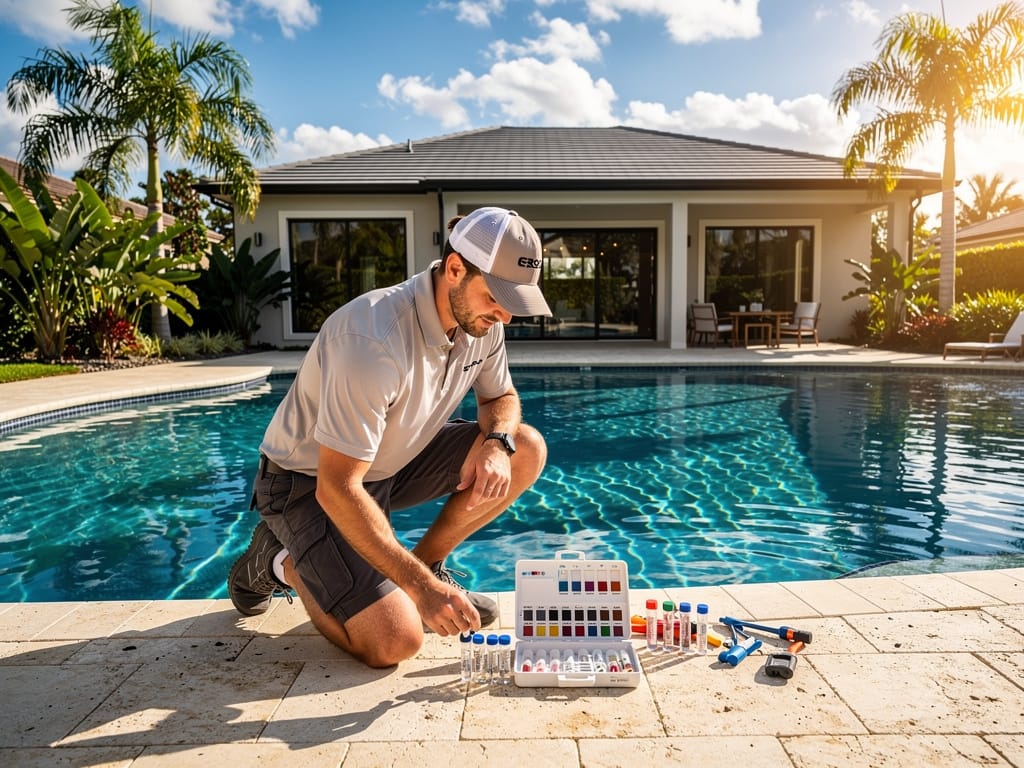
Quick Answer: Pool chemical balancing in Margate, FL targets pH 7.2–7.6, free chlorine 1–3 ppm, total alkalinity 80–120 ppm, calcium hardness 200–400 ppm, and CYA 30–50 ppm. As an inland northwest Broward city, Margate doesn’t face the ocean-salt TDS issues of coastal Broward markets, but its 1970s–80s housing stock introduces calcium hardness and plaster preservation chemistry concerns shared with other older-stock Broward cities. HOA pools must additionally meet Florida DOH minimums documented at every service visit. Margate’s significant rainfall (June–September) puts consistent downward pressure on pH, chlorine, and alkalinity that weekly management addresses.
Margate’s pool chemistry environment is shaped by two primary factors: South Florida’s year-round heat and rainfall cycle, and the older housing stock that accounts for a significant portion of the city’s residential pools. The chemistry is not exotic — the same five core parameters govern pool water quality in Margate as in any other Broward city — but the context matters for understanding why certain parameters need attention that Margate’s pool stock specifically demands.
The Five Core Chemistry Parameters for Margate Pools
pH (Target: 7.2–7.6)
South Florida’s rainfall is slightly acidic (pH ~5.5–6.0), consistently pushing pool pH downward. In Margate, where summer rainfall is heavy (June–September, 60+ inches annually), pH drift is a reliable weekly correction requirement. Low pH (below 7.2) is corrosive to pool surfaces — particularly relevant for Margate’s older plaster pools, where acidic water accelerates the calcium carbonate dissolution that roughens and erodes plaster surfaces. For these properties, pH management is a plaster preservation measure as much as a chemistry compliance requirement.
Free Chlorine (Target: 1–3 ppm Residential; ≥1.0 ppm DOH for HOA Pools)
South Florida’s UV index (10–11 in summer) destroys unstabilized chlorine within hours of application. CYA (cyanuric acid, or stabilizer) slows this UV degradation, allowing chlorine to persist between service visits at effective concentrations. Without adequate CYA (30–50 ppm target), chlorine added during a weekly visit may be substantially depleted before the next visit. For Margate HOA pools, Florida DOH requires free chlorine ≥ 1.0 ppm documented at every service visit — not as a minimum at time of service, but as the maintained minimum the pool must hold.
Total Alkalinity (Target: 80–120 ppm)
Alkalinity is the pH buffer — the chemistry that prevents pH from swinging rapidly between service visits. In Margate’s wet season, heavy rainfall dilutes both pH and alkalinity. Low alkalinity amplifies pH swings: a pool with TA at 40 ppm might drop from pH 7.4 to pH 6.8 between weekly service visits after a significant rain event. Maintaining TA at 80–120 ppm stabilizes the pH chemistry between visits, reducing the severity of chemistry drift.
Calcium Hardness (Target: 200–400 ppm) — The Older-Pool Priority
For Margate’s 1970s–80s pool stock, calcium hardness management is a plaster-life parameter, not just a chemistry parameter. Pool water below 200 ppm calcium hardness is chemically undersaturated relative to calcium carbonate — it actively leaches calcium from the nearest available source, which is the pool plaster. On plaster surfaces that have already managed 40–50 years of chemistry cycles, sustained low calcium hardness accelerates surface deterioration measurably. Test calcium hardness quarterly; add calcium chloride when levels fall below 200 ppm. This is both standard chemistry management and a cost-effective plaster-life extension measure on Margate’s older properties.
CYA (Target: 30–50 ppm)
CYA accumulates from granular trichlor chlorine and dissipates only through dilution. In Margate pools operating year-round without seasonal drain cycles, CYA can gradually accumulate above 80 ppm — the stabilizer lock threshold at which CYA binds chlorine so effectively that disinfection efficacy drops even when free chlorine readings appear normal. Test CYA quarterly and perform a partial drain-and-refill (25–35% of pool volume) when CYA approaches 80 ppm to prevent stabilizer lock from developing.
Seasonal Chemistry Management in Margate
Margate’s wet season (June–September) creates the most chemistry-intensive period of the year. Heavy rainfall in short periods dilutes all pool chemistry simultaneously: a 4-inch rain event can drop chlorine by 30–50%, push pH downward, dilute alkalinity, and introduce significant organic material that increases chlorine demand. The correct response: a chemistry check within 24–48 hours of significant rain events, not waiting for the next scheduled weekly service. During wet season, pools between weekly service visits are more vulnerable to chemistry drift than during drier months — which is why consistent weekly service (not bi-weekly) is the standard for Margate’s climate.
For pool chemical balancing in Margate, FL — residential and HOA compliance chemistry throughout the city — call Fort Lauderdale Pool Service at (954) 501-2754 or see our Margate service page.
Frequently Asked Questions
What pool chemistry levels should be maintained in Margate, FL?
Target ranges: pH 7.2–7.6 (tested and adjusted weekly); free chlorine 1–3 ppm residential, ≥1.0 ppm for HOA pools (DOH minimum); total alkalinity 80–120 ppm (test and adjust as rainfall dilutes); calcium hardness 200–400 ppm (test quarterly — especially important on older Margate plaster properties); CYA 30–50 ppm (test quarterly; partial drain-and-refill when above 80 ppm to prevent stabilizer lock). All five tested at each weekly service visit except calcium hardness and CYA, which quarterly testing is adequate for residential pools.
Why does Margate’s older housing stock affect pool chemistry management?
Specifically calcium hardness and pH management. Plaster surfaces in Margate’s 1970s–80s pools have managed chemistry cycles for 40–50 years. Water below 200 ppm calcium hardness actively leaches calcium from plaster, accelerating surface deterioration. Low pH (below 7.2) is corrosive to plaster, accelerating the etching and calcium release that roughens surfaces and eventually requires resurfacing. Both calcium hardness maintenance at 200+ ppm and consistent pH management at 7.2+ are plaster preservation measures that extend surface life on older Margate properties.
Why does my Margate pool chemistry drift so much during summer?
Three concurrent summer pressures: (1) heavy rainfall June–September dilutes all chemistry — pH, chlorine, alkalinity, and calcium hardness all drop after significant rain events; (2) extreme UV index (10–11) destroys chlorine rapidly, requiring adequate CYA to protect between service visits; (3) water temperatures 84–90°F accelerate algae growth when chemistry drifts below maintenance thresholds. These three factors combine to make Margate’s summer the highest-risk chemistry management period. Weekly service is the minimum effective interval — bi-weekly service allows chemistry to drift into algae-growth conditions in summer heat.
What is the Florida DOH chemistry standard for Margate HOA pools?
Florida DOH (enforced by Broward County Health Department) requires: free chlorine ≥ 1.0 ppm, pH 7.2–7.8, combined chlorine (chloramines) ≤ 0.2 ppm per 1.0 ppm free, and chemistry logs maintained on-site at the pool after every service visit. Inspectors arrive unannounced and test water directly — a pool that passes inspection during service but drifts out of range before the next visit may fail inspection. The DOH standard is a maintained minimum, not a service-day reading.
How do I know if my Margate pool has stabilizer lock?
Stabilizer lock (CYA above ~80 ppm) is typically identified through testing, not visual symptoms — the pool may look clean while chlorine’s disinfection efficacy is substantially reduced. Symptoms that suggest stabilizer lock: chlorine readings appear normal but algae develops anyway; you’re adding more chlorine than typical but chemistry stays unstable; green pool events occur despite apparently adequate free chlorine readings. A CYA test (liquid reagent test, not test strips — strips are not accurate at elevated CYA levels) confirms the diagnosis. Treatment: partial drain-and-refill of 25–35% pool volume to dilute CYA back into the effective range.