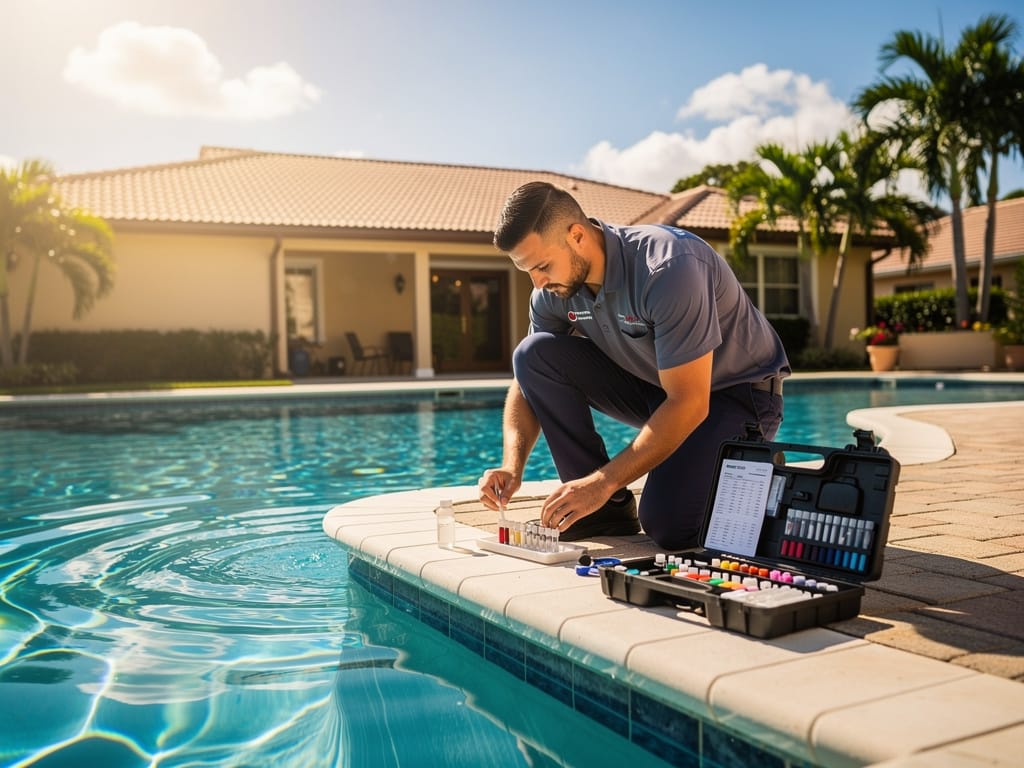
Quick Answer: Pool chemical balancing in Lauderdale Lakes, FL targets: pH 7.2–7.6, free chlorine 1–3 ppm, total alkalinity 80–120 ppm, calcium hardness 200–400 ppm, CYA 30–50 ppm. As an inland city, Lauderdale Lakes doesn’t face the coastal TDS accumulation that oceanfront Broward cities experience — but its older pool stock introduces a calcium hardness consideration: older plaster that has been leaching calcium for decades may require more active hardness management to avoid continued surface deterioration.
Pool chemistry in Lauderdale Lakes follows standard South Florida parameters — but the city’s older housing stock introduces one chemistry-maintenance angle that newer pool markets don’t face as frequently: the relationship between calcium hardness, water aggressiveness, and older plaster surfaces. Understanding this connection helps Lauderdale Lakes pool owners maintain their aging pool surfaces effectively.
The Five Core Chemistry Parameters in Lauderdale Lakes
pH (Target: 7.2–7.6)
pH is the most frequently corrected parameter in any Broward County pool. South Florida rainfall is mildly acidic (pH ~5.5–6.0), consistently pushing pool pH down. Bather activity, organic material from trees and surrounding vegetation, and CO2 dissolution all also affect pH. Low pH (below 7.2) is corrosive — to pool equipment, to older plaster surfaces in Lauderdale Lakes’ aging pool stock, and to swimmers’ eyes and skin. Weekly pH testing and upward adjustment (sodium carbonate or sodium bicarbonate) is a baseline service requirement.
Free Chlorine (Target: 1–3 ppm)
South Florida’s UV intensity is extreme — UV index 10–11 in summer destroys unstabilized chlorine rapidly. CYA (cyanuric acid) is the stabilizer that gives chlorine UV resistance. The management challenge: CYA must be kept in the 30–50 ppm range. Below 30 ppm, chlorine dissipates too fast in Florida sun. Above 80 ppm, the “stabilizer lock” phenomenon reduces chlorine’s effective disinfection power even when readings look acceptable. For Lauderdale Lakes HOA pools, Florida DOH minimum free chlorine standards (≥ 1.0 ppm) must be maintained and documented.
Total Alkalinity (Target: 80–120 ppm)
Total alkalinity is the pH buffer — it determines how resistant the pool water is to pH swings between service visits. Low TA allows pH to move rapidly with any input (rain, bather activity). In Lauderdale Lakes where rain events are frequent June–September, maintaining TA in the 80–120 ppm range is what prevents pH from cratering after a heavy rain. High TA makes pH adjustment sluggish and expensive.
Calcium Hardness (Target: 200–400 ppm) — The Lauderdale Lakes Older Plaster Consideration
This is where Lauderdale Lakes’ older pool stock diverges from newer-construction chemistry management. Pool water that is calcium-deficient (below 200 ppm) is chemically aggressive — it seeks calcium from the nearest available source, which in a pool is the plaster surface. Aggressive water leaches calcium from aging plaster, accelerating surface deterioration. In a pool whose plaster is already worn and calcium-depleted from decades of chemical exposure, maintaining calcium hardness at or slightly above the 200 ppm minimum is a direct plaster-preservation measure. Test calcium hardness at least quarterly on older Lauderdale Lakes properties and adjust with calcium chloride when levels fall below 200 ppm.
CYA (Target: 30–50 ppm)
CYA accumulates from granular trichlor additions and doesn’t dissipate except through dilution. In Lauderdale Lakes, where pools are serviced year-round without seasonal drain-and-refill cycles, CYA can gradually climb above the effective range in pools that use trichlor granules as their primary chlorine source. Testing CYA every 4–6 months and performing a partial drain-and-refill when CYA climbs above 80 ppm is the standard management approach.
For pool chemical balancing in Lauderdale Lakes, FL — residential, HOA, and older property chemistry management — call Fort Lauderdale Pool Service at (954) 501-2754 or see our Lauderdale Lakes service page.
Frequently Asked Questions
What pool chemistry parameters need to be balanced in Lauderdale Lakes?
Five core parameters: pH (7.2–7.6), free chlorine (1–3 ppm residential; DOH minimum ≥1.0 ppm for HOA pools), total alkalinity (80–120 ppm), calcium hardness (200–400 ppm — particularly important on older plaster surfaces in Lauderdale Lakes’ aging pool stock), and CYA (30–50 ppm). All five should be tested at every weekly service visit; CYA and calcium hardness testing quarterly is adequate.
Why is calcium hardness particularly important for older pools in Lauderdale Lakes?
Pool water below 200 ppm calcium hardness is chemically aggressive — it leaches calcium from the nearest available surface, which in a pool is the plaster. In Lauderdale Lakes’ older pools whose plaster has already experienced decades of calcium leaching, low calcium hardness accelerates surface deterioration. Maintaining calcium hardness at or slightly above 200 ppm on older Lauderdale Lakes properties is a direct plaster-preservation measure alongside the standard chemistry balance.
How often should pool chemistry be tested in Lauderdale Lakes?
At every weekly service visit for pH, free chlorine, and total alkalinity. Calcium hardness and CYA should be tested quarterly. For Lauderdale Lakes HOA pools, Florida DOH compliance requires documented chemistry records after every service visit — the full parameter test at each weekly visit is the compliance record. Between scheduled visits, any significant rain event (2″+ in 24 hours) warrants a chemistry check rather than waiting for the next scheduled visit.
What happens if pool pH gets too low in a Lauderdale Lakes older pool?
Low pH (below 7.2) is corrosive to pool equipment — accelerating corrosion of metal components and degrading rubber seals and gaskets. On older Lauderdale Lakes pools with aging equipment, this corrosion effect compounds existing equipment wear. Low pH is also directly corrosive to plaster surfaces, accelerating the calcium leaching and surface etching that eventually requires resurfacing. Maintaining pH above 7.2 at every service visit is one of the highest-value chemistry interventions on older Lauderdale Lakes pool properties.
What is stabilizer lock and can it affect Lauderdale Lakes pools?
Stabilizer lock occurs when CYA climbs above approximately 80 ppm — at this level, CYA binds so aggressively to chlorine that it reduces the chlorine’s ability to kill bacteria and algae, even though the free chlorine reading looks normal. This is a real risk in Lauderdale Lakes pools that use trichlor granules as their primary chlorine source over multiple years without a partial drain-and-refill. The fix is dilution: a 25–30% drain-and-refill replaces high-CYA water with fresh municipal supply, bringing the CYA level back into the effective range.