Pool Chemical Balancing in Hollywood FL — Chemistry for a Diverse Beach City
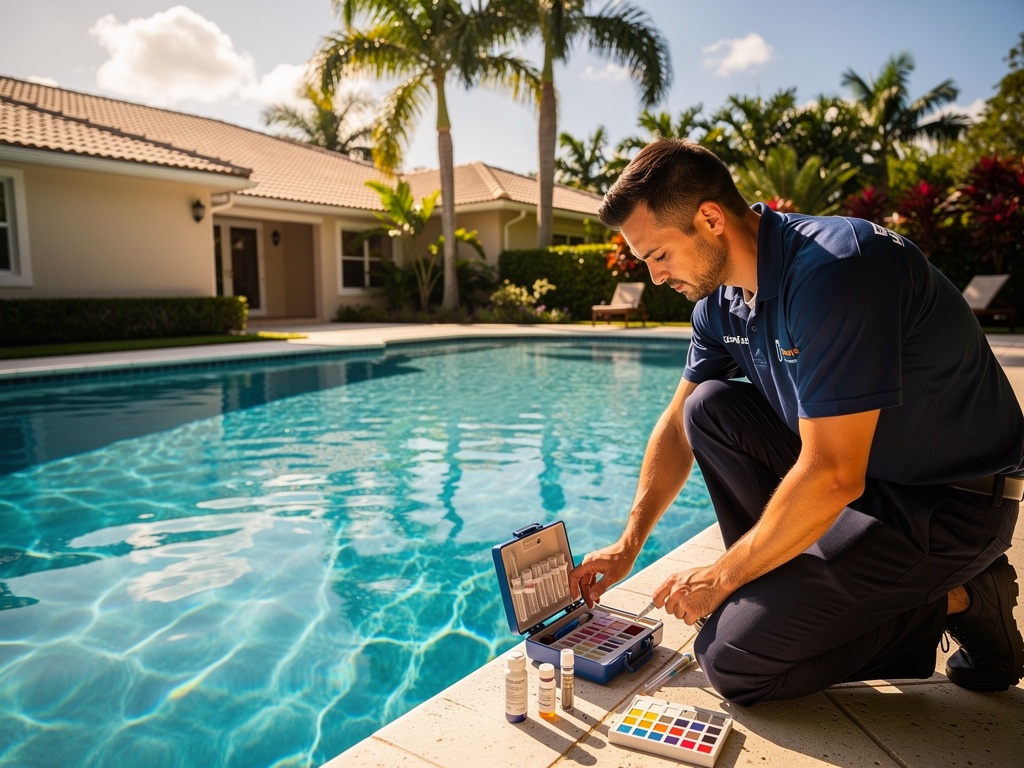
Hollywood FL pools face the same South Florida chemistry demands as every Broward County pool — intense UV, warm year-round water temperatures, and a rainy season that disrupts chemistry weekly from June through October. Hollywood’s specific mix of older plaster pools, newer salt installations, and the beach-adjacent chemistry environment of properties near the Broadwalk and Intracoastal adds context to the standard Broward chemistry picture. Understanding the full parameter set — not just pH and chlorine — is what separates complete pool chemistry management from basic service.
The Core Chemistry Picture for Hollywood Pools
pH: The Foundation
pH between 7.2 and 7.6 is the operational target for Hollywood’s chlorine pools (7.2-7.4 for salt pools). This range keeps chlorine effective as a sanitizer, prevents surface aggression from acidic water, and maintains swimmer comfort. Hollywood’s rainy season presents specific pH management challenge: South Florida rainfall at pH 5.6-6.5 pushes pool pH downward with every significant storm. The weekly correction cycle in Hollywood’s wet season — acidic rain drops pH, service visit corrects upward, next storm drops it again — requires consistent weekly professional monitoring to stay within the effective range.
Free Chlorine: Maintained by UV-Protected Stabilizer
Free chlorine at 2-4 ppm, stabilized by CYA at 30-50 ppm, is the sanitizer system for Hollywood’s standard chlorine pools. The two-parameter management approach is essential: CYA protects chlorine from Hollywood’s high UV index (8-11 year-round outdoors), but CYA above 80 ppm effectively neutralizes chlorine’s sanitizing power through stabilizer lock. For Hollywood’s older neighborhoods where trichlor tablets have been the chlorination method for years, annual CYA testing is the maintenance step that prevents the stabilizer accumulation problem before it manifests as recurring algae that doesn’t respond to shock.
Calcium Hardness: Plaster Protection for Older Hollywood Pools
Hollywood’s mid-century neighborhoods have pools with plaster surfaces that may be 20-40 years old — original or once-resurfaced plaster at varying stages of their service life. For these pools, calcium hardness maintained at 250-350 ppm is the primary protective chemistry: it prevents the pool water from becoming “hungry” for calcium that it then extracts from the pool surface. A pool with 150 ppm calcium hardness is etching its plaster surface at every hour of contact. A pool with 300 ppm is protecting it. The difference is tens of thousands of dollars in delayed replastering costs.
Alkalinity: The pH Buffer That Makes Everything Else Work
Total alkalinity at 80-120 ppm is the parameter that makes pH management predictable and consistent for Hollywood pool service. When alkalinity is in range, adding 16 oz of muriatic acid to a 15,000-gallon pool will predictably shift pH by approximately 0.2 units — giving service technicians a consistent calibration. When alkalinity is low (below 60 ppm), pH bounces erratically in response to small inputs, making stable chemistry management impossible. When it’s high (above 150 ppm), pH resists correction. Alkalinity tested and managed at every visit is the foundation of stable Hollywood pool chemistry.
Fort Lauderdale Pool Service provides complete chemistry management for Hollywood FL pools, from standard weekly balancing to CYA correction and calcium hardness protection for older plaster surfaces. All chemicals included. Contact us for a service assessment.