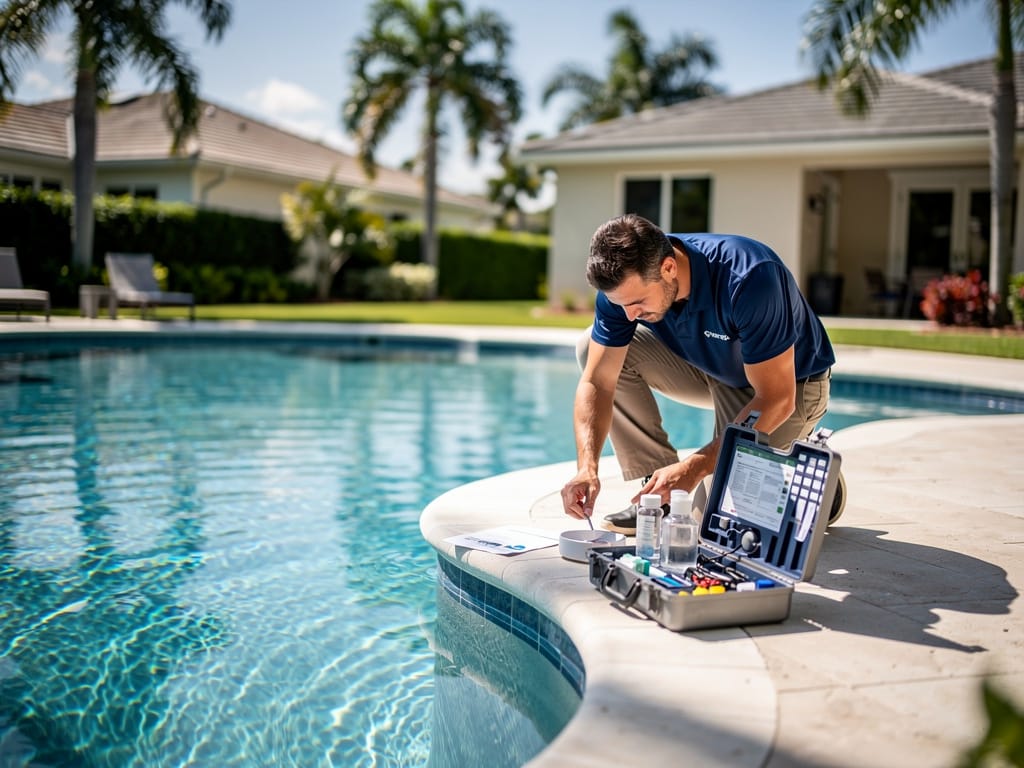
Quick Answer: Chemical balancing in Deerfield Beach pools requires particular attention to calcium hardness and alkalinity due to Broward County’s municipal water supply, which runs moderately hard. Properties along Hillsboro Boulevard and the Hillsboro corridor often show accelerated calcium scaling — a known local pattern. Target ranges: pH 7.4–7.6, free chlorine 2–4 ppm, total alkalinity 80–120 ppm, calcium hardness 200–400 ppm, CYA 30–50 ppm.
Pool chemical balancing in Deerfield Beach follows the same principles as anywhere in Broward County, but with local nuances. The city’s water supply, its geography at the Broward/Palm Beach county line, and the specific chemistry patterns of Deerfield Beach’s older pool stock all affect how balancing is approached in practice.
The Five Parameters Every Deerfield Beach Pool Needs Tested Weekly
1. pH (Target: 7.4–7.6)
pH is the master control parameter — it determines how effective chlorine is at sanitizing. At pH 7.4, about 55% of chlorine is in its active (hypochlorous acid) form. At pH 7.8, only about 27% is active. In practical terms, a pool running at pH 7.8 needs twice as much chlorine to achieve the same sanitizing effect as a pool at 7.4.
In Deerfield Beach, pH tends to drift upward naturally — a consequence of off-gassing from aeration (waterfalls, fountains), swimmer activity raising carbon dioxide, and the alkaline tendency of Broward’s municipal water. Correcting pH drift requires muriatic acid (lowers pH) or sodium carbonate/soda ash (raises pH). Most Deerfield Beach pools trend toward needing pH reduction at each service visit.
2. Free Chlorine (Target: 2–4 ppm with CYA present)
Chlorine is the primary sanitizer, killing bacteria, viruses, and algae. The target range of 2–4 ppm is for stabilized pools (with cyanuric acid present). Unstabilized outdoor pools would need higher levels. In Deerfield Beach’s summer heat, chlorine demand is high — especially in pools with high bather load or post-rain dilution. Liquid chlorine (sodium hypochlorite) is the standard addition method for Deerfield Beach pools; salt chlorination systems are common and require monitoring of the salt cell output and salt level rather than manual chlorine addition.
3. Total Alkalinity (Target: 80–120 ppm)
Alkalinity is the pH buffer — it’s what keeps pH stable between service visits. Low alkalinity causes pH to swing erratically; high alkalinity makes pH difficult to adjust downward and can contribute to calcium scaling in Deerfield Beach’s already-moderate-hardness water. Alkalinity in Broward County’s municipal water typically comes in the 80–130 ppm range, which puts Deerfield Beach pools in a reasonable starting position — but seasonal chemistry shifts and rain dilution can pull alkalinity out of range, requiring sodium bicarbonate to raise it or muriatic acid to lower it.
4. Calcium Hardness (Target: 200–400 ppm)
This is where Deerfield Beach has a specific local pattern worth noting. Broward County’s water supply runs in the 130–180 ppm calcium hardness range — moderately hard. In South Florida’s heat, evaporation concentrates calcium over time, gradually pushing pool calcium hardness upward. Properties along Hillsboro Boulevard and the Hillsboro inlet corridor see this process accelerated slightly by local water conditions.
High calcium hardness (above 400 ppm) causes scale deposits — the white crusty buildup on tile lines, pool surfaces, and inside equipment. Scale inside heaters and salt cells reduces their efficiency and shortens their lifespan. In Deerfield Beach’s older pools, accumulated calcium scaling from decades of mineral concentration is a common finding during equipment inspection. Once calcium hardness exceeds 600 ppm, partial drain and dilution is typically the only practical remedy.
5. Cyanuric Acid / Stabilizer (Target: 30–50 ppm)
CYA stabilizes chlorine against UV degradation — outdoor pools in Deerfield Beach without stabilizer would lose their chlorine within hours in the Florida sun. But CYA accumulates over time and cannot be removed chemically — only diluted by draining and refilling. Pools that are repeatedly dosed with stabilized chlorine tablets (trichlor) see CYA climb steadily. When CYA rises above 80–100 ppm, chlorine becomes increasingly ineffective regardless of how much is added. This is a common situation in Deerfield Beach pools that have been running on tablet feeders without chemistry monitoring.
Deerfield Beach Hard Water: Practical Management
The practical implication of Deerfield Beach’s moderately hard water for pool owners:
- Test calcium hardness at every service visit (not just monthly) to catch rising trends early
- Use calcium hypochlorite (Cal-Hypo) shock sparingly — it adds calcium as well as chlorine, compounding hardness over time; sodium hypochlorite (liquid chlorine) is better for Deerfield Beach’s hard-water pools
- Address tile calcium scaling annually with a tile cleaning service before heavy buildup calcifies permanently
- Monitor salt cell output if you have a salt system — calcium scaling inside the cell reduces chlorine generation efficiency
For professional pool chemical balancing service in Deerfield Beach, FL — serving Deer Creek, Deerfield Isle, Cypress Bend, and surrounding neighborhoods — call Fort Lauderdale Pool Service at (954) 501-2754 or see our Deerfield Beach service page.
Frequently Asked Questions
Why does my Deerfield Beach pool have calcium scale on the tile line?
Calcium scaling on tile is the result of calcium hardness exceeding saturation at the water surface — the hottest and most evaporation-exposed zone of the pool. Broward County’s moderate-hardness water, combined with evaporation concentration in South Florida heat, steadily raises pool calcium hardness. In Deerfield Beach’s older pools that have been refilled with municipal water many times over the years, calcium has accumulated to high levels that cause scaling when chemistry drifts. Annual tile cleaning and calcium hardness monitoring prevent heavy calcification.
What is the right pH for a Deerfield Beach pool?
Target pH 7.4–7.6 for Deerfield Beach pools. At 7.4, chlorine is most effective, equipment and surfaces experience minimal corrosion or scaling, and swimmer comfort is optimal. Deerfield Beach pools tend to drift upward toward 7.8–8.0 naturally — muriatic acid at each service visit is the standard correction. Avoid letting pH rise above 7.8; at that level chlorine efficacy is substantially reduced and calcium scaling is accelerated.
How does Broward County’s water hardness affect pool chemistry in Deerfield Beach?
Broward municipal water comes in at approximately 130–180 ppm calcium hardness — moderate by Florida standards. This starting point isn’t problematic, but South Florida’s heat causes significant evaporation (replacing with harder makeup water) and concentration over time. In Deerfield Beach pools, calcium hardness typically rises 10–30 ppm per month in summer without dilution events. Active monitoring and occasional partial top-off with soft water or dilution can slow the accumulation trend.
What happens if cyanuric acid gets too high in my Deerfield Beach pool?
CYA above 80 ppm begins to suppress chlorine’s sanitizing effectiveness — a phenomenon called “chlorine lock.” Pools with CYA above 100 ppm may need 3–4x more chlorine to achieve the same sanitizing result. Above 150 ppm, chlorine is largely ineffective regardless of level. The only remedy is partial drain and dilution. In Deerfield Beach pools using trichlor tablets as the primary chlorine source, CYA buildup is common and may require draining 25–50% of the pool water and refilling every 12–18 months.
How often should pool chemicals be tested in Deerfield Beach?
At every weekly service visit — all 5 primary parameters. Deerfield Beach’s heat, UV, and rainfall create enough chemistry volatility that monthly testing misses important shifts. In peak summer (June–September), free chlorine and pH can change significantly within 3–4 days of a service visit, particularly after rain events or heavy bather use. Weekly testing provides the data needed to keep chemistry in range between visits and to identify trend drift early.