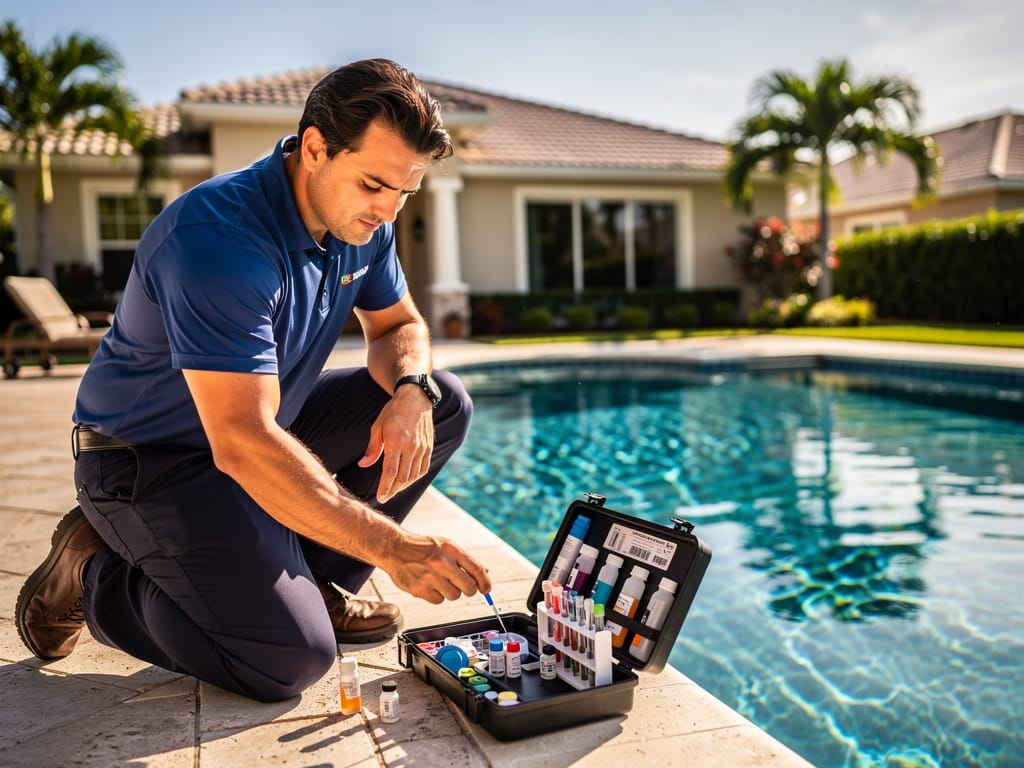
Quick Answer: Properly balanced pool water in Coral Springs, FL requires pH 7.4–7.6, free chlorine 2–4 ppm, total alkalinity 80–120 ppm, calcium hardness 200–400 ppm, and cyanuric acid 30–50 ppm. South Florida’s heat burns chlorine 2–3x faster than northern states, requiring weekly professional chemical adjustment year-round.
Pool water chemistry is the foundation of a safe, clear, swim-ready pool. In Coral Springs, Florida, the combination of intense UV, year-round heat, and frequent use means that chemical balance is more demanding — and more important — than in almost any other part of the country. This guide explains every chemical parameter your pool needs, why it matters in the South Florida context, and what to do when something is out of range.
The 5 Parameters Every Coral Springs Pool Needs Tested Weekly
1. pH (Target: 7.4–7.6)
pH measures how acidic or alkaline your pool water is. This single parameter affects almost every other aspect of pool chemistry:
- pH below 7.2: Water becomes corrosive — irritates eyes and skin, etches plaster, corrodes metal fittings and pool equipment
- pH above 7.8: Chlorine loses most of its effectiveness (at pH 8.0, only 3% of chlorine is in its active sanitizing form); water becomes cloudy; scale forms on surfaces
- pH 7.4–7.6: Chlorine is highly active; water is comfortable for swimmers; surfaces are protected
pH naturally rises in South Florida pools due to dissolved CO2 outgassing in heat. Weekly adjustment is normal.
2. Free Chlorine (Target: 2–4 ppm)
Free chlorine is the active sanitizer that kills bacteria, viruses, and algae. “Free” means it’s available and ready to sanitize — not “combined” chlorine that’s already reacted with contaminants.
- Below 1 ppm: Sanitizer is effectively depleted; algae and bacteria can establish rapidly in South Florida heat
- 2–4 ppm: Effective sanitization; comfortable for swimmers
- Above 10 ppm: Strong bleach odor; skin and eye irritation; unsafe for swimming
In Coral Springs during peak summer, UV can burn off 1–2 ppm of free chlorine per day without CYA stabilizer protection. This is why chlorine must be stabilized and added weekly.
3. Total Alkalinity (Target: 80–120 ppm)
Total alkalinity (TA) is the pool water’s buffering capacity — it resists pH swings. Without adequate alkalinity, pH bounces erratically in response to rain, bather load, and chemical additions. With too much alkalinity, pH becomes difficult to lower and stays stubbornly high.
Ideal alkalinity in South Florida: 80–100 ppm (lower end of range preferred in Florida’s warm water, which has a natural tendency toward pH rise).
4. Calcium Hardness (Target: 200–400 ppm)
Calcium hardness measures dissolved calcium in the pool water. Water needs a minimum calcium level to remain “satisfied” — water with insufficient calcium will leach it from plaster surfaces, causing pitting and surface degradation over time.
- Below 150 ppm: Water becomes corrosive to plaster and grout
- Above 500 ppm: Calcium scale begins depositing on surfaces, waterline tile, and equipment
- 200–400 ppm: Balanced; protects surfaces and equipment
Coral Springs tap water typically runs 150–250 ppm calcium — often adequate for starting but should be verified and adjusted when pools are refilled.
5. Cyanuric Acid / Stabilizer (Target: 30–50 ppm)
Cyanuric acid (CYA) is a chlorine stabilizer that shields chlorine molecules from UV degradation. In South Florida’s intense sun, chlorine without CYA protection can lose 75–90% of its concentration within a few hours of direct sunlight exposure.
- Below 20 ppm: Chlorine is rapidly destroyed by UV; effectively no protection
- 30–50 ppm: Optimal protection with maintained chlorine effectiveness
- Above 80 ppm: “Chlorine lock” begins — chlorine is present but can’t effectively sanitize; extremely difficult to reduce without draining water
CYA is introduced through stabilized chlorine tablets (trichlor) and builds up over time. Pools that use tablets exclusively can accumulate dangerously high CYA levels, which is why liquid chlorine or unstabilized shock must be used regularly to rebalance.
Additional Parameters for Specific Pool Types
Saltwater Pools (Coral Springs)
Saltwater pools in Coral Springs have the same 5 core parameters as chlorine pools, plus:
- Salt level: 2,700–3,400 ppm (test monthly; target your salt system manufacturer’s recommended range)
- Salt cell function: Check output percentage; clean cell with mild acid when scaling is visible (every 3–6 months in South Florida’s hard water)
Phosphate Testing
Phosphates are food for algae. In Coral Springs, common phosphate sources include lawn fertilizer runoff, leaf decomposition, and some municipal water supplies. If your pool repeatedly turns green despite proper chlorine levels, phosphate testing (target below 200 ppb) is worth adding to your monthly test routine.
What Happens When One Parameter Is Off
Pool chemistry is interconnected — one imbalanced parameter affects all others:
- High pH makes chlorine ineffective → chlorine appears normal on test but provides minimal protection
- Low alkalinity causes pH to bounce → hard to maintain stable chemistry
- High CYA makes chlorine ineffective → pool turns green despite adequate chlorine readings
- Low calcium hardness allows plaster etching → long-term damage that requires resurfacing
This is why proper pool chemistry testing in Coral Springs requires all 5 parameters — not just a simple chlorine test strip. A 5-parameter digital or DPD test kit provides the full picture needed for accurate adjustment.
DIY vs. Professional Chemical Balancing in Coral Springs
Some Coral Springs homeowners attempt to handle their own chemical balancing. This is feasible for those who:
- Own a reliable 5-parameter test kit and know how to use it correctly
- Understand how to calculate chemical doses for their specific pool volume
- Can commit to testing and adjusting every 5–7 days year-round
- Have a relationship with a local pool supply store for advice on unusual readings
For most Coral Springs homeowners, professional weekly service is the more reliable path — the cost ($85–$150/month) is modest compared to the cost of a single major chemical correction or equipment repair that results from neglected chemistry.
For professional pool chemical balancing in Coral Springs, FL, Fort Lauderdale Pool Service tests and adjusts all 5 parameters at every weekly service visit. See our Coral Springs pool service page or call (954) 501-2754.
Frequently Asked Questions
How often should I test my pool chemistry in Coral Springs?
Weekly, at minimum. In peak summer months (June–September), testing twice per week is advisable if bather load is high or after significant rain events. Professional service companies test at every visit and provide a record of all readings — this ongoing data helps identify trends before they become problems.
Why does my Coral Springs pool smell like chlorine if chlorine is present?
A strong chlorine odor usually indicates combined chlorine (chloramines), not excess free chlorine. Chloramines form when free chlorine reacts with bather waste (sweat, urine, sunscreen). They smell strong and irritate eyes. The fix is super-chlorination (shock treatment) to break up chloramines — not reducing chlorine, which makes the problem worse.
What is “chlorine lock” and can it happen in Coral Springs pools?
Chlorine lock (more accurately called “high CYA inhibition”) occurs when cyanuric acid levels exceed 80–100 ppm, severely reducing chlorine’s sanitizing effectiveness. It’s common in Coral Springs pools that exclusively use trichlor tablets over multiple years without monitoring CYA. Treatment requires partially draining and refilling the pool to dilute CYA below 50 ppm.
How do I lower high pH in my Coral Springs pool?
High pH (above 7.6) is lowered by adding muriatic acid (hydrochloric acid) or sodium bisulfate (dry acid). The dose depends on your pool volume and current pH reading. In South Florida, pH rises naturally due to outgassing CO2 in warm water — expect to add acid most weeks. Always add acid to a running pump with the pool fully circulating, and avoid adding directly near pool surfaces or fixtures.
What is the ideal salt level for a saltwater pool in Coral Springs?
Most saltwater pool systems (Pentair, Hayward, Jandy) operate optimally at 2,700–3,400 ppm salt. Check your system’s display or test with a salt test strip monthly. Low salt prevents the salt cell from generating adequate chlorine; high salt can trigger automatic shutdowns and accelerate cell wear. Coral Springs’s warm water doesn’t change the target range — follow manufacturer specifications.