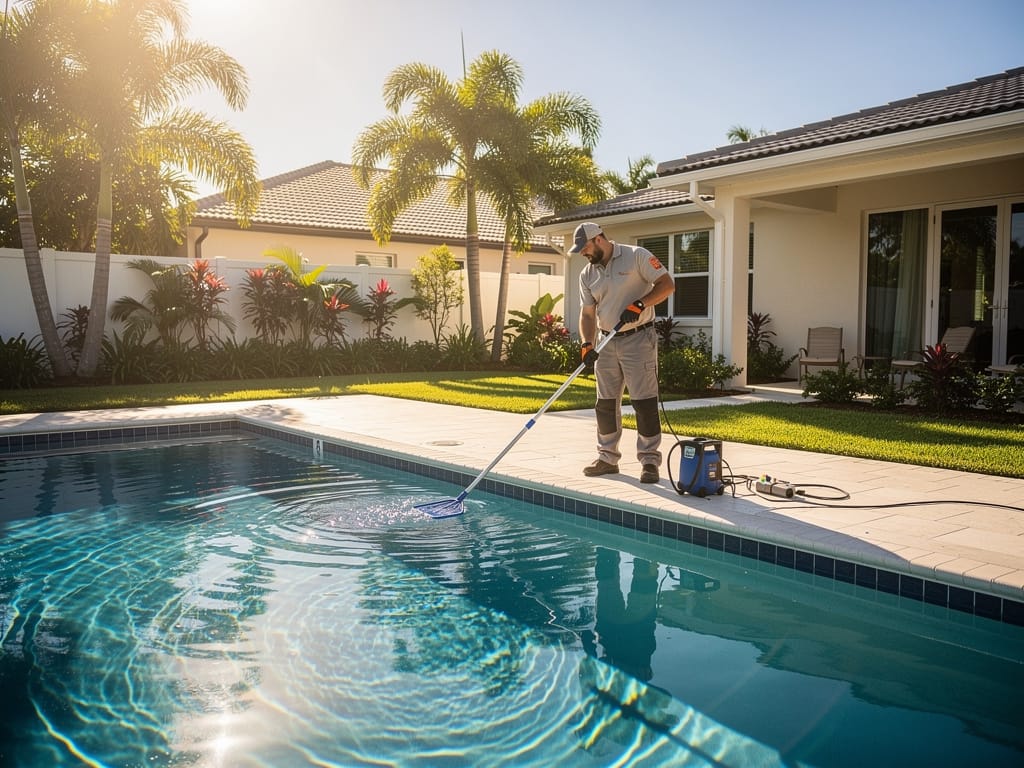
Quick Answer: In Pompano Beach, FL, your pool needs professional service every 7 days. South Florida’s heat (avg. 91°F+ in summer), year-round UV, and Pompano’s coastal humidity mean algae can establish within 48–72 hours of chlorine depletion. Weekly service is not a sales pitch — it’s the minimum effective interval for Broward County’s climate.
Homeowners new to Pompano Beach — or reconsidering their current service frequency — often ask whether weekly service is really necessary or whether bi-weekly might work. The short answer is: in Pompano Beach’s climate, bi-weekly service is a reliable path to green pool emergencies during summer. Here’s the science and the real-world data behind that conclusion.
Pompano Beach’s Climate Creates the Most Demanding Pool Conditions in the US
Pompano Beach sits in USDA Hardiness Zone 10b — a subtropical coastal zone with no meaningful winter. Three factors combine to create pool chemistry challenges that don’t exist in the same way anywhere else in the continental United States:
UV Intensity
Pompano Beach’s UV index hits 10–11+ (Extreme) during peak summer months. Un-stabilized free chlorine can be destroyed within 2–4 hours of direct sunlight exposure at these UV levels. Even with proper cyanuric acid stabilizer (CYA) at 30–50 ppm, chlorine demand in summer runs 2–3x higher than in northern states. A pool that might lose 0.5 ppm of chlorine per day in a Massachusetts summer may lose 1.5–2 ppm per day in Pompano Beach.
Water Temperature
Algae growth becomes exponential above 78°F water temperature. Pompano Beach pool water averages:
- April–May: 78–82°F (at the algae growth threshold)
- June–September: 85–92°F (prime algae conditions)
- October–November: 80–84°F (still above threshold)
- December–March: 68–76°F (below threshold for explosive growth, but not for slow growth)
There are fewer than 60 days per year when Pompano Beach pool water is consistently below the 78°F algae growth threshold. This is a year-round problem, not a seasonal one.
Coastal Humidity and Salt Air
Unlike inland cities like Plantation or Weston, Pompano Beach’s coastal humidity keeps pool water chemistry less stable. Salt particles in the air can introduce mineral imbalances, and the humidity itself supports faster organic growth in the pool environment. Waterfront properties in Pompano Isles are particularly affected.
What Happens When Pompano Beach Pools Get Bi-Weekly Service
The pattern is consistent and predictable in Pompano Beach during the warm season:
- Days 1–3: Chemistry from last service holds. Pool is clear and balanced.
- Days 4–5: Chlorine begins declining in the heat. Algae spores present in all pool water begin gaining a foothold on unbrished surfaces.
- Days 6–8: Chlorine approaches 1 ppm (below safe threshold). Cloudiness begins. Early algae visible in corners and on steps if walls weren’t brushed.
- Days 9–12: With no service in sight and temperatures above 88°F, algae bloom is established. Pool turns green.
- Day 14: Technician arrives to a green pool. Cannot complete normal service — must shock treat at additional cost, typically $150–$350.
One green pool treatment per month costs $150–$350. Twelve months of bi-weekly service might save $300–$500 annually in service fees. The math doesn’t work — bi-weekly service costs more in Pompano Beach, not less.
Hurricane Season: Why Frequency Matters Even More June–November
Pompano Beach’s hurricane exposure adds a specific risk that inland Broward homeowners don’t face to the same degree. A single significant rain event — even from a storm that doesn’t make landfall — can dilute pool chemicals enough to trigger rapid algae growth. During hurricane season:
- Heavy rain (2″+ in 24 hours) can drop free chlorine by 1–2 ppm in a single event
- Post-storm pH spikes are common as rain raises water alkalinity
- Debris load from surrounding vegetation spikes dramatically
- Power outages affecting pump timers can leave pools without circulation for 12–24 hours
Weekly service during hurricane season means your pool is checked every 7 days regardless of what storm activity occurs. With bi-weekly service, a storm event during your service gap can leave you with a green pool for 14 days before the technician arrives.
Year-Round vs. Seasonal Service in Pompano Beach
Some homeowners ask about reducing service frequency in winter. Here’s the honest answer for Pompano Beach specifically:
December through March is the closest thing to a “slow” season in Pompano Beach pool chemistry — but even then, water temperatures average 68–76°F, which still supports algae growth. Rain still dilutes chemicals. Equipment still runs. For homeowners who want to reduce costs in winter, some Pompano Beach pool companies offer modest winter pricing adjustments (10–15% off) while maintaining weekly visits. Reducing visit frequency even in “winter” is not advisable for South Florida pools.
Practical Tip: What to Do Between Weekly Visits
If your pool is professionally serviced weekly, you should rarely need to add anything between visits. The exceptions in Pompano Beach:
- After a pool party with 10+ swimmers (heavy bather load burns through chlorine rapidly)
- After a significant rain event (1.5″+ in 24 hours) — add a maintenance dose of liquid chlorine same day
- If you notice early cloudiness before your next scheduled visit — call your service company; don’t attempt to treat without testing first
For professional weekly pool service in Pompano Beach — including Palm Aire, Crystal Lake, Pompano Isles, Cypress Head, and Rock Island — Fort Lauderdale Pool Service provides year-round maintenance with storm-protocol coverage and written service reports. Call (954) 501-2754 or see our Pompano Beach pool service page.
Frequently Asked Questions
Can I do bi-weekly pool service in Pompano Beach?
In Pompano Beach, bi-weekly service consistently produces green pool emergencies during the warm season (April–November). The cost of a single green pool treatment ($150–$350) typically exceeds months of savings from bi-weekly service. This is not a theoretical risk — it’s a pattern pool service companies in Pompano Beach see repeatedly every summer.
How fast can a pool turn green in Pompano Beach?
In peak summer heat (July–September), a Pompano Beach pool with zero free chlorine can show visible algae growth within 48 hours. In coastal conditions with high humidity and salt air, the timeline can be even shorter. A pool left without service for 10–14 days during summer in Pompano Beach will almost certainly turn green.
Do I need more frequent pool service during hurricane season in Pompano Beach?
Weekly service during hurricane season is the correct approach — that frequency is already appropriate for year-round Pompano Beach conditions. What changes during storm season is the need for between-visit check-ins after significant rain events (1.5″+ in 24 hours). Many pool companies include post-storm chemical checks as part of their service protocols for Pompano Beach clients.
Does a Pompano Beach pool need service in winter?
Yes. Pompano Beach water temperatures in December–March average 68–76°F — above the algae growth threshold for most of the “winter” period. Rain dilutes chemicals year-round. Equipment needs continuous monitoring. Weekly service year-round is appropriate for all Pompano Beach pools, though some providers offer modest winter pricing adjustments.
What is the ideal pool service frequency for a waterfront property in Pompano Isles?
Waterfront properties in Pompano Isles and other Intracoastal-adjacent communities should maintain standard weekly service. Salt-air exposure and wind-driven debris in waterfront locations can increase chemical consumption and debris load compared to inland properties — if anything, these properties benefit from more attentive service, not less. A good pool company will note the increased inspection frequency needed for coastal equipment.