Quick Answer: In Coral Springs, FL, pools need professional service every 7 days. South Florida’s year-round heat (avg. 91°F+ in summer), intense UV, and year-round pool use mean algae can take hold within 48–72 hours without treatment. Weekly service is the minimum — not a upsell.
One of the most common questions Coral Springs homeowners ask when they’re new to pool ownership — or when they’re evaluating their current service plan — is whether they really need weekly service. The honest answer in South Florida is yes, and there’s solid science behind it. Here’s exactly why, and what happens when you stretch service intervals.
Why Pool Chemistry Changes Faster in Coral Springs Than Anywhere Else
Coral Springs sits in a climate zone that puts more stress on pool water chemistry than almost anywhere in the continental United States. Three factors drive this:
UV Index
South Florida’s UV index regularly hits 11+ (Extreme) during peak summer months. UV radiation destroys un-stabilized chlorine rapidly — without cyanuric acid (CYA/stabilizer) at 30–50 ppm, free chlorine in a Coral Springs pool can drop to near-zero within hours of a sunny afternoon. Even with proper stabilizer levels, chlorine demand in FL summer is 2–3x what a pool in the Mid-Atlantic states would require.
Heat
Pool water at or above 78°F is the threshold at which algae growth becomes exponential. Coral Springs average water temperatures from April through October stay between 80°F and 92°F — well above that threshold for most of the year. Warm water also accelerates bacterial growth, reduces chlorine effectiveness, and increases bather load impact (every swimmer adds body oils, sunscreen, and organic matter that consumes chlorine).
Year-Round Use
Unlike pools in northern states that sit covered for 5–6 months, Coral Springs pools are actively used 12 months a year. More bather hours means more organic load, more chemical consumption, and continuous need for maintenance. There is no “off season” service reduction appropriate for South Florida pools.
What Happens When You Push to Bi-Weekly Service
Some homeowners try bi-weekly service to save money. In northern Florida (Jacksonville, Tallahassee), bi-weekly service is sometimes reasonable during cooler months. In Coral Springs, bi-weekly service consistently produces the following pattern in summer:
- Days 1–4: Pool is clear, chemistry from last service is holding
- Days 5–7: Chlorine begins declining; pH drifts; early algae spores attach to walls
- Days 8–10: Visible water cloudiness appears; green tint begins in corners and steps
- Days 11–14: Algae bloom is established; pool is green and unsafe to swim in
- Next service day: Technician cannot complete normal service — shock treatment required at extra cost
The cost of one green pool treatment ($150–$350) typically exceeds the cost savings from several months of bi-weekly service. Weekly service is the economical choice in Coral Springs.
Year-Round vs. Seasonal Service in Coral Springs
Every Coral Springs pool needs year-round service — 52 weeks per year. Here’s why seasonal gaps are problematic even in “winter”:
- Coral Springs water temperatures in December–February average 65–72°F — above the algae growth threshold
- Rain events (even in winter) dilute chemicals, raise pH, and introduce contaminants
- Equipment that goes uninspected for weeks develops problems that worsen quietly
- Pools used less frequently in “winter” still accumulate organic debris from surrounding landscaping
Some service companies offer a slightly reduced “winter rate” in South Florida, but the service interval should not change. Weekly visits year-round protect your equipment, your water quality, and your investment.
What Gets Checked at Each Weekly Service Visit
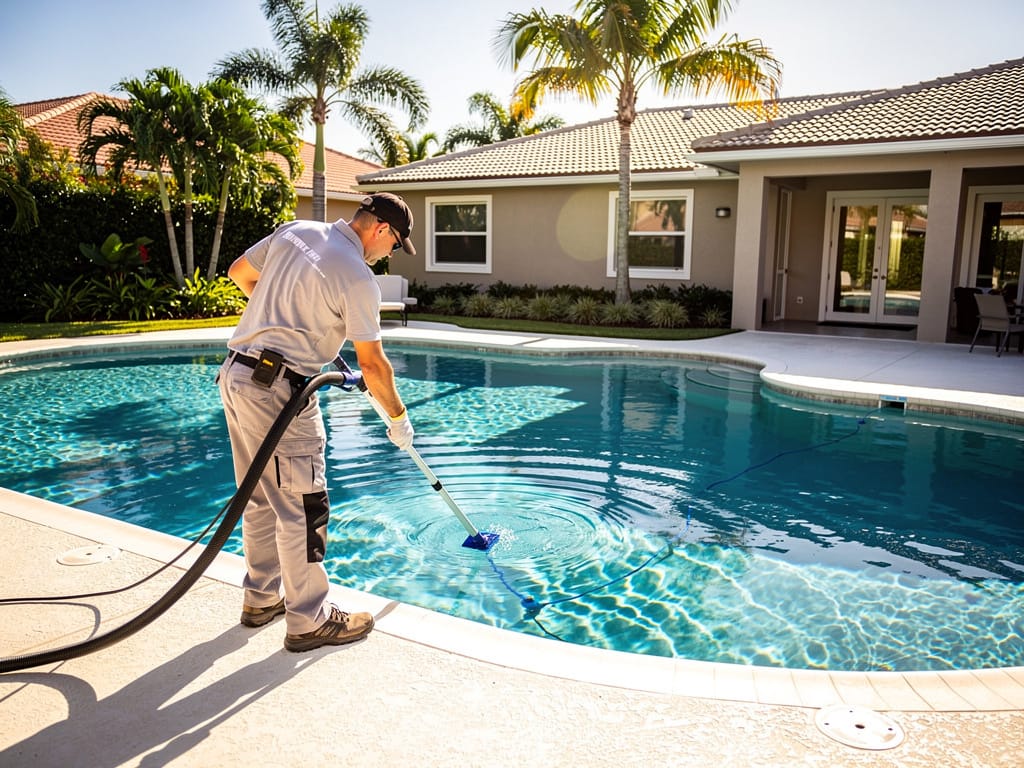
A proper weekly service visit in Coral Springs isn’t just “throw some chlorine in and go.” A thorough visit includes:
- 5-point water test: pH (target 7.4–7.6), free chlorine (2–4 ppm), total alkalinity (80–120 ppm), calcium hardness (200–400 ppm), CYA/stabilizer (30–50 ppm)
- Surface debris removal: Skimming leaves, insects, and surface debris
- Wall and step brushing: Prevents algae attachment — must be done even if pool looks clear
- Floor vacuuming: Manual or automatic; removes settled debris
- Filter check: Pressure readings; backwash or clean when indicated
- Equipment inspection: Pump flow, motor noise, timer settings, lights, salt cell, automation
- Chemical adjustment: Add appropriate chemicals based on test results
This process takes 45–75 minutes for a standard Coral Springs residential pool. If your technician is at your pool for 10–15 minutes, something is being skipped.
Special Considerations for Coral Springs HOA Communities
Many Coral Springs neighborhoods — including Winding Trail, Eagle Trace, and Heron Bay — are heavily HOA-governed. Pool appearance is often mentioned in HOA community rules, and some communities have formal inspection programs for pools visible from common areas or neighboring properties. An algae bloom is not just a chemistry problem in these communities — it can generate an HOA notice of violation.
Professional weekly service eliminates HOA pool compliance concerns entirely. Service reports document that your pool is maintained to standard, providing written evidence if you ever need to respond to a complaint.
How Often Should You Add Chemicals Between Service Visits?
If your pool is professionally serviced weekly, you typically should not need to add chemicals between visits under normal conditions. Exceptions include:
- Hosting a large pool party (heavy bather load in one day)
- Significant rain event that dilutes chemicals (1″+ in 24 hours)
- Visible cloudiness appearing before the next scheduled visit
In these cases, adding chlorine tabs or liquid chlorine as a stop-gap is appropriate. Call your pool company if the issue persists — between-visit problems are often signs of an underlying chemistry or equipment issue that needs attention.
For professional weekly pool service in Coral Springs, FL, Fort Lauderdale Pool Service provides year-round maintenance including detailed service reports after every visit. Learn more at our Coral Springs pool service page or call (954) 501-2754.
Frequently Asked Questions: Pool Service Frequency in Coral Springs, FL
Can I do bi-weekly pool service in Coral Springs to save money?
In South Florida, bi-weekly service almost always results in algae growth between visits during warmer months (April–October). The cost of one algae treatment ($150–$350) typically exceeds months of savings from reduced service frequency. Weekly service is the most economical option in Coral Springs’s climate.
Does my Coral Springs pool need service in winter?
Yes. Coral Springs water temperatures in December–February average 65–72°F — warm enough for algae growth. Rain dilutes chemicals year-round, and equipment needs consistent monitoring. Weekly service year-round is appropriate for all Coral Springs pools, though some providers offer modest winter pricing adjustments.
How quickly can a pool turn green in Coral Springs?
In peak summer heat (July–September), a Coral Springs pool with depleted chlorine can show visible algae growth within 48–72 hours. A fully neglected pool can turn from clear to bright green in 4–5 days. This is why weekly professional service — not bi-weekly — is the standard in South Florida.
What chemical levels should my Coral Springs pool maintain?
Ideal Coral Springs pool chemistry: pH 7.4–7.6, free chlorine 2–4 ppm, total alkalinity 80–120 ppm, calcium hardness 200–400 ppm, cyanuric acid (CYA) 30–50 ppm. In summer heat, free chlorine can drop faster — your service technician should be adjusting based on test results at every visit, not using a fixed chemical quantity.
How long does a proper weekly pool service visit take?
A thorough weekly service on a standard Coral Springs residential pool (15,000–20,000 gallons) should take 45–75 minutes. This includes surface skimming, wall brushing, floor vacuuming, full 5-point water test, chemical adjustment, filter check, and equipment inspection. Visits under 20 minutes indicate shortcuts being taken.