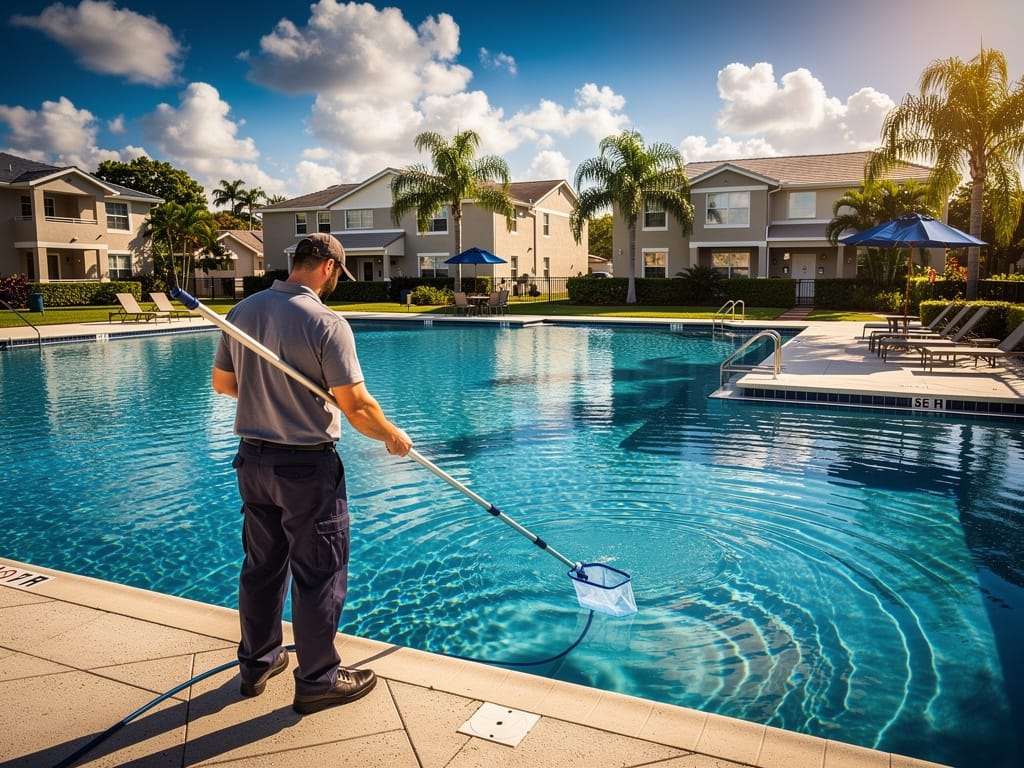
Quick Answer: HOA and condo pool service in Lauderhill, FL must satisfy Florida Department of Health semi-public pool requirements — including chemistry documentation on-site after every service visit, specific free chlorine and pH compliance ranges, and availability for Broward County Health Department inspection at any time. Lauderhill’s high HOA density, particularly in planned communities like Inverrary and throughout the city’s numerous condominium buildings, makes this one of the most common pool service scenarios in the city.
Lauderhill has one of the higher HOA and condominium concentrations in central Broward County. The Inverrary planned community in the northwest part of the city, the numerous condominium buildings along SR-7 and throughout the residential fabric of the city, and the townhome and planned unit developments throughout Lauderhill all represent HOA pool service clients whose service requirements go significantly beyond what a standard residential pool service contract covers.
Florida DOH Requirements for Lauderhill HOA Pools
What Florida Law Requires
Under Florida Statutes Chapter 514 and the Florida Administrative Code, HOA and condo common-area pools in Lauderhill are regulated as semi-public swimming pools. Broward County Health Department enforces these standards locally. Key requirements:
- Free chlorine: Minimum 1.0 ppm at all times (or 3.0 ppm bromine as an alternative sanitizer)
- pH: 7.2–7.8 (documented at each service visit)
- Combined chlorine (chloramines): Must not exceed 0.2 ppm per 1.0 ppm free chlorine — a swimmer comfort and safety threshold
- Chemistry logs: Must be maintained on-site, showing readings from each service visit with date, parameter values, and technician identification
- Safety equipment: Ring buoys, shepherd’s hook, first aid kit, appropriate depth markings, and no-diving signage where required
- Pool closure authority: Broward County Health Department inspectors can require immediate pool closure for chemistry out of compliance, missing safety equipment, or incomplete documentation
What Happens During a Broward County Health Department Inspection
Inspectors arrive unannounced. They will: test the water chemistry directly (with their own test kit), review the on-site chemistry log for completeness, inspect safety equipment, and check the pool area for general sanitation. If they find chemistry out of range, safety equipment missing, or logs incomplete, they have authority to close the pool immediately pending corrective action. A pool that is closed by the health department is an immediate issue for the HOA board — residents lose use of the amenity, and the board has a compliance liability to address.
What HOA Boards in Lauderhill Should Require From Their Pool Service Company
Chemistry Documentation at Every Visit
The most important deliverable. Written records showing date, time, all chemistry parameters tested (free chlorine, pH, total alkalinity, calcium hardness, combined chlorine), chemicals added with quantities, and technician name and license number. These records must be physically on-site at the pool (in a binder at the equipment room or pool area), not just in the service company’s database. Inspectors expect to find them at the pool, not request them from the company later.
Consistent, Named Technician
HOA management companies and property managers in Lauderhill consistently prefer a named technician for their accounts — both for relationship continuity and for DOH compliance (the technician who signed the chemistry log is the person accountable for that service visit). Insist on this as a contractual term; service companies that resist are telling you something about how they manage routes.
CPO Certification
The Certified Pool Operator (CPO) credential from PHTA is required by many Lauderhill HOA bylaws and condo association insurance policies. This is separate from the company’s CPCO contractor license — it’s a competency certification for the technician performing the service. Confirm whether your governing documents or insurance specify this requirement before finalizing a service vendor selection.
For HOA and condo pool service in Lauderhill, FL — Inverrary, SR-7 corridor communities, and all Lauderhill HOA developments — call Fort Lauderdale Pool Service at (954) 501-2754 or see our Lauderhill service page.
Frequently Asked Questions
What does Florida law require for HOA pool maintenance in Lauderhill?
Florida Statutes Chapter 514 requires: free chlorine ≥ 1.0 ppm, pH 7.2–7.8, combined chlorine within 0.2 ppm per 1.0 ppm free, chemistry logs maintained on-site and available for inspection, and safety equipment (ring buoy, hook, first aid kit, appropriate signage) in place. Broward County Health Department inspects HOA pools unannounced and can close non-compliant pools immediately.
What happens if our Lauderhill HOA pool fails a health department inspection?
The inspector may require immediate pool closure until chemistry is corrected and documented by a licensed technician. The pool remains closed until the technician completes remediation and signs off. For a Lauderhill HOA with multiple buildings using a common pool, closure means immediate resident complaints and management liability. Same-day emergency service from your pool company is required — which is why your service contract should include a named emergency contact and defined response time, not just a general business number.
Does our Lauderhill HOA pool need a CPO-certified service technician?
Check your HOA’s governing documents and your condo association’s insurance policy. CPO (Certified Pool Operator from PHTA) is an operator-level competency credential that many Florida HOA bylaws and insurance policies require for common-area pool service. This is separate from the service company’s CPCO contractor license — it applies to the individual technician assigned to your property. If required, confirm the assigned technician’s CPO certification, not just the company’s general credential claims.
How does a Lauderhill HOA board change pool service companies?
Three steps: (1) board vote per HOA bylaws — confirm the required approval threshold; (2) vendor evaluation and selection — verify CPCO license, insurance certificate (with HOA as additional insured), CPO certification if required, and references from comparable Lauderhill or Broward HOA properties; (3) written service agreement with scope, frequency, documentation requirements, and emergency response terms specified. Plan 3–4 weeks from board decision to new service start, including notice to the existing vendor per your current contract’s termination terms.
Where should our Lauderhill HOA pool’s chemistry logs be kept?
On-site at the pool — physically present in the pool area or equipment room, accessible without contacting the service company. Florida DOH inspectors expect to find chemistry records at the pool during an inspection. Records stored in the service company’s online system, in the property manager’s office, or available “upon request” from the service provider do not satisfy the on-site documentation requirement. Establish with your service company where exactly the records will be stored on-site and confirm this arrangement in writing in the service agreement.