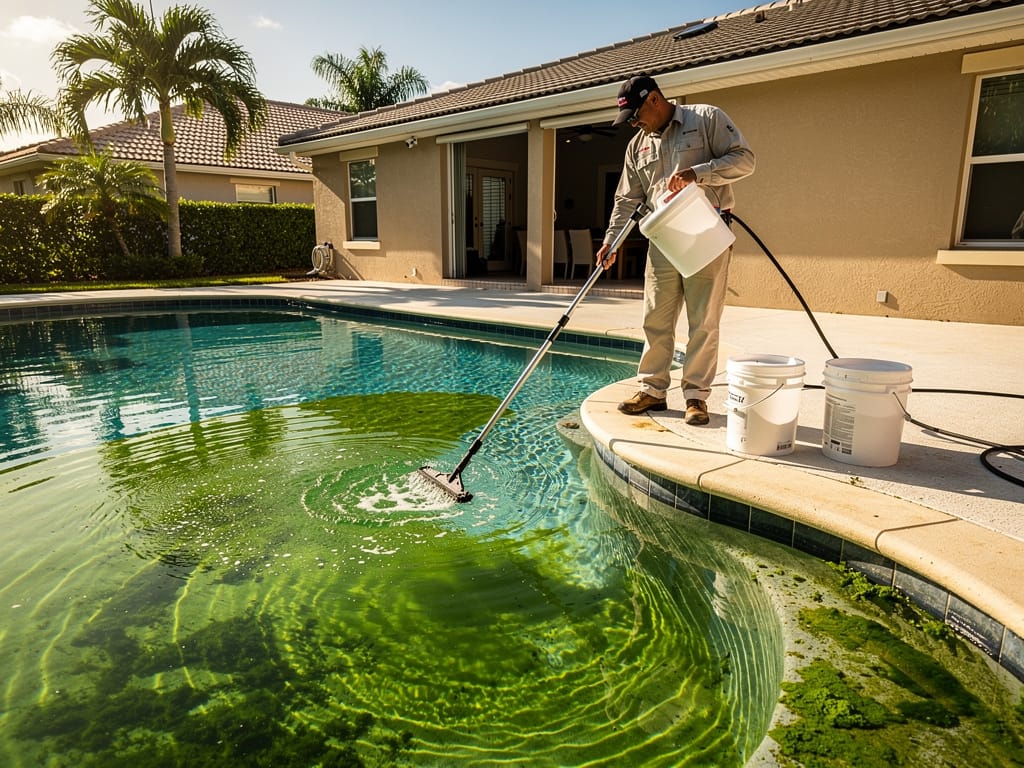
Green Pool Recovery in Sunrise — Chemistry, HOA Visibility, and Prevention
In Sunrise’s active HOA communities, a green pool isn’t just a chemistry problem — it’s a visible compliance issue in a city where property appearance standards are monitored and enforced. Understanding what causes green pools in Sunrise’s diverse pool stock, what recovery involves, and why prevention is the correct investment for this market provides the full picture for Sunrise homeowners evaluating their pool service options.
Why Sunrise Pools Go Green — A Multi-Cause Market
Wet Season Chemistry Disruption
South Florida’s June-October wet season is the primary green pool season for Sunrise. The combination of daily rainfall that dilutes chemistry, 84-90°F water temperatures, and UV index consistently at 10-11 creates conditions where algae can establish in a pool within 48-72 hours of chlorine depleting below effective levels. A pool that has 2 ppm free chlorine on Monday can show visible green tinge by Thursday after three significant afternoon storms — each diluting the chlorine dose from the previous service visit.
Stabilizer Lock in Older Sunrise Neighborhoods
Sunrise’s older neighborhoods — particularly those closer to Plantation and Lauderhill where homes were built in the 1980s and 1990s — have a specific green pool risk pattern driven by CYA accumulation. Many of these pools have used trichlor chlorine tablets for years, each tablet adding a small dose of cyanuric acid stabilizer along with the chlorine. Over time, without periodic draining, CYA can accumulate to 80-150 ppm — well above the 30-50 ppm target that provides UV protection without interfering with chlorine effectiveness.
Above 80 ppm, CYA binds so much of the available chlorine that the pool’s effective sanitizer level drops dramatically even when the free chlorine reading appears adequate. A pool testing at 2-3 ppm free chlorine with 100 ppm CYA has roughly the same effective sanitizer as a pool with 0.3-0.5 ppm free chlorine and no CYA — far below the threshold needed to prevent algae. This condition — stabilizer lock — produces green pools that don’t respond to standard shock treatment, confusing homeowners who add chlorine and see no improvement. The only resolution is partial drain-refill to dilute CYA below 70 ppm.
Phosphate Loading Near Mature Landscaping
Sunrise’s older neighborhoods with mature trees and established landscaping have higher phosphate input to pools than newer developments. Phosphates enter from leaf decomposition, lawn fertilizer runoff, and organic material tracked in on feet. At levels above 100-200 ppb, phosphates provide the nutrient base that allows algae to establish at lower chlorine depletion thresholds than a phosphate-free pool. Persistent algae problems in Sunrise pools that respond to shock but return within a week often have elevated phosphate as an underlying contributor.
HOA Visibility Factor in Sunrise
Sunrise’s strong HOA communities add a dimension to green pool events that doesn’t exist in less organized markets: compliance timeline pressure. A green pool noticed by an HOA compliance officer generates a written notice with a correction deadline. In Sunrise’s active HOA communities, this deadline is typically 5-14 days — short enough that the homeowner must immediately engage a pool professional to recover the pool within the compliance window, often paying emergency service pricing rather than standard rates.
The comparison: weekly professional service ($110-$165/month), green pool recovery treatment ($175-$350), potential HOA fine ($50-$200 first offense, escalating), and the social visibility of a non-compliant pool in a community where neighbors notice. For Sunrise HOA homeowners, the prevention math strongly favors consistent professional maintenance.
Fort Lauderdale Pool Service provides green pool recovery and preventive weekly maintenance throughout Sunrise. Contact us for a service assessment.