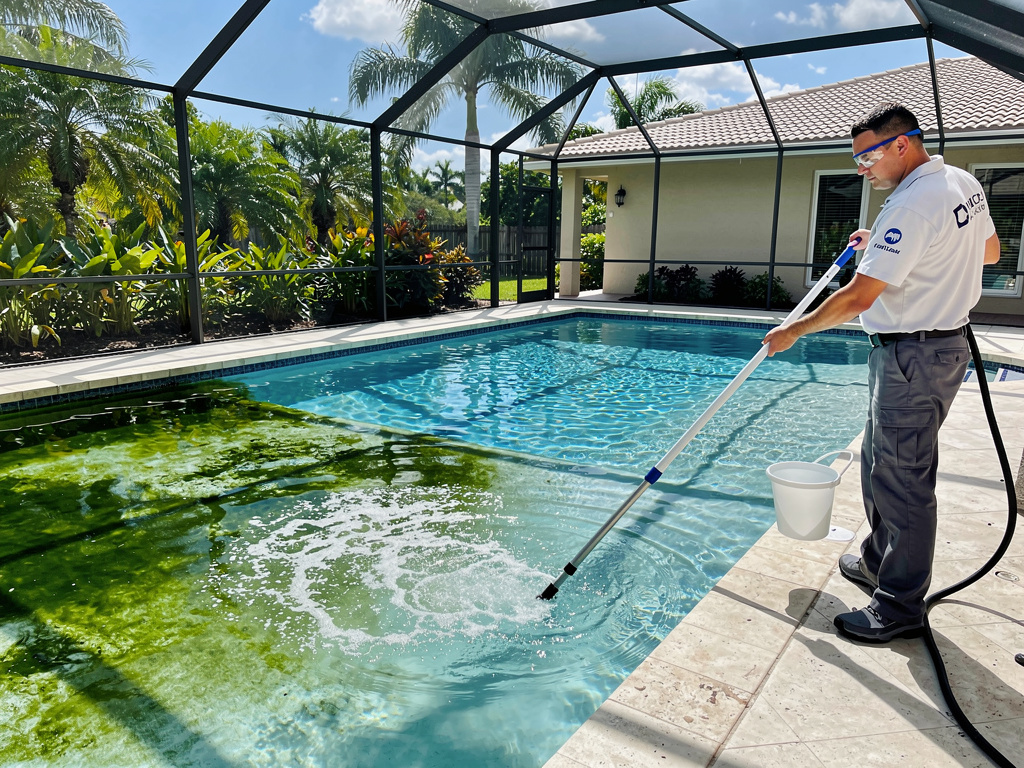
Green Pool Recovery in Davie — Diagnosing the Equestrian Capital’s Most Common Problem
Green pools are a recurring challenge throughout South Florida, but in Davie’s equestrian zones, the green pool problem has a specific character: standard shock treatment that clears suburban pools within 48-72 hours often fails to produce lasting results on Davie horse-property pools. The pool clears temporarily, then goes green again within a week. More shock is applied. The cycle repeats. This pattern is the diagnostic signature of phosphate-driven algae — and it’s the most common green pool presentation in Davie’s equestrian areas.
Why Davie Equestrian Pools Don’t Respond to Standard Shock
Calcium hypochlorite shock at the standard 2-4 lbs per 10,000 gallons kills algae by direct oxidation — it works effectively when the pool has normal phosphate levels and CYA is within the 30-80 ppm operating range. When phosphate levels are 500-1,500 ppb (typical of active Davie horse properties), the shock kills the visible algae bloom — the pool temporarily clears — but the phosphate nutrient that enabled the bloom remains in the water at full concentration. Within 3-7 days, algae spores that survived or re-entered through airborne introduction find a phosphate-rich environment and begin growing again. The cycle repeats indefinitely until phosphate is addressed.
The correct treatment sequence for Davie equestrian pools with suspected phosphate-driven algae: test phosphate first (reagent kit or professional test), apply lanthanum-based phosphate remover and run filter to remove precipitated phosphate-remover complex, confirm phosphate below 200 ppb, then apply shock and algaecide. This sequence takes 2-3 days longer than standard shock treatment but produces lasting results because it addresses the cause rather than the symptom.
CYA Lock: The Other Davie Green Pool Cause
Davie’s older suburban neighborhoods — particularly properties near the Plantation border built in the 1980s and 1990s — have a different green pool risk: CYA stabilizer accumulation from years of trichlor tablet use. Above 80 ppm CYA, so much chlorine is bound by the stabilizer that the pool’s effective sanitizer level drops to a fraction of the measured free chlorine. A pool testing at 2.5 ppm free chlorine with 120 ppm CYA has roughly equivalent sanitizing power to a pool with 0.3 ppm free chlorine and no stabilizer — well below what prevents algae growth.
CYA lock mimics phosphate-driven algae in its resistance to shock treatment: the pool shows measured chlorine but can’t maintain sanitation. The diagnostic is a proper CYA test — standard two-parameter test strips don’t include CYA. Resolution requires partial drain to dilute CYA below 70 ppm, chemistry re-establishment from the lower CYA baseline, and transition to liquid chlorine for ongoing maintenance to prevent CYA re-accumulation from trichlor tablets.
Fort Lauderdale Pool Service provides green pool recovery and preventive weekly maintenance throughout Davie, with phosphate testing and CYA management as standard elements of service for equestrian-zone properties. Contact us for a service assessment.