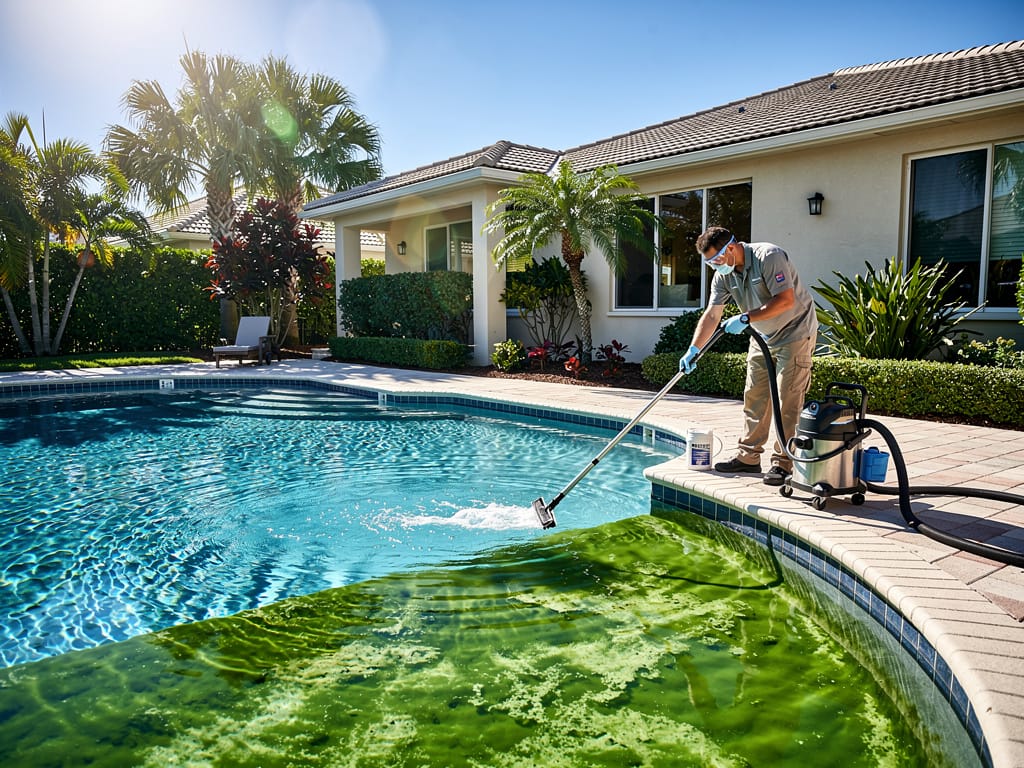
Quick Answer: Green pool recovery in Coral Springs, FL takes 3–7 days depending on severity. A mildly green pool (early algae, some visibility) typically clears in 24–48 hours with proper shock treatment and brushing. A severely green or black pool requires 3–7 days of intensive treatment, multiple filter backwashes, and follow-up chemistry adjustment. Total recovery cost: $150–$400.
If you’ve ever looked out at your Coral Springs pool and discovered it’s turned green, you know the feeling — somewhere between frustration and dread. The good news: green pool recovery is a defined, well-understood process with predictable timelines. The bad news: there are no shortcuts that work, and attempting to rush the process almost always prolongs it. Here’s the complete, honest guide to green pool recovery in Coral Springs.
Why Pools Turn Green in Coral Springs
Green pool water means algae — specifically, a bloom of green algae that has established itself in your pool water and on pool surfaces. In Coral Springs, this happens fast because of the climate:
- Water temperature: Algae growth accelerates exponentially above 78°F. Coral Springs pool water averages 82–92°F from May through October — ideal conditions for algae to multiply rapidly.
- Chlorine depletion: South Florida’s UV intensity burns through chlorine faster than anywhere in the continental US. A pool that loses 1–2 ppm of free chlorine daily (typical in summer) can drop to zero chlorine within 2–3 days if chemicals aren’t topped off.
- Rain events: A heavy rain dilutes pool chemicals significantly, dropping chlorine levels and raising pH simultaneously — a double hit that creates perfect algae conditions. West Broward County receives average annual rainfall of 62 inches, with peak rainfall June–September coinciding with peak heat.
- Missed service visit: Even one missed weekly service visit during summer months can be enough to start an algae bloom in a Coral Springs pool.
Assessing Severity: Which Stage Is Your Pool In?
Green pool recovery timeline depends heavily on the severity of the algae bloom. Professionals categorize green pools in three stages:
Stage 1: Light Green (Early Algae)
Appearance: Water has a light green or blue-green tint. You can still see the pool floor clearly. Algae is present in the water column but not yet anchored heavily to walls.
Recovery time: 24–48 hours with proper treatment
Typical cost: $150–$200
Stage 2: Medium Green (Established Algae)
Appearance: Pool is clearly green. You can see the floor to a depth of 1–3 feet but not the deep end. Algae is visible on walls and steps.
Recovery time: 3–5 days
Typical cost: $200–$300
Stage 3: Dark Green or Black (Severe Algae)
Appearance: Water is opaque green or black. Floor is not visible at any depth. Algae is heavily established on all surfaces, potentially including black algae (the most difficult to treat).
Recovery time: 5–10 days; may require partial or full drain
Typical cost: $300–$600 (or more if drain/acid wash is needed)
The Green Pool Recovery Process: Step by Step
Professional green pool recovery in Coral Springs follows this sequence:
Step 1: Test the Water
Before adding any chemicals, a thorough 5-point water test determines current pH, chlorine, alkalinity, calcium hardness, and CYA levels. This is critical — shocking a pool with high pH (above 7.8) is ineffective because chlorine’s sanitizing power drops dramatically at high pH. Any pH adjustment must happen before shock treatment.
Step 2: Adjust pH to 7.2
Lower pH slightly below the normal range (7.4–7.6) to 7.2 before shocking. At pH 7.2, chlorine (hypochlorous acid) is approximately 63% in its active form. At pH 7.8, that drops to 24%. The pH adjustment is not optional — it’s what makes the shock work.
Step 3: Shock Treatment
A green Coral Springs pool typically requires 3–10 times the normal chlorine dose, depending on severity. For a Stage 1 pool: 1–2 lbs of calcium hypochlorite shock per 10,000 gallons. For Stage 3: significantly more, plus follow-up doses over multiple days. The pool must be shocked in the evening (not during the day when UV burns off the unstabilized shock before it can work).
Step 4: Brush Thoroughly
Every surface of the pool must be brushed — walls, steps, corners, behind ladders, around return jets. Brushing breaks algae loose from surfaces and brings it into the water column where the chlorine can kill it. This step must be repeated daily during recovery. Many homeowners skip brushing or do it half-heartedly, which is the #1 reason green pool recoveries take longer than necessary.
Step 5: Run the Pump Continuously
During recovery, the pump should run 24 hours a day. Continuous circulation distributes the shock treatment throughout the pool and continuously passes water through the filter, removing dead algae.
Step 6: Backwash or Clean the Filter
As dead algae clogs the filter, pressure rises. The filter must be backwashed (for sand/DE filters) or cleaned (for cartridge filters) when pressure rises 8–10 psi above the clean baseline, which during active recovery may be once or twice per day. A clogged filter stops the recovery process.
Step 7: Follow-Up Treatment (Days 2–5)
Return daily to test chlorine (it will drop rapidly as it kills algae), add maintenance doses of shock, and brush again. The pool transitions from green → murky yellow-green → cloudy white → clearing → clear as dead algae is removed from the water.
Step 8: Final Chemistry Balance
Once the pool is clear, all 5 chemistry parameters are adjusted back to normal ranges and the pool is cleared for swimming.
When a Pool Drain is Necessary
In severe Stage 3 cases — particularly pools with established black algae — a professional drain and acid wash may be the faster, more reliable option. Signs that indicate drain-and-wash over in-water treatment:
- Black algae visible on plaster or tile surfaces (dark spots that don’t respond to brushing)
- Pool has been green for more than 2 weeks
- Very high CYA (cyanuric acid above 100 ppm) from over-stabilization, which renders chlorine ineffective at normal doses
- Multiple failed shock treatments with no visible improvement
An acid wash removes algae and staining from pool plaster and resets the surface. Cost in Coral Springs: $350–$600 for drain, acid wash, and refill. Pools should not be drained without professional oversight in South Florida — the water table pressure can damage an empty pool shell.
Preventing the Next Green Pool
The most cost-effective green pool recovery is the one you prevent:
- Never let free chlorine drop below 2 ppm — this is the effective threshold in FL heat
- After any significant rain event, add supplemental chlorine same-day
- Maintain CYA at 30–50 ppm year-round (higher in summer to protect against UV)
- Keep weekly service appointments — don’t skip during vacation; arrange coverage
- Brush pool walls weekly even when the pool looks clean
For green pool recovery and ongoing maintenance in Coral Springs, FL, call Fort Lauderdale Pool Service at (954) 501-2754. We service Coral Springs and all of West Broward County.
Frequently Asked Questions: Green Pool Recovery in Coral Springs
How long does green pool recovery take in Coral Springs, FL?
Recovery time depends on severity. A lightly green pool (early algae) typically clears in 24–48 hours. A moderately green pool takes 3–5 days. A severely green or black pool may take 5–10 days or require draining. Continuous pump operation, daily brushing, and proper chemical dosing at each stage are what determine the timeline.
How much does green pool treatment cost in Coral Springs?
Professional green pool recovery in Coral Springs typically costs $150–$350 for in-water treatment depending on severity. Severe cases requiring drain and acid wash run $350–$600. This does not include the cost of follow-up weekly maintenance, which should resume immediately after recovery to prevent recurrence.
Can I swim in a green pool?
No. Green pool water indicates active algae and typically zero or near-zero free chlorine. This creates conditions for bacteria including E. coli and Pseudomonas to thrive. Green pool water can cause eye infections, ear infections, skin irritation, and gastrointestinal illness. Do not swim until the pool is fully clear and chemistry is confirmed balanced.
Why did my pool turn green after a rainstorm in Coral Springs?
Rain dilutes pool chemicals — particularly chlorine and alkalinity — while simultaneously introducing organic matter (pollen, dirt, bird droppings) that consumes chlorine. In South Florida, even 1–2 inches of rain can drop free chlorine by 1–2 ppm, which in summer heat can be enough to trigger algae growth within 24–48 hours. After any significant rain, add supplemental chlorine same day.
What is black algae and is it harder to treat than green algae?
Black algae (Cyanobacteria) is significantly more difficult to treat than green algae. It forms a protective outer layer and grows deeply into plaster surfaces, making it resistant to standard shock treatment. Effective treatment requires aggressive brushing with a steel-bristle brush, triple-dose chlorine, algaecide, and often an acid wash to remove the organisms from plaster pores. Black algae that recurs after multiple treatments typically requires a drain and acid wash to eliminate completely.