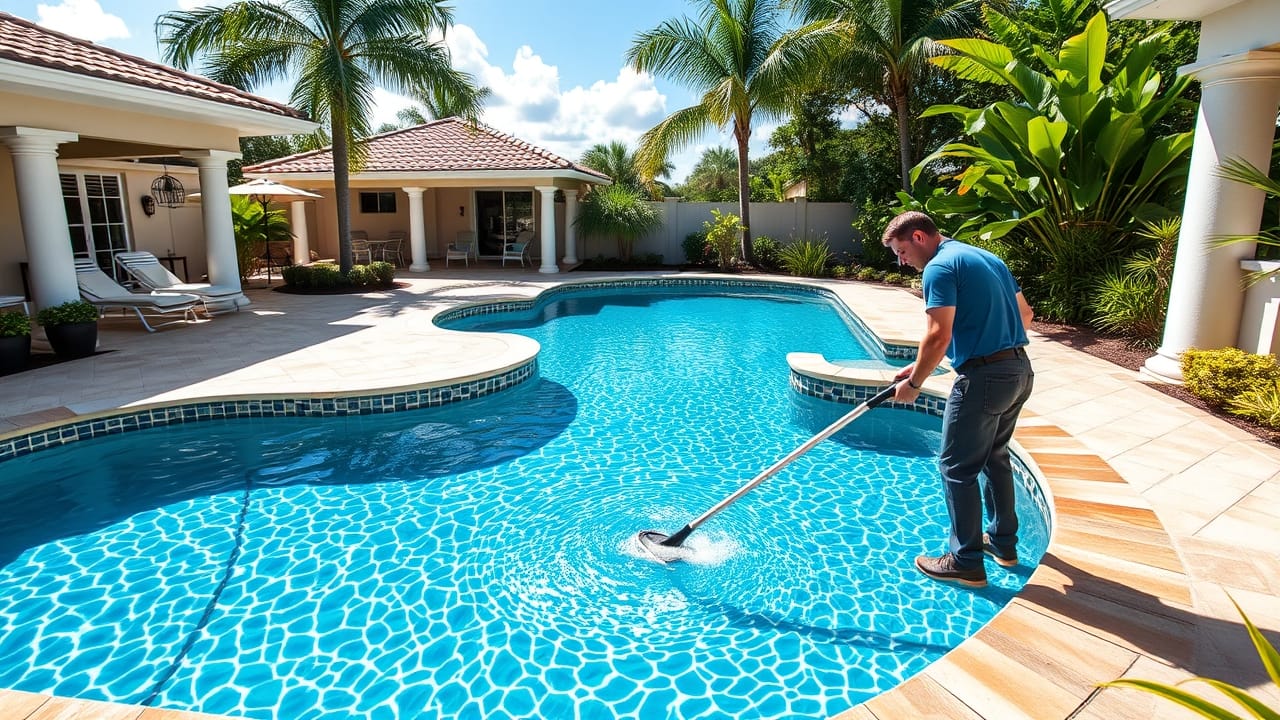
Pompano Beach sits at a unique crossroads for Florida pool ownership. With Atlantic Coast breezes carrying salt air well inland, year-round temperatures that rarely dip below 60°F, and a rainy season stretching from June through October, pools here face a more demanding maintenance environment than virtually anywhere else in Broward County.
Whether you live in Palm Aire, Cypress Bend, Pompano Isles, or one of the city’s many Intracoastal communities, keeping your pool clean, balanced, and equipment-sound requires a consistent, professional approach. This guide walks through everything you need to know: what weekly service covers, how Pompano Beach’s climate and neighborhoods create distinct challenges, what repairs to watch for, how to navigate HOA requirements, and how to choose a pool company you can trust year-round.
For homeowners ready to schedule professional Pompano Beach pool service, this guide explains exactly what to expect and what questions to ask.
Why Pompano Beach Pools Need Year-Round Professional Service
Pompano Beach’s location directly on the Atlantic Coast gives it a true tropical climate rather than the subtropical conditions seen further inland. That distinction matters significantly for pool owners.
The city averages 63 inches of rainfall per year, heavily concentrated between June and October. During these months, a single heavy afternoon storm can drop enough water into a pool to lower total alkalinity by 15–20 ppm, dilute sanitizer levels, and shift pH toward neutral — all within hours. Without same-week service to correct the imbalance, that disruption becomes a green or cloudy pool by the weekend.
Salt air is the second defining factor. Pompano Beach’s oceanfront position means salt-laden air reaches neighborhoods well inland, including Palm Aire and McNab Park. This ambient salinity accelerates corrosion of pump housings, filter bands, heater heat exchangers, and electrical connections faster than you’d see in a more inland Broward city. Salt air also deposits mineral residue on tile and waterline surfaces at an elevated rate.
UV intensity is the third driver. With UV index regularly hitting 10–11 from April through October, chlorine degrades aggressively. Pools in Pompano Beach without adequate cyanuric acid stabilizer can lose 90% of their free chlorine in a single day of direct sunlight. Even properly stabilized pools require more frequent chemical monitoring than pools in northern states.
Finally, Pompano Beach pools are in active use 12 months a year. Because there is no true off-season, pumps, filters, and heaters run continuously — meaning wear and failure rates are higher than in seasonal markets. Annual equipment inspections are not optional here; they are the baseline.
Pompano Beach Neighborhoods and Pool Service Considerations
Pompano Beach’s diverse neighborhoods each bring distinct pool maintenance considerations. Understanding your neighborhood’s specific conditions helps set the right service expectations.
Palm Aire
One of Pompano Beach’s largest planned communities, Palm Aire includes thousands of homes — many governed by the Palm Aire Community Association. Pool owners here frequently need to maintain written documentation of regular professional service for HOA compliance. The community’s mix of single-family homes and villas means pool sizes vary widely, from compact plunge pools to full-length lap pools. Palm Aire’s interior location reduces direct salt air exposure somewhat, but summer humidity still drives significant algae pressure.
Pompano Isles and Intracoastal Communities
Pompano Beach’s Intracoastal waterway communities — including Pompano Isles and the waterfront finger lots extending east toward the ocean — face the highest salt air exposure in the city. Homes within blocks of saltwater require more frequent equipment inspections and calcium hardness monitoring to prevent scaling caused by evaporative salt concentration.
Cypress Bend
This planned community in western Pompano Beach typically features newer construction with modern pool equipment. Cypress Bend’s active HOA still requires documentation of professional service for compliance during routine inspections, and the community’s dense landscaping introduces higher-than-average organic debris loads into pools.
Collier City and Coral Heights
These established central-city neighborhoods include a high proportion of older pools — many built in the 1970s and 1980s. Aging plaster surfaces, older single-speed pumps, and outdated filter systems are common. Pool companies servicing these areas need experience with legacy equipment and resurfacing assessment.
McNab Park and Cresthaven
Mature trees throughout McNab Park and Cresthaven elevate bather load with organic debris — leaves, flowers, and seed pods that challenge filtration and raise phosphate levels, which in turn feed algae growth. Weekly brushing and phosphate control are particularly important in these neighborhoods.
Sample Road Corridor
Communities along Sample Road (NW 48th Street) represent some of Pompano Beach’s most active residential areas. These pools benefit from cost-effective weekly maintenance plans that emphasize consistency over premium add-ons.
What Professional Pool Service in Pompano Beach Includes
A comprehensive weekly pool service visit in Pompano Beach covers a defined set of tasks. Understanding what these are — and holding your service company to them — protects your investment.
Water Testing and Chemical Adjustment
Every visit should begin with a full water chemistry test: free chlorine, combined chlorine, pH, total alkalinity, calcium hardness, and cyanuric acid. In Pompano Beach’s climate, all six parameters require weekly attention. A professional technician adjusts chemicals based on test results — not by applying a flat dose of chemicals regardless of actual readings.
Skimming and Surface Cleaning
Surface skimming removes leaves, insects, pollen, and debris before it sinks and decomposes. In neighborhoods with mature landscaping, this step takes longer and demands thorough coverage of the entire surface.
Brushing Pool Walls and Floor
Brushing disrupts algae biofilm on surfaces before it becomes visible growth. Every visit should include brushing walls, steps, and corners — areas where circulation dead zones allow algae and scale to develop unnoticed.
Vacuuming
Settled debris and fine particulate on the pool floor should be vacuumed weekly. Automatic pool cleaners are acceptable for between-visit maintenance, but they do not replace manual vacuuming on service days.
Basket and Filter Maintenance
Skimmer baskets and pump strainer baskets need to be cleared at each visit to maintain proper flow rate. Filter pressure should be checked weekly; backwashing or cartridge cleaning occurs when pressure rises 8–10 PSI above clean baseline, typically monthly.
Equipment Inspection
A trained technician should visually inspect the pump, filter, heater, and chlorinator at each visit. Early detection of worn seals, clogged impellers, or salt cell scaling prevents small issues from becoming expensive emergency repairs.
Service Documentation
Every visit should be documented with chemistry readings before and after treatment, tasks performed, chemicals added, and any equipment observations. This record protects homeowners from disputes and provides HOAs with proof of compliance.
Common Pool Repairs in Pompano Beach
Pompano Beach’s marine environment and year-round pool use accelerate wear on equipment and surfaces. These are the most common repair needs in the area.
Pump Repairs and Replacement
Pump shaft seals fail more quickly in high-humidity, salt-air environments. A failing seal causes shaft leaks that, left unaddressed, allow water into the motor and lead to complete motor failure. Florida law now requires replacement pumps over 1 horsepower to be variable-speed models — and these units offer 60–80% energy savings over single-speed equivalents, typically paying for themselves within 18–24 months.
Filter Repairs
Sand filter media lasts 5–7 years before channeling reduces effectiveness. D.E. (diatomaceous earth) filter grids in heavily loaded Pompano Beach pools — where bather count and organic debris are high — may need replacement every 5–7 years. Cartridge filters in smaller pools need element replacement roughly every 1–2 years depending on load.
Heater Issues
Gas and heat pump pool heaters face accelerated corrosion of heat exchanger components in Pompano Beach’s salt air. Heat pump units — increasingly preferred for energy efficiency — can develop refrigerant issues, coil corrosion, and compressor failures. Annual inspections catch developing problems before complete failure during swimming season.
Saltwater Chlorine Generator Maintenance
Saltwater pools are popular in Pompano Beach for their comfort and reduced chemical handling. Salt chlorine generator cells require regular acid washing to remove calcium scale and periodic full replacement, typically every 3–7 years depending on run time and water chemistry quality.
Pool Resurfacing
Older plaster surfaces — common in Pompano Beach homes built before 2000 — develop calcium nodules, etching, and staining from ongoing mineral exposure. Resurfacing with new plaster, pebble finish, or quartz aggregate is typically required every 10–15 years.
Pool Chemical Balancing in Broward’s Subtropical Climate
Chemical balance in Pompano Beach requires active weekly management. Here are the core parameters and their specific Pompano Beach considerations.
Free Chlorine (2.0–4.0 ppm)
The primary sanitizer. Rapidly depleted by intense UV exposure and high bather loads. Must be stabilized with cyanuric acid (CYA) at 30–50 ppm to slow UV degradation.
pH (7.2–7.6)
Heavy rain drives pH toward the acidic range, requiring sodium carbonate additions after significant storm events. Heavy aeration from waterfalls or jets raises pH over time; this is common in Pompano Beach pools with water features.
Total Alkalinity (80–120 ppm)
Acts as a pH buffer. Rain dilution is the primary disruptor in Pompano Beach. Weekly monitoring catches alkalinity drift before it destabilizes pH and creates corrosive or scaling conditions.
Calcium Hardness (200–400 ppm)
Pompano Beach municipal water has moderate calcium levels, but summer evaporation concentrates calcium and pushes pools toward scaling on tile, surfaces, and in heater heat exchangers. Regular monitoring prevents costly calcium carbonate buildup.
Cyanuric Acid (30–50 ppm)
Essential in South Florida. Without stabilizer, outdoor pools lose nearly all chlorine effectiveness within hours of direct sun exposure. Cyanuric acid levels above 80 ppm begin to inhibit chlorine effectiveness — dilution or partial drain may be needed if CYA accumulates excessively.
Phosphate Control
Phosphates from fertilizer runoff, organic debris, and fill water feed algae. Testing and treating elevated phosphate levels is standard practice for Pompano Beach pools, particularly those in landscaped communities where lawn irrigation introduces regular phosphate loading.
HOA Pool Requirements in Pompano Beach Communities
Many Pompano Beach homes are governed by HOAs with pool maintenance requirements that extend beyond Florida’s baseline safety regulations. Understanding and documenting compliance protects you from fines and neighbor disputes.
Documentation Requirements
Larger communities like Palm Aire and Cypress Bend may require written service logs as part of periodic HOA property reviews. A single inspection failure — typically triggered by a visibly green or cloudy pool — can result in daily fines of $25–$150 under most Broward County HOA agreements. Repeated violations can result in liens. Ask your pool service company for monthly documentation with chemical readings and technician signatures.
Water Clarity Standards
Most Pompano Beach HOAs require pool water to be clear and algae-free, with the bottom of the pool visible from the deck. During rainy season, this standard requires proactive chemistry management rather than reactive response.
Pool Barrier and Safety Compliance
Florida Statute 515 requires at least one approved safety layer for all residential pools: a fence with self-closing, self-latching gate; a pool alarm; an approved safety cover; or door alarms on all home doors that give direct access to the pool area. Many Pompano Beach HOAs require compliance beyond the statutory minimum and inspect annually.
Extended Absence Protocols
If you travel frequently or own a vacation property in Pompano Beach, confirm with your HOA whether pool covers are required during extended absences. Shock treatment and a raised chlorine level before departure help maintain water quality while you’re away.
Hurricane and Storm Season Pool Preparation
Hurricane season runs June through November — overlapping Pompano Beach’s rainy season almost entirely. Having a prepared routine prevents storm-related pool damage and simplifies recovery.
Before a Storm
Lower the pool water level by 3–6 inches to accommodate storm rainfall without overflow onto decking. Do not drain the pool — an empty shell can float out of the ground in saturated South Florida soil. Turn off all pool equipment at the breaker before the storm arrives to prevent surge damage.
Remove all loose items from the pool deck: furniture, umbrellas, pool toys, and accessories become dangerous projectiles in tropical-force winds. Do not apply a non-anchored pool cover — wind can drive debris under improperly secured covers and cause surface damage.
Shock the pool to 10–15 ppm free chlorine before the storm. This pre-treatment addresses the bacterial and organic load that storm rain and windblown debris will introduce.
After a Storm
Clear debris from the pool immediately — organic debris accelerates algae growth dramatically in Pompano Beach’s heat. Shock again after the storm, test all chemistry parameters, and adjust before restarting equipment. Inspect pump, filter, and electrical connections for storm damage before powering back on.
Be patient: post-storm chemical rebalancing in Pompano Beach pools can take 2–3 days of additional treatment and circulation before water fully clears.
How to Choose a Pool Service Company in Pompano Beach
With dozens of pool service companies operating in Broward County, choosing the right one involves asking the right questions upfront.
Licensing and Insurance
Florida requires pool service contractors to hold a Certified Pool/Spa Contractor (CPSC) license through the Florida Department of Business and Professional Regulation. Verify the license is current and confirm the company carries general liability insurance. Both protect you if equipment is damaged or an incident occurs on your property.
Service Transparency
Ask specifically: do I receive a service log after every visit? What does a standard visit include? How are chemical adjustments handled — test-based adjustments or flat weekly dosing? A reputable company provides written documentation without being prompted.
Technician Consistency
Consistency matters more than most homeowners realize. A company that assigns a new technician each week loses continuity of care — the ongoing baseline knowledge of how your specific pool behaves. Ask whether you’ll have a dedicated route technician and what the backup policy is.
Repair Response Time
Ask about typical response times for equipment failures. Companies with full-time repair technicians can usually respond within 24–48 hours for non-emergency equipment issues — critical in a market where pools run year-round.
Transparent Pricing
Monthly pool service in Broward County typically runs $150–$300 depending on pool size, features, and service frequency. Be cautious of significantly below-market pricing — it often reflects reduced service time, under-dosed chemicals, or inadequate equipment attention.
Frequently Asked Questions About Pool Service in Pompano Beach
How often should I have my pool serviced in Pompano Beach?
Weekly service is the standard for residential pools in Pompano Beach. The subtropical climate — intense UV, heavy summer rainfall, and year-round use — creates chemical and biological demands that do not allow for bi-weekly service without visible water quality decline. Some pools with very low bather load and excellent circulation may manage bi-weekly visits during December through February, but weekly service is strongly recommended during Pompano Beach’s rainy season.
What’s the difference between a pool cleaner and a licensed pool service technician?
A pool cleaner often refers to someone who handles surface cleaning and skimming without formal chemical expertise or licensing. A licensed pool service technician both cleans and actively manages water chemistry — testing and adjusting six or more parameters weekly. In Florida, any person charging for pool service work must hold or work under a CPSC license. Always verify licensing before signing a service agreement.
Why does my Pompano Beach pool keep turning green after heavy rain?
Green water after rain is almost always triggered by one of three conditions: diluted sanitizer levels from rainwater, phosphate introduction from runoff, or inadequate circulation allowing algae to establish before chemistry recovers. Pompano Beach’s summer rainstorms are particularly aggressive at disrupting chemical balance. The standard recovery protocol involves shock treatment, phosphate remover if levels are elevated, extended filter run time, and re-established weekly service — followed by improved post-storm monitoring going forward.
How do I know if my pool pump needs repair or replacement?
Warning signs include: reduced water flow from return jets (clogged impeller or failing filter), air bubbles in return jets (air leak on the suction side), unusual grinding or humming from the pump motor (bearing wear), equipment cycling on and off rapidly (flow or pressure switch issue), or noticeably higher electric bills (motor running inefficiently). In Pompano Beach’s salt-air environment, visible corrosion — rust staining, flaking housing, or corroded electrical connections — is also a prompt for professional inspection.
Are saltwater pools lower maintenance than chlorine pools in Pompano Beach?
Saltwater pools reduce the frequency of manual chlorine additions, but they are not lower maintenance overall. The salt chlorine generator (SWG) cell requires regular acid washing to remove calcium scale — typically every 3–4 months in Pompano Beach’s hard-water environment — and cell replacement every 3–7 years. pH in saltwater pools tends to drift higher, requiring more frequent acid additions. Standard chemical parameters still need weekly testing and adjustment. The comfort advantage of saltwater is real; the “no-maintenance” perception is not.
Professional Pool Service in Pompano Beach — Ready to Help
Pompano Beach pools are an extraordinary asset and a real ongoing responsibility. The combination of Atlantic salt air, subtropical rainfall, intense UV, and year-round use puts more demand on pool systems here than in nearly any other residential environment in the country. Weekly professional service isn’t a premium option — it’s the baseline that separates a pool that’s a source of enjoyment from one that becomes a persistent source of cost and frustration.
Our team provides professional Fort Lauderdale pool service across all of Broward County — including Pompano Beach, Hollywood, Weston, Coral Springs, Plantation, and every city in between. We combine licensed technicians, test-based chemical management, and documented service logs to give you the consistency and transparency your pool deserves.
Contact us today for a free pool evaluation and service quote tailored to your home, your neighborhood, and your schedule.