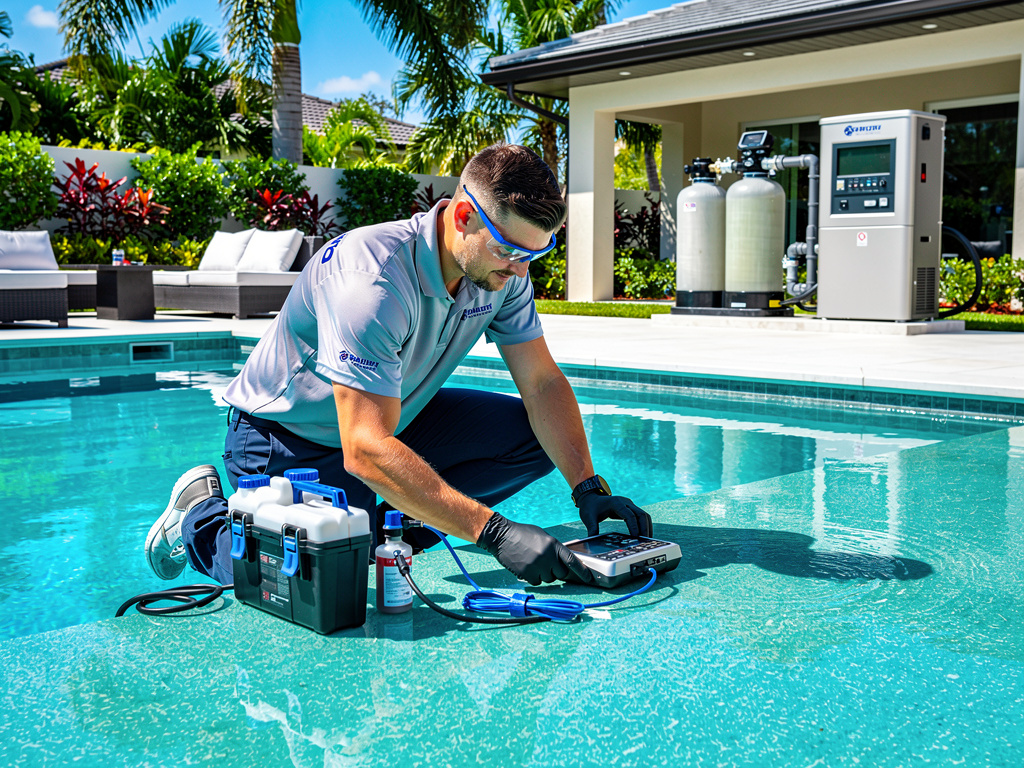
Water Chemistry in Weston FL Luxury Pools
Water chemistry in Weston is not a “set it and forget it” discipline. The city’s sophisticated pool inventory — premium finishes, advanced automation, integrated spas, water features — demands precise chemistry management with tighter tolerances than standard residential pools. Getting it right protects hundreds of thousands of dollars of installation value. Getting it wrong produces etched surfaces, scaling on glass tile, calcium deposits on water features, and equipment corrosion.
Full Chemistry Panel: Weston FL Standard
Every Weston pool should be tested weekly for the complete parameter set:
- Free Chlorine: 1–3 ppm (2–4 ppm for salt pools at high bather load)
- Combined Chlorine: Below 0.2 ppm (higher = chloramines = chlorine smell, skin irritation)
- pH: 7.4–7.6 — critical for both sanitizer effectiveness and surface protection
- Total Alkalinity: 80–120 ppm (buffers pH against rapid swings)
- Calcium Hardness: 200–400 ppm for plaster pools; 175–225 ppm for salt pools
- Cyanuric Acid (CYA): 30–50 ppm for salt pools; 30–80 ppm for tab-chlorinated pools
- Phosphates: Below 100–200 ppb
- Salt Level (if applicable): 2,700–3,400 ppm for most salt chlorinators
Premium Surface Chemistry Requirements
Pebble and Quartz Finishes
Pebble Tec, Pebble Sheen, Diamond Brite, and quartz aggregate finishes — prevalent across Weston’s luxury homes — are more durable than standard marcite but not immune to chemistry damage. Aggressive water (pH below 7.2, calcium hardness below 150 ppm) slowly etches the cement binding the aggregate, causing rough texture and exposing the pebble matrix to staining. Maintaining pH above 7.4 and calcium above 200 ppm is the primary protection for these finishes.
Glass Tile and Waterline Tile
Many Weston pools feature imported glass tile at the waterline, in spa shells, or as full-surface treatments. Glass tile is particularly susceptible to calcium scale — deposits that cloud the tile surface and require acid washing or professional scaling removal to correct. Maintaining calcium hardness in the lower portion of the acceptable range (200–300 ppm) and keeping pH below 7.6 prevents scale formation on glass tile.
Travertine and Natural Stone Decking
Weston’s luxury pools are frequently surrounded by travertine, marble, or natural stone decking. Chemical splashes — particularly acid — etch these surfaces immediately. Professional technicians working in Weston handle acid additions carefully, diluting in pool water rather than applying concentrated acid near stone surfaces, and never leaving chemical containers on travertine decking.
Salt System Chemistry in Weston FL
Salt chlorination systems are extremely common in Weston’s luxury market. The chemistry management for salt pools differs from traditional chlorine systems in several important ways:
- Lower CYA target: Salt-generated chlorine is unstabilized — some CYA is needed to protect it from UV, but the target range (30–50 ppm) is lower than for tab-chlorinated pools, avoiding the CYA accumulation that plagues older pools
- pH drift: Salt systems tend to raise pH over time due to the electrolytic process. More frequent acid additions are typically needed versus tab systems
- Salt cell inspection: Monthly visual inspection of the electrolytic cell for calcium scaling — a scaled cell generates less chlorine and can fail prematurely. Annual acid-cleaning of the cell is standard
- Salt level monitoring: Salt depletes slowly through splash-out and backwash. Testing monthly and adding bags as needed keeps the chlorinator operating at peak efficiency
Spa Chemistry: The Separate Balance
Attached spas in Weston pools are often shared-body systems — the same water circulates between pool and spa. However, when the spa is isolated (spillover valves closed, spa heater active), the high temperature (100–104°F) dramatically accelerates chemistry changes:
- Chlorine degrades 3–5× faster at spa temperatures than at pool temperatures
- pH rises faster as CO₂ offgasses at high heat
- Scale formation accelerates significantly above 100°F
Spa chemistry should be tested independently and adjusted specifically — technicians who apply pool chemistry assumptions to spa water will produce a spa that’s simultaneously under-sanitized and scaling.