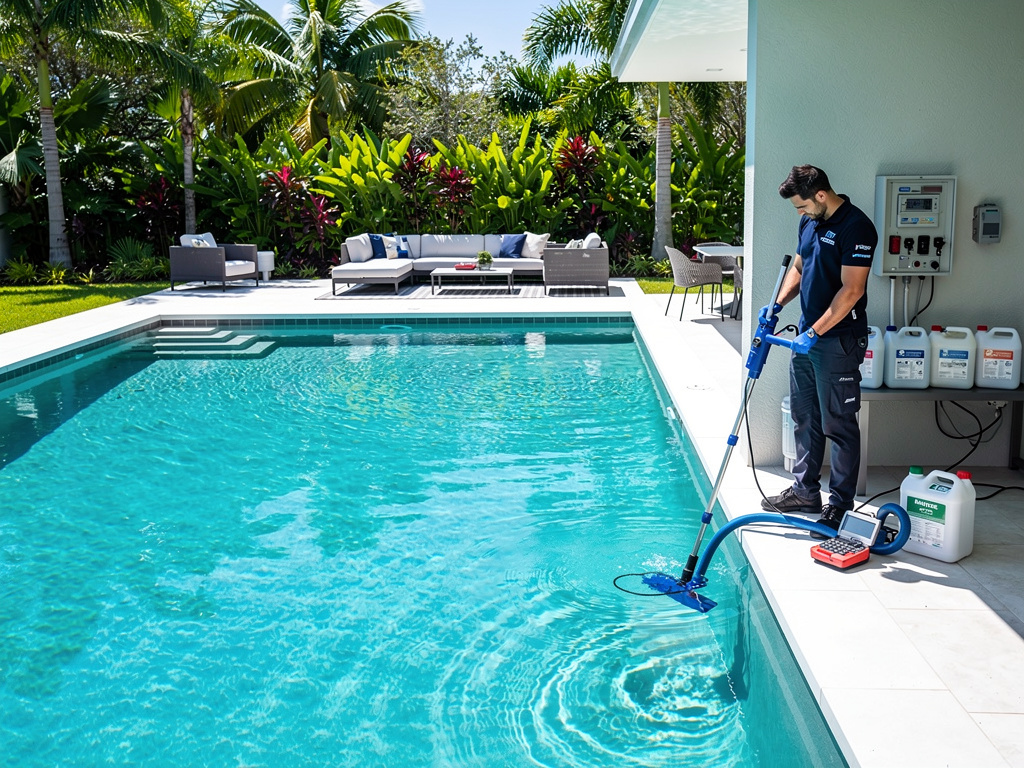
Salt System Pools in Weston FL
Weston’s luxury residential market has one of the highest salt chlorination penetration rates in Broward County. Custom pool installations from the 2000s onward — which make up a large share of Weston’s newer developments in The Ridges, Savanna, and newer sections of Weston Hills — frequently include salt chlorinators as standard equipment. Older Weston homes in Bonaventure have often converted to salt systems during renovation projects.
Salt pools in Weston are valued for their softer-feeling water, reduced chemical handling requirements, and the consistent chlorine generation that keeps luxury pools pristine. But they’re not maintenance-free — they’re differently maintained, with specific requirements that general pool service companies sometimes mishandle.
How Salt Chlorination Works
A salt chlorinator (salt chlorine generator) uses electrolysis to convert dissolved sodium chloride (pool salt) into hypochlorous acid — the same active sanitizer produced by liquid chlorine or tabs, just generated continuously on-site from salt already dissolved in the water. The salt is not consumed in this process; it regenerates. What depletes is water volume (through splash-out, backwash, and backfill) and the electrolytic cell’s lifespan over time.
Pool salt concentration for most systems targets 2,700–3,400 ppm — roughly 1/10th the salinity of ocean water. At this concentration, the water feels distinctly softer and lighter than tab-chlorinated pools, with no chlorine odor and less skin or eye irritation. Weston’s luxury homeowners who switch to salt systems rarely go back.
Salt System Service Requirements
Monthly Salt Level Testing
Salt depletes slowly through splash-out, heavy rain events (dilution), and backwash water removal. Monthly salt testing with a calibrated test kit or meter is essential — the chlorinator’s built-in salinity reading is useful but not a substitute for independent verification. When salt drops below 2,500 ppm, chlorine generation becomes inconsistent. Adding bags of pool-grade salt (sodium chloride, not table salt) corrects the level; each bag adds approximately 200 ppm per 10,000 gallons.
Salt Cell Inspection and Cleaning
The electrolytic cell is the heart of the salt system — blades of titanium coated in ruthenium oxide that generate chlorine through electrolysis. In Weston’s hard water, calcium deposits form on the cell blades over time, reducing chlorine output and eventually causing cell failure. Monthly visual inspection of the cell (remove from housing, inspect blades) and annual acid-cleaning extends cell life from the manufacturer’s typical 3–5 year estimate to 5–7+ years with proper care.
pH Management
Salt chlorination raises pool pH over time as the electrolytic process releases hydroxide ions. Weston salt pool owners typically need more frequent muriatic acid additions than equivalent tab-chlorinated pools. A well-calibrated salt system with proper flow rates minimizes this pH drift, but regular testing and correction remain essential. Uncorrected high pH (above 7.8) creates scale on salt cell blades, accelerating calcium buildup and reducing system efficiency.
Automation Integration
Most Weston luxury homes with salt systems also have Jandy AquaLink or Pentair IntelliTouch automation — the salt chlorinator output is typically controlled by the automation system, allowing remote adjustment of chlorine generation percentage. Technicians must understand how to read and adjust chlorinator output via the automation interface, not just the standalone chlorinator controller. Mismatched settings between the automation and chlorinator are a common cause of under- or over-chlorination in Weston luxury pools.
Common Salt System Issues in Weston FL
- Cell scaling: Calcium deposits on blades — most common in Weston’s harder water areas. Annual acid wash prevents
- Low salt warning with recent salt addition: Often a flow sensor calibration issue or cell failure indication
- pH constantly high: Cell output too aggressive for pool volume; automation setting adjustment needed
- Algae despite salt system “running”: Check salt level (may be low), CYA level (should be 30–50 ppm), cell output setting, and flow rates — any one of these can mask as “salt system failure”
- Cell end-of-life: Typically 3–5 years without maintenance, 5–7+ with proper care. Replacement cells run $250–$500 depending on brand
Salt System Brands Common in Weston FL
- Hayward AquaRite: Most common brand in Weston installations; AquaRite Pro integrates with Hayward OmniLogic automation
- Pentair IntelliChlor: Native integration with Pentair IntelliTouch/EasyTouch automation systems; common in Weston custom builds
- Jandy TruClear: Standard in Jandy AquaLink installations; found in many Weston properties using Jandy automation
Ensure your service company specifically identifies the brand and model of your salt system and has the technical knowledge to service it — not just read the output display.