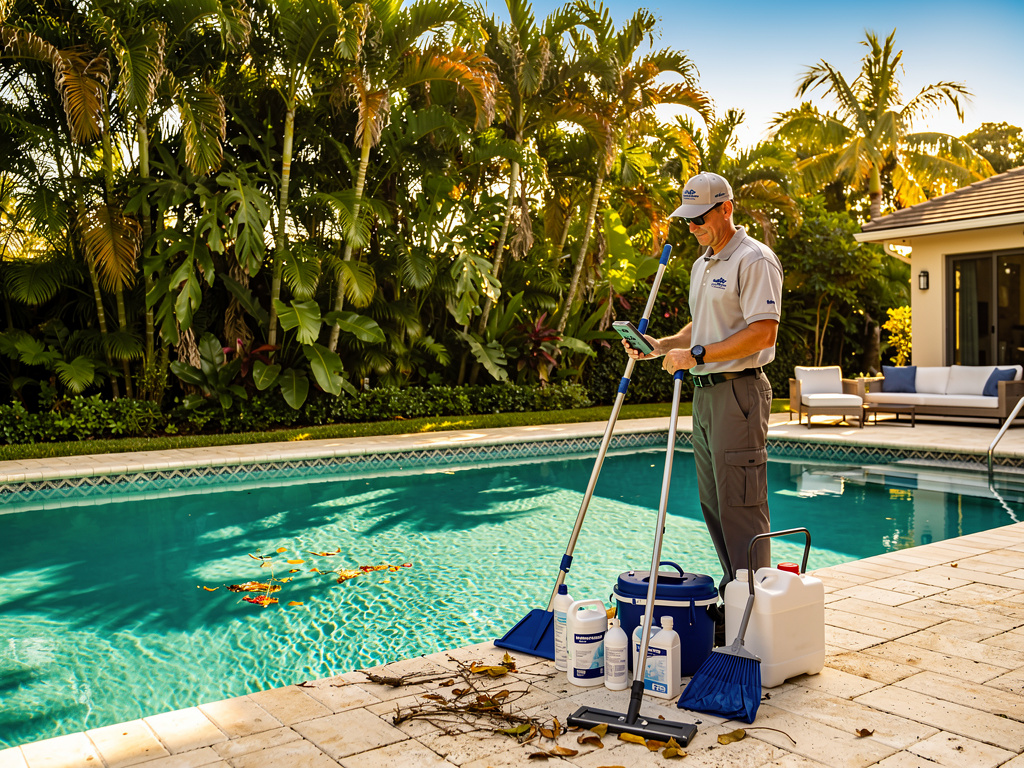
Pool Chemical Balancing in Plantation FL
Maintaining proper water chemistry in Plantation is more demanding than in many South Florida communities. The city’s defining characteristic — its lush, mature tree canopy — creates a pool chemistry environment that punishes shortcuts. Understanding the specific chemical challenges Plantation pool owners face is the first step to solving them.
Core Water Chemistry Parameters
Every Plantation pool requires weekly monitoring of:
- Free Chlorine: 1–3 ppm (sanitizer — your front line against algae and bacteria)
- pH: 7.4–7.6 (affects chlorine effectiveness; Plantation’s rainfall frequently pushes pH down)
- Total Alkalinity: 80–120 ppm (buffers pH against rapid swings)
- Cyanuric Acid (CYA): 30–80 ppm (stabilizes chlorine against UV — but becomes a liability above 80 ppm)
- Calcium Hardness: 200–400 ppm (prevents plaster etching in Plantation’s softer water areas)
- Phosphates: Under 100–200 ppb (critical in Plantation’s high-debris environment)
The Plantation Phosphate Problem
Phosphates are the single most underdiagnosed chemistry issue in Plantation pools. The city’s oak trees, ficus hedges, tropical plantings, and lawn fertilizer runoff all contribute phosphates to pool water. Communities like Jacaranda, Plantation Woods, and Plantation Acres — where mature landscaping is abundant — consistently produce pools with elevated phosphate readings.
High phosphates don’t directly harm water clarity — they just feed algae. When phosphates exceed 200–500 ppb, chlorine demand increases significantly, and green pool events become frequent even when chlorine is maintained. The fix is a targeted phosphate remover (lanthanum chloride-based products). A single treatment typically drops phosphates dramatically within 24–48 hours. In Plantation, periodic phosphate treatment every 4–8 weeks is standard for canopy-heavy properties.
CYA Accumulation in Older Plantation Pools
Cyanuric acid is added to pools (via stabilized chlorine tablets or direct addition) to protect chlorine from UV degradation. In South Florida’s sun, some CYA is essential — without it, chlorine in an outdoor pool degrades within hours. But CYA accumulates in pool water over time and doesn’t evaporate or get consumed.
Plantation’s older pools — particularly in eastern Plantation and Jacaranda where homes date to the 1970s–1980s — frequently have CYA levels of 100–200+ ppm from decades of stabilized chlorine use. Above 80 ppm, CYA begins to significantly impair chlorine’s ability to kill algae and bacteria, a phenomenon called “chlorine lock.” The pool tests positive for chlorine, but the effective sanitizing power is a fraction of what the reading suggests.
If your Plantation pool uses steady chlorine tabs, request a CYA test at least twice yearly. If levels exceed 80 ppm, a partial drain and refill (diluting the water) is the only correction. This runs $150–$300 for the service.
Rainfall and pH Management in Plantation FL
Plantation receives 60+ inches of rain annually, concentrated in the May–October wet season. Heavy rainfall:
- Dilutes chlorine, reducing concentration below safe levels
- Drops pH (rain is naturally acidic at pH 5.6 or below)
- Introduces phosphates from runoff across surrounding lawn and landscape
- Overflows pools, reducing TDS (total dissolved solids) — which can actually help reset calcium and CYA levels naturally over time
After major rainstorms in Plantation, always test and correct chemistry — don’t assume the pool is fine because it “looks clear.” Low chlorine after rain is when algae bloom fastest.
Salt Systems vs. Chlorine Tabs in Plantation
Salt chlorinator systems are increasingly popular in Plantation’s newer western developments, including some sections of Jacaranda and newer-build HOA communities. Salt systems generate chlorine on-demand from dissolved salt, eliminating the need to add tablets regularly — which also slows CYA accumulation (salt-generated chlorine is unstabilized).
For Plantation’s older pools on traditional chlorine tabs, the main tradeoff is ongoing CYA management. Salt systems avoid this issue entirely at the cost of higher upfront equipment investment ($1,200–$2,200 installed) and periodic cell cleaning and replacement.