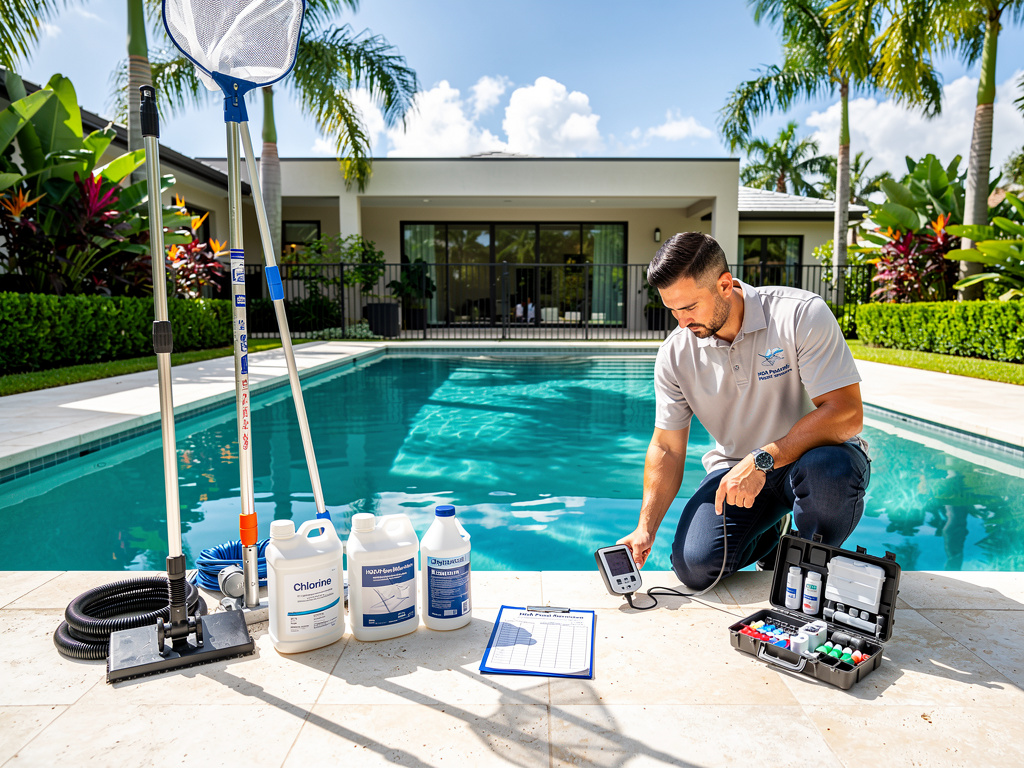
HOA Pool Service in Miramar FL: Managing Pool Compliance in One of Broward’s Most Organized Communities
Miramar FL is one of Broward County’s most HOA-intensive cities. The planned community development model that shaped the city’s growth — from Silver Lakes and Riviera Isles to Sunset Lakes and the dozens of organized subdivisions that define Miramar’s suburban landscape — created a city where HOA governance is the norm rather than the exception. Pool compliance in this environment operates on two distinct levels: private residential pools subject to HOA appearance standards, and community amenity pools subject to Broward County Health Department regulation. Both require professional pool service that delivers documented results — not just a clear pool, but evidence of professional management.
Private Pool HOA Compliance in Miramar’s Communities
Silver Lakes, Riviera Isles, and Sunset Lakes
These three communities represent Miramar’s best-known planned development areas, each with active HOA management and regular compliance inspection programs. A private pool in these communities that presents with green water, visible algae, or apparent neglect generates a written notice with a specific correction timeline — typically 7-14 days in Miramar’s most active HOA enforcement communities. Professional weekly pool service prevents compliance events entirely by maintaining the pool in consistently satisfactory condition at every inspection.
Written service records are the compliance evidence tool when disputes arise. If an HOA compliance officer notes a pool condition that the homeowner believes is incorrect or has already been addressed, service records with specific dates, chemistry readings, and technician notations provide the documentation to contest the notice effectively. Homeowners receiving HOA compliance notices for pool conditions without documented professional service history have limited recourse; those with complete written records have clear evidence of proactive management.
Safety Barrier Compliance
Florida Statute 515 requires a 4-foot minimum enclosure with self-closing, self-latching hardware for all Miramar residential pools. Miramar’s HOA-specific CC&Rs may impose additional requirements. With the city’s family-oriented demographics — Miramar’s household profile includes many families with young children across its Caribbean and Latin American communities — pool safety barrier compliance is a life-safety matter that HOA enforcement reinforces. New pool owners in Miramar HOA communities should review both the state statute and their HOA’s specific governing documents.
Community Amenity Pool Management
Miramar’s HOA communities include dozens of shared amenity pools — the community pool facilities that residents access as part of HOA membership. These pools are classified as semi-public swimming pools under Florida Statutes Chapter 514, regulated by the Broward County Health Department with specific ongoing requirements.
The most commonly cited BCHD compliance gap at Miramar community pools: missing or incomplete on-site chemistry logs. The regulation requires this log to be physically present at the pool after every service visit — not filed at an office, not maintained electronically without a pool-side printed copy. During BCHD inspection, the inspector checks for the on-site log first. An HOA board whose pool service company doesn’t know this requirement — or doesn’t follow it consistently — faces compliance citations that reflect on the HOA’s governance quality.
Fort Lauderdale Pool Service provides HOA-compliant pool maintenance for Miramar FL private residences and community amenity pools, with BCHD-format documentation and CPSC licensing. Contact us for a service assessment.