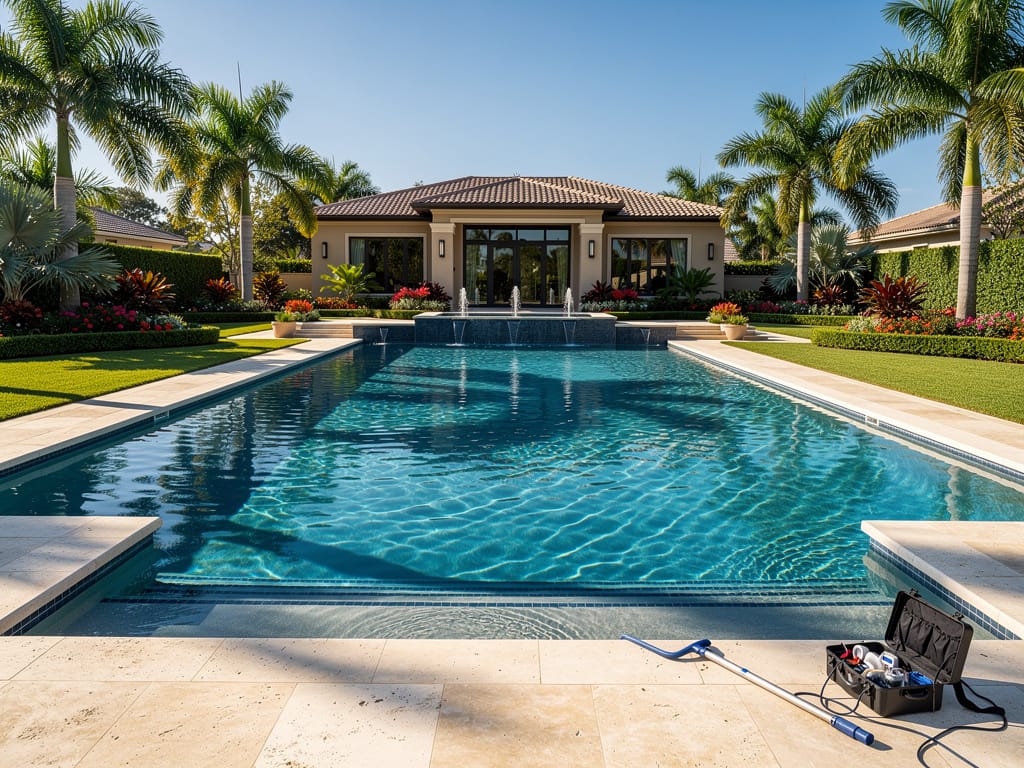
Pool and Spa Service in Parkland — Elite Integrated Maintenance for Estate Water Environments
Parkland’s estate pool and spa combinations are among the most sophisticated residential water environments in South Florida. The interaction between a large main pool and an integrated spa — separate water bodies operating at very different temperatures, connected by automated valve systems, sharing equipment but requiring distinct chemistry management — creates a service requirement that rewards genuine expertise. This guide covers what complete pool and spa maintenance looks like for Parkland’s Heron Bay, Watercrest, and Miralago properties.
Why Pool and Spa Chemistry Are Different Systems
The Temperature Effect on Chemistry
The fundamental reason pool and spa water require separate chemistry management is temperature. A Parkland estate spa operating at 102°F is not just a smaller pool — it is a different chemical environment. Water at 102°F has different solubility characteristics for every chemistry parameter than the same water at 84°F pool temperature. Calcium carbonate is less soluble (precipitates faster as scale), chlorine degrades faster (depletes 3-5x more rapidly than in pool water), pH is more volatile and trends higher with jet aeration, and combined chlorine compounds form faster from bather load at higher temperature.
Managing spa water as if it behaves like pool water is the most common spa chemistry error in estate pool service — and it produces visible consequences over time: calcium-scaled jets, persistent odor from combined chlorine, heater heat exchangers coated in scale that reduces heating efficiency, and spa surfaces that look prematurely aged. The correct approach begins with acknowledging that spa water requires independent testing with independent targets.
Spa-Specific Chemistry Targets for Parkland
Correct Parkland estate spa chemistry targets: free chlorine 3-5 ppm (higher than pool due to accelerated depletion), pH 7.2-7.4 (tighter range than pool to manage scale risk at high temperature), total alkalinity 80-120 ppm (same range as pool but more frequent correction due to aeration-driven pH volatility), calcium hardness 150-250 ppm (lower than pool to reduce scale risk at spa temperature — the high temperature makes water appear more scale-forming at any given calcium level). Total dissolved solids testing quarterly to monitor TDS accumulation in spa water.
Spa-Specific Service at Every Visit
Independent Testing and Chemical Adjustment
At every weekly service visit: the spa is tested independently. pH, free chlorine, alkalinity, and a visual calcium assessment at the waterline and jet faces. Chemical adjustments are calculated specifically for the spa water volume (typically 600-1,500 gallons for a Parkland estate spa) — not extrapolated from the main pool treatment. When the spa has had heavy use since the last visit, a targeted shock treatment is applied to eliminate accumulated combined chlorine and restore the spa’s fresh water feel.
Jet and Blower Inspection
Spa jets are inspected quarterly for calcium scale accumulation on nozzle faces and inside jet bodies. Scale on jet faces disrupts the hydrotherapy massage pattern and progressively clogs the jet over time. Spa blower intakes are inspected for debris — blower air pulled through organic debris creates aeration of contaminated air through the spa water. Valve actuators for pool/spa mode switching are verified to complete their full travel correctly — an actuator that stops mid-travel can create flow issues in both pool and spa circuits.
Spa Water Drain and Refill Schedule
One service element that separates elite Parkland spa maintenance from standard pool service: scheduled spa water replacement. Pool water is replaced through dilution over time as splash-out, evaporation, and filter backwash gradually turn over the water volume. Spa water, with its smaller volume and higher contamination rate per gallon, requires intentional full drainage and refill every 3-4 months for heavily used estate spas. This resets accumulated TDS, CYA, and combined chlorine compounds that no chemistry treatment can eliminate from existing water — providing a clean baseline for optimal spa water quality. Some Parkland estate service providers include scheduled spa drain-refill in annual service contracts.
Fort Lauderdale Pool Service provides integrated pool and spa maintenance for Parkland estate properties including Heron Bay, Watercrest, and Miralago, with dedicated technicians experienced in estate spa water chemistry and equipment. Contact us for a service consultation.