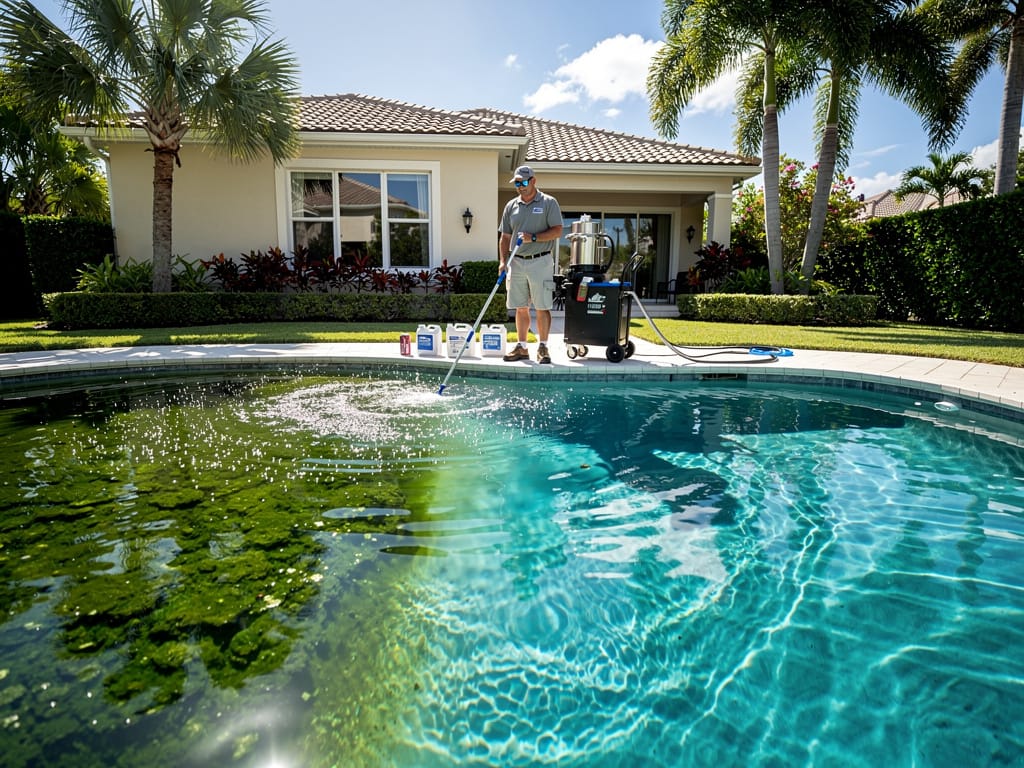
Green Pool Recovery in Parkland — Scale, Complexity, and the Prevention Imperative
A green pool in Parkland is not a minor inconvenience — it is a significant property management event. At the scale of Parkland’s estate pool systems, a green pool involves treating 40,000-80,000+ gallons of compromised water, addressing the vanishing edge trough and spa independently, and taking a premium outdoor living space completely offline for 3-5 days. Understanding what causes green pools in Parkland’s sophisticated estate systems, what recovery involves at this scale, and why prevention is the only sensible approach for these properties frames the service investment correctly.
How Parkland Estate Pools Go Green
The Automation Trap
Parkland’s estate pools are among the most sophisticated automated residential pool systems in South Florida — and automation creates a specific green pool risk pattern that doesn’t exist in simpler systems. An estate pool with full automation, salt chlorination, and real-time equipment monitoring appears to be under active management around the clock. But the automation system monitors equipment function, not actual water chemistry. A salt cell that is scaling and producing chlorine at 60% of rated output may not trigger an alert until the shortfall reaches a defined threshold — while the pool water is being progressively under-sanitized for days or weeks before the alert fires. The system shows “Normal” on the app; the pool is moving toward a chemistry failure.
The diagnostic protocol that prevents this: direct free chlorine testing at every weekly service visit, regardless of what the automation system reports. This is the single most important quality distinction between elite Parkland pool service and standard automation monitoring — the technician verifies what is actually in the water, not what the system says should be there.
Rainy Season Scale Effects
South Florida’s June-October rainy season affects large Parkland pools in proportion to their water surface area. A 60,000-gallon Heron Bay estate pool with a 1,200 square foot water surface area absorbs substantially more rainfall volume than a standard 15,000-gallon pool — meaning rainy season dilution of salt, chlorine, and chemistry parameters accumulates faster in absolute terms. Salt level management is particularly important: a large Parkland salt pool can lose sufficient salt concentration in a single heavy rainy week to suppress the salt system’s chlorine generation, silently transitioning from salt chlorination to a pool with no active sanitizer while the automation system shows no alert because the residual salt reading is still within the system’s reporting range.
Vanishing Edge Trough as Independent Algae Source
Vanishing edge troughs in Parkland’s estate pools are a specific green pool vector that doesn’t exist in standard residential systems. The trough accumulates debris and scale at rates higher than the main pool, can be partially shaded, and receives less circulation chemistry than the main pool body. An undertreated vanishing edge trough can develop an active algae colony that continuously seeds the main pool — appearing as recurring algae issues that resolve partially after shocking but return within days. Complete green pool recovery for Parkland estate pools must treat the trough as an independent water body, not assume main pool treatment chemistry reaches it adequately.
Recovery at Estate Pool Scale
Green pool recovery for a 60,000-gallon Parkland estate pool requires: assessment of all water bodies (main pool, spa, vanishing edge trough) independently, calcium hypochlorite shock at 8-16+ lbs total for the full system, algaecide application throughout, thorough brushing of all pool, spa, trough, and water feature surfaces, VS pump set to maximum speed and continuous filtration for the recovery period, and chemistry monitoring every 24 hours until the pool clears. Total recovery time: 72-120 hours for a large estate pool versus 48-72 hours for a standard pool. Product cost for the recovery treatment: $200-$400 in chemistry before labor is factored.
Prevention Economics for Parkland Estates
A complete professional service contract for a Parkland estate pool at $350-$600/month represents $4,200-$7,200 annually. A single green pool recovery event costs $350-$800 in treatment alone, plus 4-5 days of pool unavailability. For Parkland estate homes where the pool is an integral part of the property’s entertainment and lifestyle value, the prevention math is clear.
Fort Lauderdale Pool Service provides professional weekly maintenance and green pool recovery throughout Parkland including Heron Bay, Watercrest, and Miralago. Contact us for a service consultation for your Parkland estate pool.