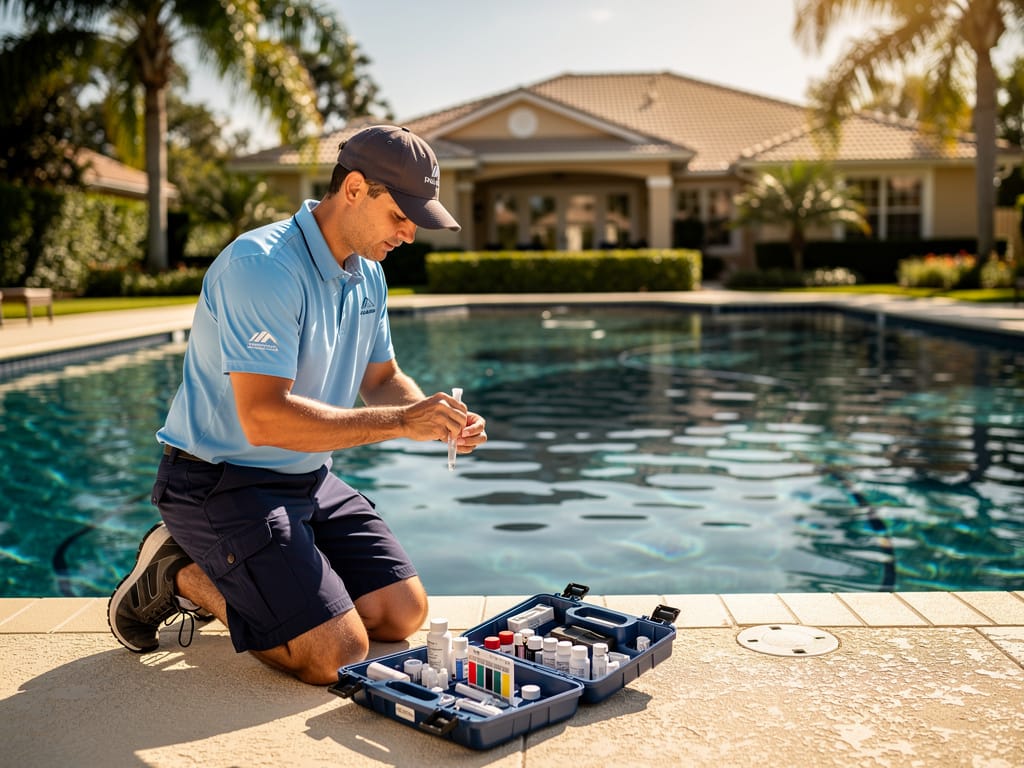
Pool Chemical Balancing in Coconut Creek — Modern Pools, Modern Chemistry
Coconut Creek’s newer pool stock brings different chemistry management requirements than the 1970s plaster pools common in older Broward communities. The city’s prevalence of salt chlorinator systems, newer plaster and pebble finishes, and modern automated equipment creates a chemistry management profile that requires expertise in current pool technology — not just traditional chlorine chemistry.
This guide covers the complete chemistry picture for Coconut Creek pools, with specific attention to salt system chemistry management that is increasingly relevant in this community.
The Core Chemistry Parameters for Coconut Creek Pools
pH: 7.2-7.4 for Salt Pools, 7.2-7.6 for Chlorine Pools
pH is the most important weekly chemistry parameter in any pool, but it carries additional significance for Coconut Creek’s salt pool owners. Salt chlorination naturally raises pH as the electrolytic process produces hydroxyl ions along with chlorine. Without consistent weekly pH correction, salt pool water drifts toward 7.8-8.0 — a range where chlorine loses significant disinfection effectiveness and calcium becomes prone to precipitating out of solution.
Calcium precipitation from high-pH water deposits on the electrolytic cell plates, reducing chlorine output efficiency. A salt pool that runs at pH 7.8-8.0 for an extended period accumulates calcium scale on its cell faster than a salt pool maintained at 7.2-7.4 — meaning more frequent cell cleanings and earlier cell replacement. pH management is the most cost-effective salt cell maintenance step available.
Free Chlorine: 2-4 ppm (Chlorine Pools); 1-3 ppm (Salt Pools)
Salt systems generate chlorine continuously during pump operation, creating a more stable free chlorine level than manual chemical addition. Properly functioning salt systems typically maintain free chlorine in the 1-3 ppm range without weekly manual addition — the system self-adjusts within its programmed output percentage. Weekly testing verifies the system is functioning correctly; low chlorine despite adequate salt level and normal output settings is the primary symptom of salt cell degradation requiring attention.
For Coconut Creek’s chlorine pools, free chlorine maintenance follows the standard South Florida protocol: cyanuric acid at 30-50 ppm to protect chlorine from UV degradation, weekly addition to maintain the 2-4 ppm target, and shock treatment when chlorine is depleted or combined chlorine (chloramines) accumulates.
Total Alkalinity: 80-120 ppm
Alkalinity buffers pH against rapid change between service visits. For salt pools in Coconut Creek, where pH rises naturally between visits, adequate alkalinity (targeting 90-110 ppm) slows the upward pH drift, reducing the magnitude of pH correction needed each week. Very low alkalinity in a salt pool allows pH to rise sharply between visits — compounding the scale risk from elevated pH discussed above.
Calcium Hardness: 200-400 ppm
Coconut Creek’s newer pool surfaces — plaster, pebble finish, or tile — are generally in better condition than the aging plaster stock of older Broward communities. However, calcium hardness management remains important: low calcium (below 200 ppm) causes water to extract calcium from pool surfaces, regardless of their age. For salt pools specifically, low calcium hardness also contributes to salt cell plate corrosion — the cell’s titanium plates are coated with a ruthenium oxide catalytic layer that can degrade faster in consistently low-calcium, low-pH water. Maintaining 250-350 ppm calcium hardness protects both pool surface and salt cell in Coconut Creek’s newer pools.
Cyanuric Acid: 30-50 ppm for Chlorine Pools; 60-80 ppm for Salt Pools
Chlorine pools in Coconut Creek’s outdoor environment need CYA stabilizer at 30-50 ppm to protect chlorine from South Florida’s intense UV. Salt pool users often run slightly higher CYA (60-80 ppm) because the continuous low-level chlorine generation from the salt cell benefits from additional UV protection — the cell runs less hard to maintain target chlorine levels when CYA is in the optimal range. CYA should be tested quarterly and managed below 80 ppm to avoid the stabilizer lock condition that reduces chlorine disinfection efficacy.
Salt Level: 2,700-3,400 ppm
Salt level is unique to Coconut Creek’s salt pool chemistry. The optimal range for most residential salt systems is 2,700-3,400 ppm — well below the level that produces a noticeably salty taste (seawater is approximately 35,000 ppm). Coconut Creek’s rainy season dilutes salt concentration, requiring periodic salt additions of 50-100 lbs per event depending on pool size and rainfall. Salt level that drops below 2,700 ppm typically triggers a “low salt” alarm and shuts down chlorine production, requiring manual chlorine addition as a bridge until salt is added and dissolved.
Seasonal Chemistry in Coconut Creek
South Florida’s wet season from June through October is the most chemistry-demanding period for Coconut Creek pools. Heavy rainfall simultaneously dilutes chlorine, pH, alkalinity, and salt levels, while UV and temperature conditions create maximum algae growth pressure. Weekly service visits during rainy season must account for the cumulative dilution from multiple rain events in the interval since the last visit — a particularly salt-system-relevant concern, as salt level management requires both testing and physical salt addition.
Fort Lauderdale Pool Service provides complete chemistry management for Coconut Creek pools including salt level testing and management, salt cell inspection, VS pump efficiency verification, and full 5-parameter chemistry documentation after every visit. Contact us for a service assessment specific to your Coconut Creek pool’s equipment and chemistry needs.