What Weekly Pool Service Actually Includes in Coconut Creek
For Coconut Creek’s busy professional and family households, pool service is a background function — something that happens on schedule so the pool is always ready without any active management on your part. That’s the value proposition of quality weekly service. But “weekly pool service” is a description that covers enormous variation in what’s actually done. This guide explains what a complete service visit looks like in Coconut Creek, what’s specifically added for salt pools, and how to tell if your current service is actually complete.
The Complete Weekly Service Checklist for Coconut Creek Pools
1. Full Chemistry Testing — Every Parameter, Every Visit
A legitimate weekly service visit tests all major chemistry parameters with proper reagent testing — not a 2-parameter dip strip. For Coconut Creek pools: pH, free chlorine, total alkalinity, and combined chlorine at every visit. Calcium hardness and cyanuric acid quarterly. For salt pools: direct free chlorine measurement plus salt level verification every 4-6 weeks. The results are recorded numerically — not “good” or “OK” — and provided to the homeowner in writing.
Why this matters specifically for Coconut Creek’s salt pool owners: a salt cell that is scaling and producing less chlorine than its rated output may show no error code on the system display. Only direct free chlorine testing reveals that the actual sanitizer level has dropped despite the system appearing to operate normally. A service company that checks the system display but doesn’t test free chlorine directly is missing the most important salt pool performance metric.
2. Chemical Balancing with All Required Additions
Based on chemistry readings, all required chemicals are added to bring every parameter to target: pH adjuster (muriatic acid or soda ash), alkalinity increaser if needed, chlorine or salt addition, calcium chloride if calcium is low, and algaecide as preventive treatment. All chemicals should be included in the monthly service price — no per-correction billing. For salt pools, salt addition when levels drift below 2,800 ppm is a routine service task that should be included in a complete service contract.
3. Salt Cell Inspection (Salt Pool Specific)
At every visit, the technician inspects the salt cell through its clear housing for calcium scale buildup on the titanium plates. Light frosting is normal and doesn’t require cleaning. Significant white or gray mineral deposits indicate scaling that reduces chlorine output — these need acid cleaning before they become thick enough to damage the cell. A technician who doesn’t inspect the cell at each visit misses the early-stage scaling that’s cheapest to address.
4. Surface Skimming and Basket Service
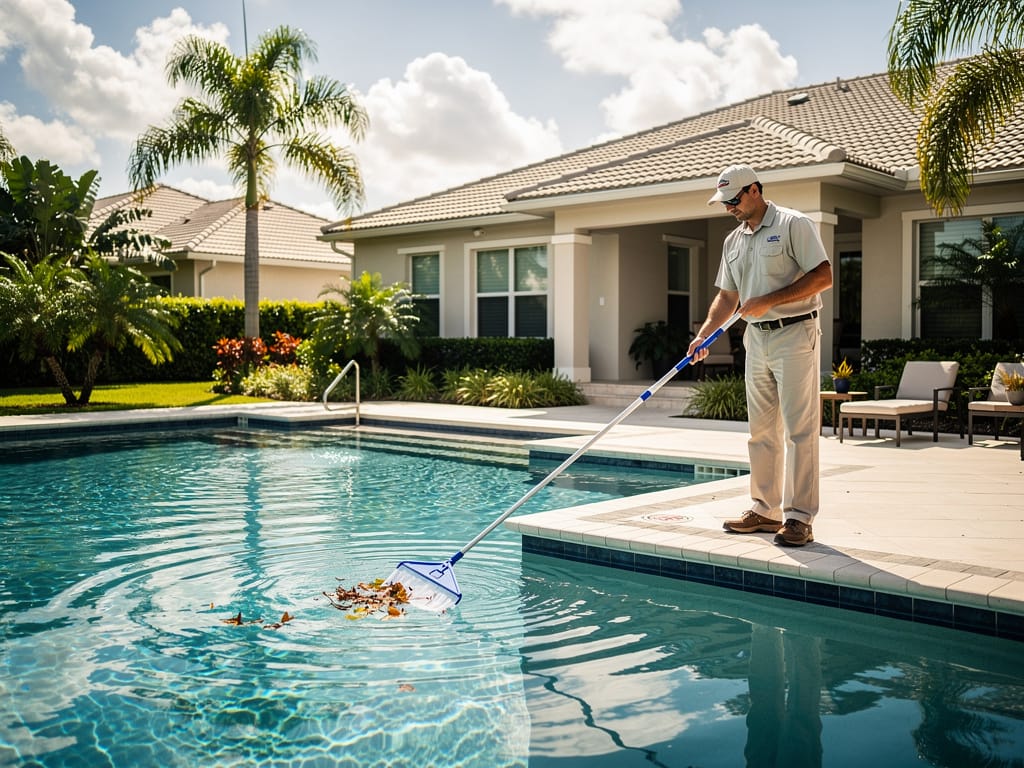
The water surface is net-skimmed to remove floating debris. Both the skimmer basket and the pump basket are removed and emptied. Clogged pump baskets restrict flow and can cause the pump to run hot — accelerating seal wear and eventual motor failure. This is a 3-minute step that prevents an expensive equipment outcome.
5. Brushing All Pool Surfaces
Walls, steps, ledges, and the floor-wall transition are brushed to prevent algae from establishing on pool surfaces. In Coconut Creek’s summer climate, a pool that goes 2 weeks without brushing in June-September will typically show early algae on surfaces before it’s visible in the water column. Brushing at every visit is the cheapest algae prevention step available.
6. Equipment Visual Inspection
At every visit: pump (listening for bearing noise, checking for leaks at unions and lid), filter (reading pressure gauge against baseline — 8-10 psi above baseline indicates cleaning needed), VS pump display (confirming current RPM schedule and checking for fault codes), salt system display (checking output percentage setting, salt reading, cell status), and heater or heat pump if present. For Coconut Creek’s newer equipment, the VS pump and salt system displays provide useful real-time diagnostics that a qualified technician reads as part of every service call.
7. Scheduled Vacuuming and Written Documentation
Vacuuming per the agreed schedule (weekly or bi-weekly) removes settled debris from the pool floor. Written service documentation is completed and provided to the homeowner — physically left poolside, texted, or accessible through an app — showing all readings and actions taken. This is the step that makes the entire visit auditable and creates the accountability that separates professional service from commodity maintenance.
Fort Lauderdale Pool Service: Complete Weekly Maintenance in Coconut Creek
Fort Lauderdale Pool Service performs all elements of complete professional service on every visit in Coconut Creek, including the additional salt cell and VS pump inspection required for the city’s newer pool equipment. Our written service records document every visit. Contact us for a no-pressure service assessment.