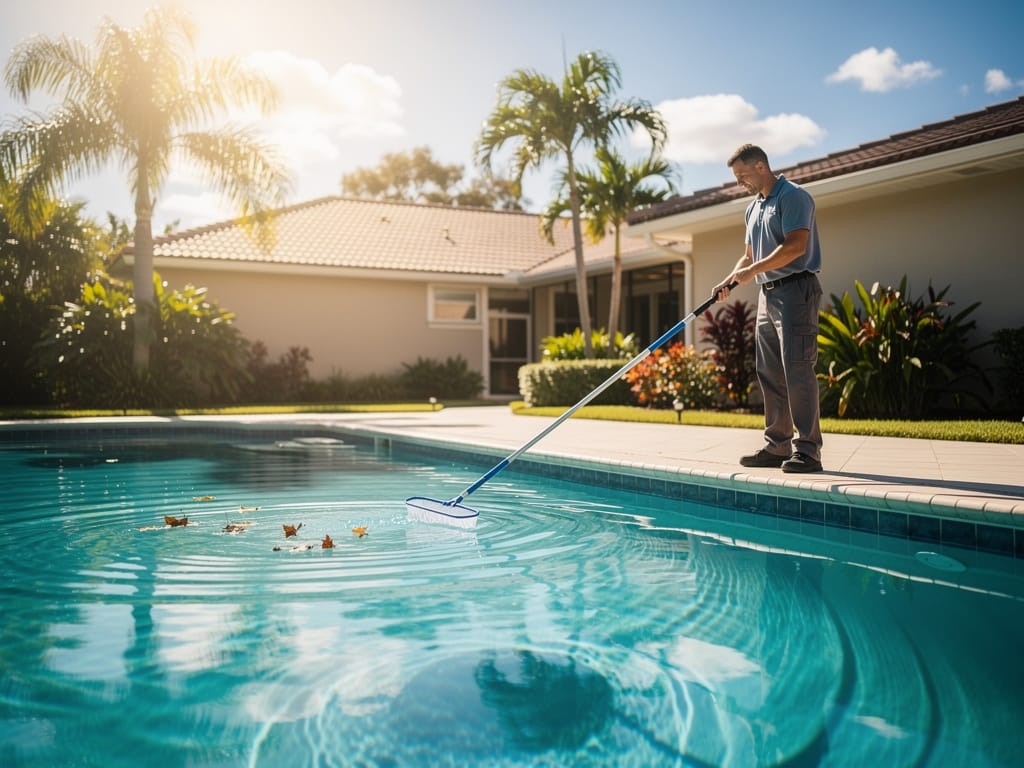
Quick Answer: A professional weekly pool maintenance visit in Tamarac, FL includes water chemistry testing and balancing, brushing all pool surfaces, skimming the water surface, emptying skimmer and pump baskets, equipment visual inspection, and scheduled vacuuming — all documented in a written service record provided to the homeowner. The visit typically takes 20–35 minutes for a standard residential pool. For Tamarac’s 55+ community, knowing exactly what is included in every visit — and verifying that it is actually being performed — is the key to getting value from your pool service contract.
One of the most common questions from Tamarac homeowners shopping for pool service: “What exactly do they do every week?” It’s a reasonable question, and the honest answer is that it varies substantially between companies. A legitimate weekly service visit and a low-price budget visit may both be called “weekly pool service” — but one takes 25 minutes and includes complete chemistry documentation, and the other takes 7 minutes and leaves no record. Knowing what a proper visit includes lets Tamarac homeowners verify that they’re getting what they’re paying for.
What a Complete Weekly Pool Service Visit Includes
1. Water Chemistry Testing — The Non-Negotiable Foundation
A complete chemistry test at every visit includes free chlorine, pH, total alkalinity, and combined chlorine using professional reagent testing — not a 2-parameter dip strip. Calcium hardness and cyanuric acid are tested quarterly minimum on residential pools, and at every visit for Florida DOH-compliant HOA pools in The Woodlands and Mainlands. The readings are recorded and provided to the homeowner in writing. Without this documentation, there is no chemistry trend history, no HOA compliance record, and no accountability if chemistry management falls short.
2. Chemical Balancing with All Required Corrections
Based on the chemistry reading, the technician adds whatever is needed to bring all parameters to target range: pH adjuster (muriatic acid or sodium carbonate), alkalinity increaser, calcium chloride (calcium hardness), shock (if chlorine is low), algaecide (preventive), and stabilizer (if CYA is below target). All chemicals should be included in the monthly service price with no per-correction billing. A company that bills separately for pH adjustment or chlorine addition every visit has a pricing model that makes proper chemistry management economically disincentivized for the technician.
3. Brushing All Pool Surfaces
Every pool surface contacted by water — walls, steps, ledges, the transition between wall and floor — is brushed to prevent algae from establishing on the surface. For Tamarac’s older 1970s plaster pools, brushing is especially important: rough plaster surfaces provide significantly more surface area for algae attachment than smooth surfaces. A technician who skips or minimizes brushing accelerates algae establishment on older plaster, and the difference is apparent within a few weeks in South Florida’s climate.
4. Surface Skimming
The pool water surface is net-skimmed to remove floating debris — leaves, insects, grass clippings — before they sink and decompose. In Tamarac’s landscaped neighborhoods, especially The Woodlands and Mainlands where mature tree canopy is common, surface debris is an ongoing source of organic material that consumes chlorine and contributes to algae conditions when it decomposes on the pool floor. Skimming at every visit keeps the surface clear and reduces the nutrient load in the water.
5. Basket Service
Both the skimmer basket (in the pool wall) and the pump basket (in the equipment pad pump housing) are emptied at every visit. Clogged baskets restrict flow and reduce circulation and filtration effectiveness. A pump basket that becomes too clogged can starve the pump of water, causing it to run hot and accelerating seal wear — a slow equipment failure that leads to an expensive repair. Basket service at every visit is a routine maintenance step that prevents this category of damage.
6. Equipment Visual Inspection
At every visit, the technician performs a visual inspection of accessible equipment: pump (listening for bearing noise, checking for leaks at unions), filter (checking pressure gauge against baseline), visible plumbing (checking union connections), and heater or heat pump if present (checking for error codes or warning indicators). This is particularly valuable for Tamarac’s 1970s-era pool equipment: aging pump seals, old filter tanks, and original plumbing connections develop failure patterns that a consistent technician learns to recognize early. A technician who visits your pool for the first time cannot provide this baseline comparison.
7. Vacuuming — Scheduled Within the Service Agreement
Vacuuming removes debris and sediment from the pool floor that skimming and circulation don’t address. Standard service agreements in Tamarac include vacuuming on a scheduled basis — weekly or bi-weekly depending on the contract. Confirm the frequency at contract signing. A pool that isn’t vacuumed regularly develops calcium and debris accumulation on the floor surface that contributes to staining and provides substrate for algae growth on older plaster.
8. Written Service Documentation
The visit is documented in a written service record — either paper left poolside or a digital record accessed through an app — showing all chemistry readings, chemicals added, basket status, equipment observations, and any concerns noted. This documentation is the homeowner’s proof that the visit occurred and that professional standards were followed. It is required for HOA pool compliance and invaluable for tracking chemistry trends on older plaster pools.
How Long Should a Weekly Service Visit Take?
For a standard Tamarac residential pool (15,000–20,000 gallons, single-speed or variable-speed pump, no automation): a properly performed complete service visit takes 20–35 minutes. Visits under 10 minutes cannot include all eight components above. If you see your technician leave in under 10 minutes, something is being skipped. The most commonly skipped elements at low-price service companies: brushing (usually first to go), vacuuming (deferred indefinitely), and equipment inspection (completely absent).
Fort Lauderdale Pool Service: Complete Weekly Service in Tamarac
Fort Lauderdale Pool Service performs all eight components at every weekly service visit in Tamarac, including The Woodlands and Mainlands neighborhoods. Our technicians document every visit with written chemistry records and are experienced with the older plaster pool equipment common throughout Tamarac’s 1970s-built neighborhoods. Contact us for a free service assessment and quote.
Frequently Asked Questions
What does weekly pool service include in Tamarac, FL?
A complete weekly service visit in Tamarac includes: water chemistry testing (pH, free chlorine, alkalinity, combined chlorine — all parameters, not just a 2-parameter dip strip); chemical balancing with all required corrections; brushing all pool surfaces (walls, steps, ledges, transitions); surface skimming; skimmer and pump basket emptying; equipment visual inspection (pump, filter, plumbing, heater); scheduled vacuuming per the service agreement; and written service documentation provided to the homeowner after every visit. The visit typically takes 20–35 minutes for a standard residential Tamarac pool.
How long should a weekly pool service visit take in Tamarac?
For a standard Tamarac residential pool: 20–35 minutes. This time is required to perform complete chemistry testing and balancing, brush all surfaces, skim, service both baskets, conduct equipment inspection, and document the visit. Visits completing in under 10 minutes cannot include all of these elements — something is being skipped. If you consistently observe your technician departing in under 10 minutes, ask specifically what is being performed at each visit and compare to a complete service list.
Should my pool service technician in Tamarac leave documentation after every visit?
Yes. Written service documentation after every visit should be standard. The record should show: date and time, technician name, all chemistry readings with actual values (not “normal” or “good”), chemicals added with product and quantity, basket status, and any equipment observations. This documentation: (1) proves the visit occurred; (2) creates a chemistry trend history for older plaster pool management; (3) provides HOA compliance documentation for Woodlands and Mainlands common-area pools; (4) establishes accountability if service quality disputes arise. A company that doesn’t provide written records is not performing complete professional service.
How often should my pool in Tamarac be vacuumed?
Standard residential service in Tamarac includes vacuuming weekly or bi-weekly, depending on the contract terms. Pools with minimal debris (screened enclosures, limited tree coverage) can often go bi-weekly. Pools with heavy debris loads from surrounding mature trees — common in The Woodlands and Mainlands — typically benefit from weekly vacuuming to prevent floor accumulation that stains older plaster and provides substrate for algae. Confirm vacuuming frequency specifically in your service agreement at the time of signing, not after you notice it hasn’t been performed.
What pool equipment should be inspected at each Tamarac weekly service visit?
At minimum: pump (listening for bearing noise, checking for leaks at unions and lid), filter (reading pressure gauge against baseline — pressure 8-10 psi above baseline indicates cleaning is needed), visible plumbing connections (checking for leaks at unions and fittings), and heater or heat pump if present (error codes, warning indicators, and cycle frequency). For Tamarac’s 1970s-era pools: aging pump seals, original filter tanks, and old plumbing unions are the most common failure points. A consistent technician who knows your equipment’s normal condition recognizes early warning signs; a rotating technician on a first or second visit cannot.