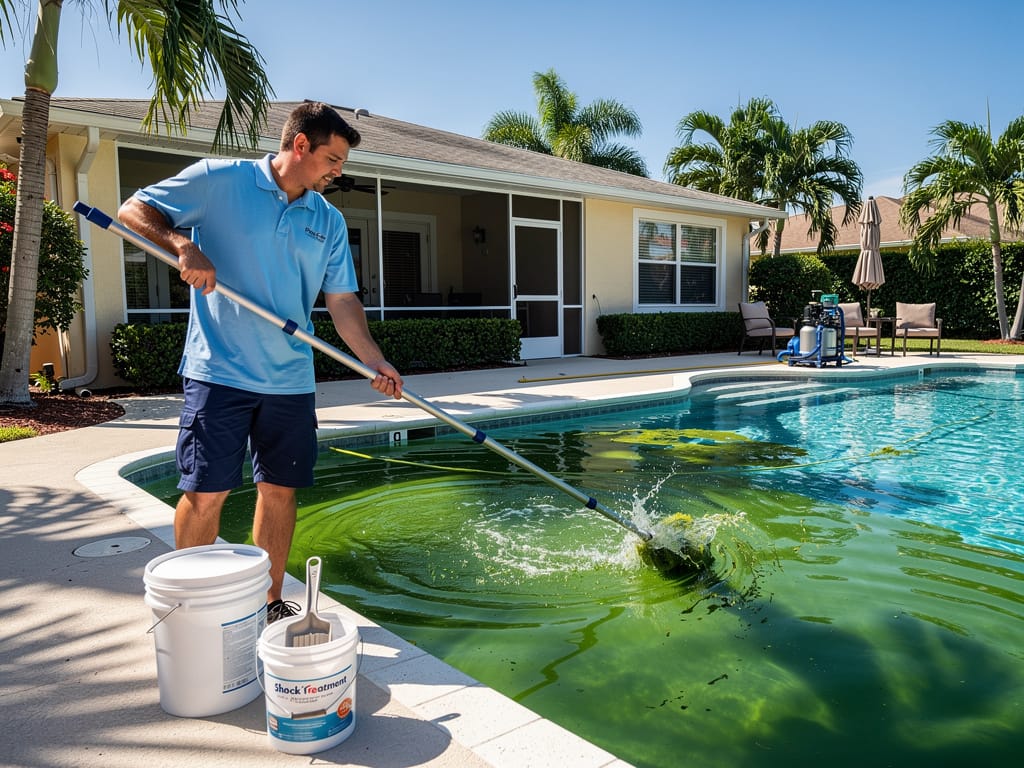
Quick Answer: Green pool recovery in Tamarac, FL costs $150–$350 for most residential pools — covering shock treatment, algaecide application, brush-and-vacuum, filter backwash, and chemistry rebalancing. Tamarac pools that go green typically do so during South Florida’s wet season (June–September) after chemistry is disrupted by rainfall, during a service lapse, or following a tropical weather event. For Tamarac’s 55+ community, the most important fact is that green pool recovery costs 2–4 months of regular pool service — making prevention the only genuinely affordable strategy.
Tamarac pools go green — and they go green faster than most homeowners expect. South Florida’s combination of intense UV, warm water temperatures, abundant rainfall, and airborne nutrients creates near-ideal conditions for algae growth the moment pool chemistry drifts. In Tamarac’s established neighborhoods, including The Woodlands and Mainlands, a pool can shift from clear to noticeably cloudy in as little as 72 hours during peak wet season if chlorine depletes between service visits.
This guide covers what causes green pool events in Tamarac, what recovery actually involves, what it costs, and how to prevent it in a community where many homeowners are managing pool ownership on a fixed income.
Why Tamarac Pools Go Green
Wet Season Chemistry Disruption
June through September in Tamarac brings heavy, frequent rainfall. A single significant rain event can: dilute free chlorine by 20–40%, drop pH below 7.0, lower alkalinity outside the stable buffer range, and introduce phosphates and organic matter from runoff. These are the nutrients and conditions that algae need to establish. If the rain occurs on day 4 or 5 of a 7-day service cycle and chlorine was already approaching the low end of range, algae can establish and become visible before the next service visit.
Service Lapses
The second most common green pool trigger in Tamarac: service gaps. A technician who misses a visit, a homeowner who switches companies during a coverage gap, or a July 4th or Labor Day week where service is delayed — these gaps in a South Florida summer chemistry schedule routinely produce green pools. The hotter the month, the faster chlorine depletes without replenishment, and the faster algae establishes once chlorine falls below 0.5 ppm.
CYA Stabilizer Lock
As noted in the chemistry guide, Tamarac pools that have used trichlor granules as their primary chlorine source for years can accumulate CYA above 80–100 ppm. At these levels, CYA binds chlorine so effectively that even a free chlorine reading of 2–3 ppm may not provide adequate disinfection. The result: algae grows despite what appears to be adequate chlorine. Many Tamarac homeowners experience recurring green pool problems that are actually stabilizer lock rather than inadequate chlorine — a diagnosis that requires a CYA-specific test, not a standard 3-parameter test strip.
What Green Pool Recovery Involves in Tamarac
Step 1: Chemistry Assessment
A professional technician tests the full chemistry panel before beginning treatment — pH, free and combined chlorine, alkalinity, calcium hardness, and CYA. This determines how far chemistry has drifted and whether a standard shock treatment will be effective. If CYA is above 80 ppm (stabilizer lock), shock treatment effectiveness is compromised and a partial drain-and-refill may be necessary before or concurrently with chemical treatment.
Step 2: pH Adjustment
Chlorine’s disinfection efficacy is pH-dependent. Before shocking, pH must be brought to the 7.2–7.4 range. At pH above 7.8, shock treatment effectiveness is sharply reduced — a common reason that DIY green pool treatments fail. Homeowners shock at high pH and wonder why the pool is still green after adding expensive chlorine product.
Step 3: Shock Treatment
Calcium hypochlorite (cal-hypo) shock is applied at rates of 2–4 lbs per 10,000 gallons of pool water for a standard green pool — significantly higher than maintenance dosing. The goal is superchlorination: driving free chlorine above 10 ppm to kill all active algae. For heavily green or black-algae situations, multiple shock treatments 24 hours apart may be required.
Step 4: Algaecide Application
A compatible algaecide is applied after initial shocking to address algae that the chlorine alone may not penetrate, particularly at the plaster surface of older Tamarac pools. Note: algaecide should not be applied simultaneously with shock — the products interact and reduce each other’s effectiveness.
Step 5: Brushing and Filtration
All pool surfaces are brushed to break up algae colonies and expose them to circulation and chemical treatment. The filter runs continuously (24 hours) during treatment. For older Tamarac pools with original DE or sand filters, confirming the filter is operating at adequate pressure before treatment begins is part of professional service — a clogged filter extends recovery time significantly.
Step 6: Clarifier and Final Chemistry
Once algae is killed (pool water transitions from green to cloudy white or blue-grey), a clarifier is applied to coagulate dead algae particles for filter removal. Full chemistry is then rebalanced including pH, alkalinity, calcium hardness, and maintenance chlorine before the pool is declared recovered.
Green Pool Recovery Cost in Tamarac
| Severity | Typical Recovery Cost | Notes |
|---|---|---|
| Light green (early algae) | $150–$225 | Single shock + algaecide + brushing |
| Moderate green (established) | $225–$300 | Multiple shock treatments + clarifier |
| Heavy/black algae | $300–$450+ | Multiple visits, possible acid wash |
| CYA lock + drain-and-refill needed | $400–$600+ | Partial drain adds water cost + refill chemistry |
At $150–$300 per event, two green pool events per year ($300–$600) exceeds the price difference between a $65/month low-service contract and a $100/month full-service contract ($420/year difference). The math consistently favors prevention through proper weekly service.
Prevention in Tamarac’s Climate
Weekly professional pool service with all-inclusive chemicals is the only reliable green pool prevention strategy in Tamarac’s summer climate. Bi-weekly service carries meaningful green pool risk in June–September. Monthly service makes summer algae events nearly certain. For Tamarac’s fixed-income resident population, understanding this relationship between service frequency and recovery cost is the most important pool maintenance economics concept available.
For green pool recovery and ongoing prevention service in Tamarac, FL — Woodlands, Mainlands, and all residential neighborhoods — call Fort Lauderdale Pool Service at (954) 501-2754 or see our Tamarac service page.
Frequently Asked Questions
How much does green pool recovery cost in Tamarac, FL?
$150–$450+ depending on severity. Light early-stage algae: $150–$225 (single shock + algaecide + brushing). Established moderate algae: $225–$300 (multiple treatments + clarifier). Heavy or black algae: $300–$450+. If high CYA (stabilizer lock) requires partial drain-and-refill before treatment can be effective: $400–$600+. Cost comparison: two green pool events per year typically exceeds the full-year price difference between low-service and full-service weekly contracts.
Why do Tamarac pools turn green so fast in summer?
South Florida’s wet season (June–September) creates near-ideal algae conditions: heavy rainfall that dilutes chlorine and drops pH, water temperatures of 84–90°F that accelerate algae growth, and UV index 10–11 that destroys unstabilized chlorine within hours. A pool in Tamarac during peak wet season can go from clear to noticeably green in 48–72 hours if chlorine falls below 0.5 ppm after a rain event between service visits. This is why weekly service — not bi-weekly or monthly — is the only reliable prevention in Tamarac’s summer climate.
Can I treat my green pool myself in Tamarac to save money?
For light early-stage algae with chemistry you can test accurately: yes, with calcium hypochlorite shock (not stabilized chlorine), pH pre-adjusted to 7.2–7.4, and continuous filtration. Where DIY green pool treatment most commonly fails: (1) shocking at high pH above 7.6 — chlorine effectiveness drops dramatically; (2) not testing CYA — if above 80 ppm, shock won’t work regardless of dosage; (3) insufficient shock dose — treating a moderate algae bloom with a maintenance shock rate; (4) not brushing thoroughly before shocking. If the pool doesn’t clear within 48–72 hours of a proper shock treatment, professional service is the next step.
What causes a Tamarac pool to go green even with regular chlorine tablets?
Three common causes: (1) CYA stabilizer lock — accumulated CYA from trichlor tablets above 80 ppm makes chlorine ineffective even at 2–3 ppm readings; (2) pH too high — chlorine above pH 7.8 is mostly inactive; (3) phosphate load — fertilizer runoff or decomposing leaves introduce phosphates that feed algae faster than maintenance chlorine can control. A professional chemistry panel identifies which factor is responsible and determines the correct treatment approach.
Does a green pool in Tamarac require an HOA violation response?
In Tamarac’s HOA communities including The Woodlands and Mainlands, a pool that is visibly green or cloudy can result in an HOA compliance notice — many community governing documents classify an algae-green pool as a nuisance or maintenance violation. Fines in some Tamarac HOAs can reach $100/day. A green pool also creates mosquito breeding conditions that compound the violation. Professional green pool recovery ($150–$300) is considerably less expensive than accumulated HOA fines. The correct response to an HOA green pool notice is immediate treatment, not delay.