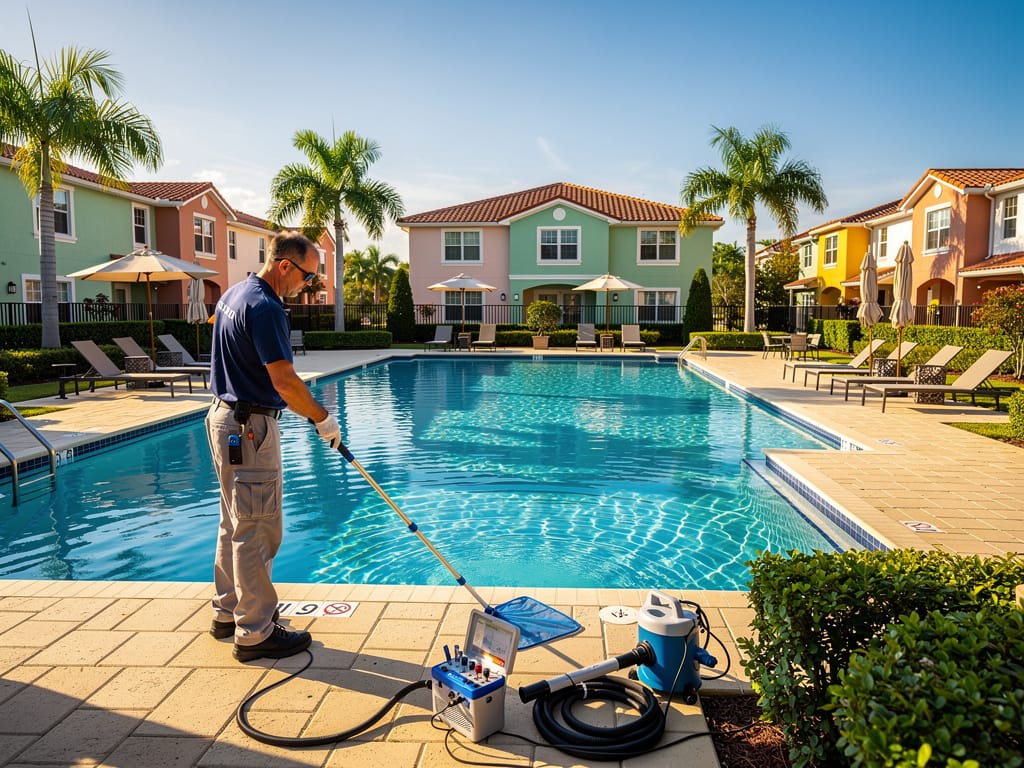
Quick Answer: HOA pool service in Margate, FL must meet Florida Department of Health semi-public pool requirements — chemistry documentation on-site after every visit, free chlorine ≥ 1.0 ppm, pH 7.2–7.8, and availability for unannounced Broward County Health Department inspection. Margate’s high concentration of condominium buildings and HOA communities makes this the city’s most common commercial pool service scenario. HOA boards in Margate should require compliance documentation, CPO certification if specified by bylaws or insurance, and a named emergency contact with defined response time in any service contract.
Margate has one of northwest Broward County’s higher concentrations of HOA-governed residential communities — condominium buildings, townhome associations, and planned unit developments spread throughout the city, particularly along the Banks/Hammondville corridor and in the numerous developments built in the late 1970s through 1990s. Common-area pools in these communities are governed by Florida’s semi-public pool regulations under Chapter 514, Florida Statutes, enforced locally by the Broward County Health Department. HOA boards in Margate that manage common-area pool service have both a compliance obligation and a resident amenity responsibility to meet.
Florida DOH Requirements for Margate HOA Pools
Chemistry Standards
- Free chlorine: Minimum 1.0 ppm at all times (or 3.0 ppm bromine as alternative sanitizer)
- pH: 7.2–7.8, documented at each service visit
- Combined chlorine (chloramines): Not to exceed 0.2 ppm per 1.0 ppm free chlorine
- Total alkalinity: 60–180 ppm (Florida DOH range; 80–120 is the operational target for stability)
Documentation Requirements
Chemistry logs must be maintained on-site at the pool — not in the service company’s database, not in the property manager’s office, not “available upon request.” Florida DOH inspectors arrive unannounced and expect to find chemistry records physically at the pool. Logs must show: test date and time, all parameters tested with actual readings, chemicals added with quantities, and the technician’s name and license number. A single incomplete log entry is a compliance finding; missing the log entirely is grounds for pool closure.
Safety Equipment
Ring buoy with throw rope, shepherd’s hook/pole, first aid kit, proper depth markings, no-diving signage where required, and posted emergency phone number. Broward County Health Department inspectors check safety equipment during inspections — missing items produce compliance findings even when chemistry is perfect.
Inspection Reality for Margate HOA Boards
Broward County Health Department inspectors may arrive at a Margate HOA pool unannounced at any time. An inspector who finds chemistry out of range, missing safety equipment, or incomplete documentation has authority to close the pool immediately. For a Margate condominium with 50–200 residents sharing a single pool, closure is an immediate community relations and liability problem. The board’s defense against this scenario is a service contract that explicitly requires compliance documentation, has defined the specific on-site storage location for chemistry logs, and includes a named technician who is accountable for compliance at every visit.
What Margate HOA Boards Should Require From Their Pool Service Contract
Written Chemistry Documentation at Every Visit
Not “available upon request” — physically on-site at the pool after every service visit, in a binder at the equipment room or poolside cabinet. Specify this in the contract language: “Chemistry records shall be maintained on-site at the pool facility in a designated binder, updated at each service visit.”
Named Technician Assigned to the Account
HOA management companies in Margate consistently require a named technician with consistent assignment — both for relationship continuity and because the technician who signs the chemistry log is accountable for that visit’s compliance record. Service companies that resist this requirement are signaling how they manage routes.
CPO Certification Verification
Check your HOA’s governing documents and condo association insurance policy. The Certified Pool Operator (CPO) credential from PHTA is required by many Florida HOA bylaws and insurance policies for common-area pool service. This is separate from the company’s CPCO contractor license — it applies to the technician assigned to your property. Require the assigned technician’s CPO certification number in writing if your documents require it.
Emergency Response Terms
Define in the contract: “In the event of pool closure by Broward County Health Department or chemistry out of compliance, service company shall respond within [4/8/24] hours.” A company that won’t commit to emergency response terms is a risk for any Margate HOA with ongoing compliance obligations.
For HOA and condo pool service in Margate, FL — condominium buildings, townhome associations, and all HOA communities throughout the city — call Fort Lauderdale Pool Service at (954) 501-2754 or see our Margate service page.
Frequently Asked Questions
What Florida law governs HOA pool service in Margate?
Florida Statutes Chapter 514 and the Florida Administrative Code govern semi-public pools (HOA and condo common-area pools) in Margate. Broward County Health Department enforces these standards locally with unannounced inspection authority. Requirements include: free chlorine ≥ 1.0 ppm, pH 7.2–7.8, combined chlorine within compliance range, chemistry logs on-site after every visit, and required safety equipment. Non-compliance can result in immediate pool closure.
How often does the health department inspect HOA pools in Margate?
Broward County Health Department inspects on an unannounced schedule — there is no predictable inspection frequency you can plan around. HOA pools in Broward County may be inspected multiple times per year or go longer between inspections. The compliance posture required is readiness for inspection at every moment the pool is open. Chemistry must be in range, logs must be on-site and complete, and safety equipment must be in place. Any gap in any of these creates compliance liability regardless of when the actual inspection occurs.
What should a Margate HOA contract include for pool service?
Six required elements: (1) named technician assigned to the account; (2) service frequency (weekly minimum); (3) chemistry parameters required at each visit with documentation method and on-site storage location specified; (4) chemicals included with no separate billing; (5) CPO certification requirement if specified by HOA documents or insurance; (6) emergency response time commitment (hours from contact to on-site response for compliance emergencies). Absence of any of these elements creates either compliance liability or financial surprise for the HOA.
Can a Margate HOA be fined for pool chemistry violations?
Yes — Broward County Health Department can issue citations for semi-public pool violations in Margate, which may include fines and closure orders. More significantly, a pool closure due to chemistry violations creates resident complaints, potential legal liability if a resident can demonstrate they were harmed by a non-compliant pool, and insurance complications depending on your condo association’s policy terms. The HOA board’s best protection is a service contract that makes compliance documentation mandatory and enforceable, with a named technician accountable for every visit’s chemistry log.
How much does HOA pool service cost in Margate compared to residential?
Significantly more. Residential weekly pool service in Margate: $80–$125/month. HOA/condo common-area pool service: $175–$500+/month. The premium reflects: higher bather load chemistry demands (more chemical consumption per week), Florida DOH compliance documentation system and accountability, commercial contract terms (emergency response commitment, named technician, additional insured on liability policy), and larger pool volumes consuming more chemicals per service visit. The compliance and accountability tier is the primary cost driver — not arbitrary commercial markup.