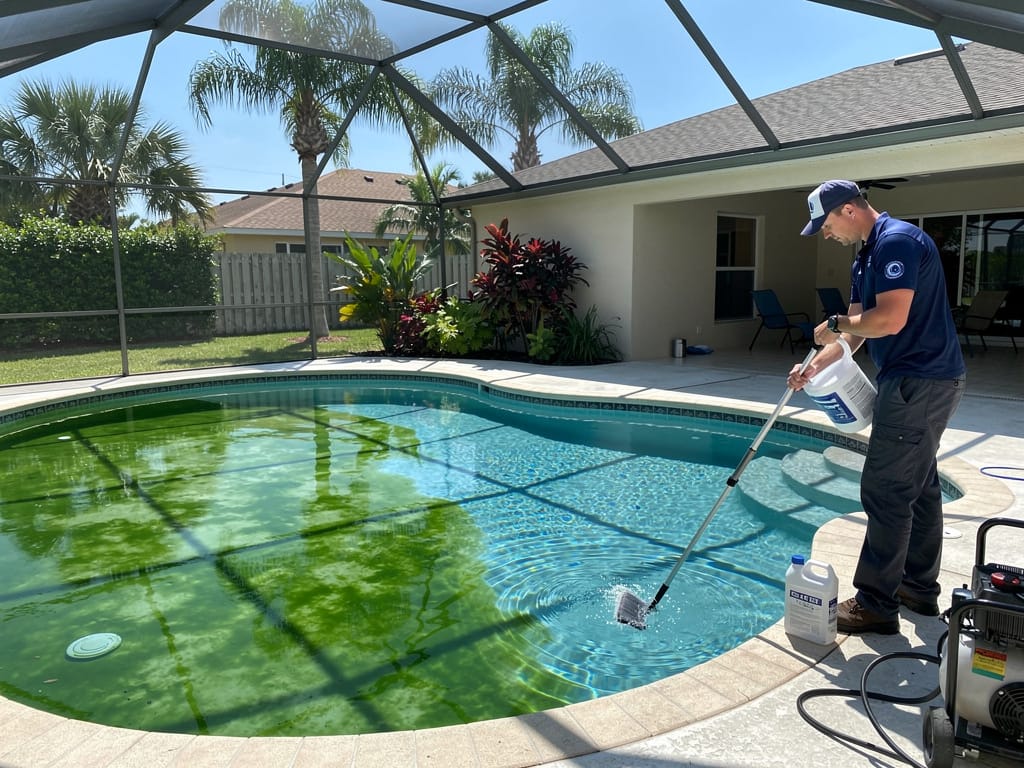
Quick Answer: Green pool recovery in Margate, FL costs $150–$350 for a standard residential pool and takes 24–96 hours to clear depending on severity. Margate’s year-round heat and wet season rainfall create consistent conditions for green pool development when service lapses, chemistry drifts, or equipment fails. Post-storm recovery requires chemistry testing before any chemical addition — never shock a pool with unknown chemistry. For Margate’s 1970s–80s plaster pools, aggressive shock treatment without pH adjustment first can damage older plaster surfaces that are more sensitive to chemical extremes than newer pool surfaces.
Green pools are one of the most common pool service emergencies in Margate. South Florida’s year-round heat means algae growth conditions exist 12 months a year — unlike northern climates where cold temperatures suppress algae during off-season months. In Margate, a pool that misses one weekly service visit during summer can begin showing visible green within 2–3 days. Understanding the recovery process, realistic timelines, and what prevents recurrence helps Margate pool owners respond effectively and avoid the same problem repeating.
Green Pool Recovery Process in Margate
Step 1: Diagnosis and Chemistry Testing (Day 1)
Before any chemical addition, a complete water test is required: pH, free chlorine, total alkalinity, calcium hardness, CYA, and phosphates. This is not optional — adding shock to a pool with unknown chemistry can produce dangerous chlorine gas from extreme pH imbalance, fail to deliver the calculated chlorine yield if pH is too high, damage older Margate plaster if pH is severely low, or waste expensive chemicals on conditions that defeat them. For post-storm recovery where rain has substantially diluted and altered chemistry, this testing step is particularly important.
Step 2: pH and Alkalinity Adjustment (Day 1)
Shock treatment requires pH in the 7.2–7.4 range to be maximally effective. If pH is above 7.6 before shocking, a significant portion of the chlorine added will be in the ineffective hypochlorite form rather than the active hypochlorous acid form. Adjust pH and alkalinity to target range before adding shock. For Margate’s older plaster pools, this pre-shock pH adjustment also protects the surface — extremely low pH shock treatment to a pool with pH already depressed by rainfall causes accelerated plaster etching.
Step 3: Shock Treatment (Day 1)
Bring the pool to shock level: 10 ppm for light green algae, 20–30 ppm for moderate to dark green. Calcium hypochlorite (granular shock) is the standard product for South Florida green pool recovery. The pump runs continuously — 24 hours/day — throughout the recovery period. Algaecide may be added as a secondary treatment for persistent cases or where black algae is present alongside the green bloom.
Step 4: Brush All Surfaces (Day 1)
Brushing all pool surfaces immediately after shock treatment breaks up algae mats, disrupts surface biofilms, and exposes embedded algae organisms to the elevated chlorine level. In Margate’s older pools where plaster surfaces are rougher than new construction, brushing is particularly important — rough plaster provides significantly more algae attachment surface. Brush walls, floor, steps, ledges, and waterline areas. Use a nylon brush on standard plaster; stainless steel only for severe black algae requiring mechanical disruption.
Step 5: Filter and Clarify (Days 1–3)
The filter runs continuously throughout recovery. As algae dies and becomes suspended matter, the filter captures it. When the filter pressure rises 8–10 psi above the clean baseline (sand/DE filter) or the cartridge shows heavy loading, backwash or clean immediately — a loaded filter during green pool recovery severely slows clearing. Clarifier or flocculant helps dead algae particles coagulate for capture.
Step 6: Vacuum and Final Test (Days 2–3)
As the water clears, vacuum the pool floor to remove settled dead algae debris. Final water test confirms chemistry is in range before the pool is returned to use. Free chlorine should be 1–3 ppm (not shock level) before swimming — shock-level chlorine is a skin and eye irritant.
Common Causes of Green Pools in Margate
- Missed weekly service visit in summer heat
- Post-storm chemistry dilution dropping chlorine below 1.0 ppm
- Pump or timer failure stopping circulation for 24+ hours
- CYA above 80 ppm (stabilizer lock) reducing chlorine efficacy
- High phosphates fueling algae growth despite adequate chlorine
For green pool recovery in Margate, FL — residential and HOA pools throughout Banks/Hammondville corridor and all Margate neighborhoods — call Fort Lauderdale Pool Service at (954) 501-2754 or see our Margate service page.
Frequently Asked Questions
How long does it take to clear a green pool in Margate?
24–48 hours for light early green algae with proper shock level, continuous pump operation, and filtration running continuously. Moderate green: 48–72 hours. Dark green or pea-soup: 72–96 hours, potentially requiring partial water replacement if chemistry is severely compromised. Black algae: 7–14 days minimum, often longer on Margate’s older rougher plaster surfaces that provide more embedding depth for black algae root structures. These timelines assume correct pH-first adjustment before shock, adequate shock level, and continuous filtration — not just dumping shock into an unbalanced pool.
How much does green pool treatment cost in Margate?
$150–$350 for standard residential green pool recovery. Light green pool caught early: toward the lower end. Dark green or pea-soup requiring multiple service visits, high chemical volume, and possible partial drain-and-refill: toward the upper end. Black algae treatment on older Margate plaster surfaces: typically $300–$500+ due to the multi-week treatment course, repeated brushing visits, and higher chemical volume. One green pool event per quarter eliminates the cost advantage of any “affordable” pool service that failed to prevent it.
My Margate pool turns green every summer — what’s causing it?
Recurring summer green pools in Margate typically have one of three root causes: (1) insufficient service frequency — bi-weekly or less-than-weekly chemistry management in Margate’s summer heat is insufficient to maintain continuous algae prevention; (2) CYA above 80 ppm (stabilizer lock) — chlorine appears adequate on testing but disinfects poorly; (3) high phosphates feeding algae through periods of chemistry drift. A professional should test CYA and phosphates specifically, as these are the two most commonly overlooked causes of recurring green pool conditions in Broward County’s older residential pool market.
Is green pool recovery harder on older Margate plaster pools?
Yes, in two ways: (1) Older rougher plaster provides more surface area for algae attachment and embedding — brushing must be more thorough and black algae recovery in particular takes longer because the organisms are embedded deeper in porous older plaster; (2) Chemical extremes during aggressive shock treatment (especially low pH combined with high chlorine) are more damaging to older plaster than to new surfaces. The solution is proper pH adjustment before shock, not less effective shock — an undershocked green pool takes longer to recover and may require repeat treatments, which is harder on the plaster than a single correct treatment.
Can I treat a green pool myself in Margate?
Yes, for light green conditions: test all chemistry first (get a liquid reagent test kit, not just test strips), adjust pH to 7.2–7.4, add calcium hypochlorite shock at 1 lb per 10,000 gallons (light green) to 2–3 lbs per 10,000 gallons (dark green), brush all surfaces, run the filter continuously, and backwash when pressure rises. For moderate to dark green pools, pea-soup conditions, or black algae: professional service is typically faster, cheaper total, and less risky to older Margate plaster surfaces. DIY green pool treatment that goes wrong (wrong chemistry sequence, wrong chemical amounts, wrong product selection) can create surface damage that costs far more than the service call would have.