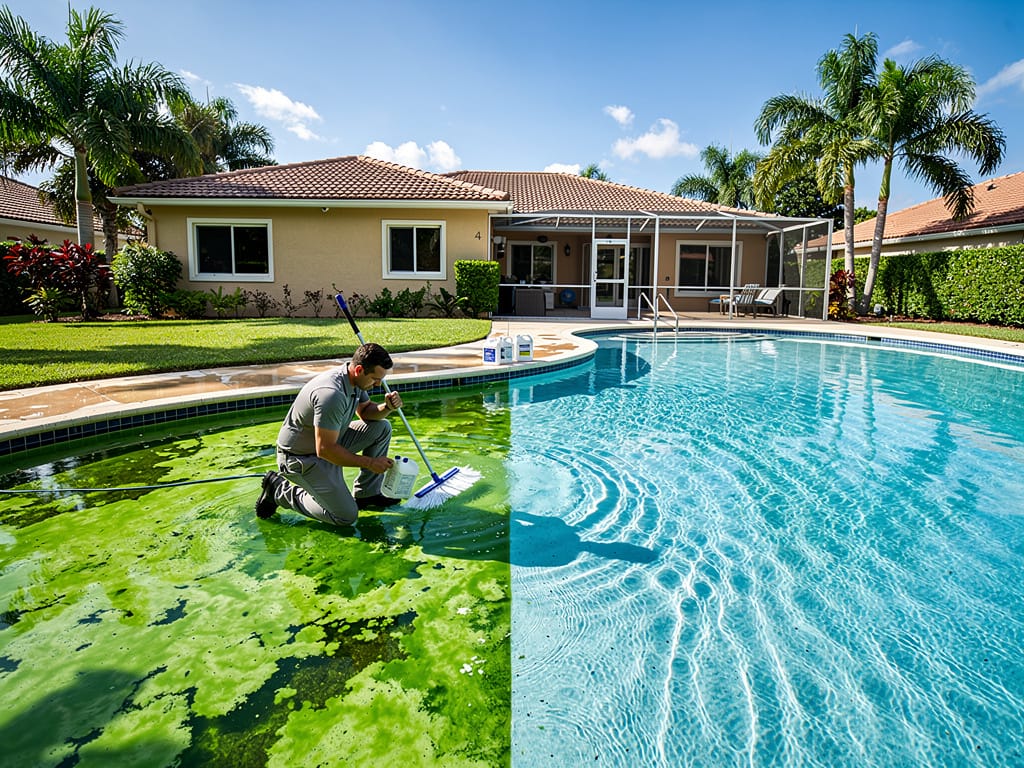
Quick Answer: Green pool recovery in Lauderhill, FL costs $150–$350 for a standard residential pool and requires 24–72 hours to clear, depending on algae severity. Lauderhill’s year-round heat and wet season (June–September) make green pools a common outcome of service lapses, chemical depletion after heavy rain, or equipment downtime. Post-storm green pool recovery requires water testing before chemical addition — do not apply shock to a pool with unknown chemistry.
Lauderhill’s climate creates consistent green pool conditions: summer water temperatures of 84–90°F, heavy rainfall June through September that depletes chemistry and introduces organic material, and year-round UV exposure that breaks down unstabilized chlorine within hours. A pool that misses one weekly service visit during summer can develop visible algae within days. Green pool recovery in Lauderhill is a routine service need, not an unusual event.
The Green Pool Recovery Process in Lauderhill
Stage 1: Diagnosis (Day 1)
Before any chemical addition, the pool is tested: pH, free chlorine, total alkalinity, calcium hardness, CYA, and phosphates. This is not optional — adding shock to a pool with unknown chemistry can create dangerous chlorine gas, damage equipment, or fail to produce the chlorine yield the calculation assumed. In Lauderhill, post-storm recovery is particularly important to test first: heavy rainfall significantly dilutes and alters pool chemistry.
Stage 2: Shock Treatment (Day 1)
The pool is brought to shock level — typically 10–30 ppm free chlorine depending on algae severity (green = lighter; black = maximum). pH is adjusted to 7.2–7.4 before shock addition to maximize chlorine efficacy. Calcium hypochlorite (granular shock) is the most common product for green pool recovery in South Florida. Algaecide may be added for persistent or black algae as a secondary treatment. The pool pump runs continuously through recovery.
Stage 3: Brush and Filter (Days 1–2)
All pool surfaces are brushed to break up algae mats and expose embedded organisms to the shock treatment. Brushing is particularly important on the 1970s–80s plaster surfaces common in Lauderhill — older, slightly roughened plaster provides more surface for algae to embed than smooth newer surfaces. The filter is cleaned (backwashed for sand/DE; element cleaning for cartridge) and runs continuously, typically 24 hours per day through recovery.
Stage 4: Clarifier and Vacuuming (Days 2–3)
As the algae dies and the water begins to clear, a clarifier or flocculant is often added to help dead algae particles coagulate and fall to the pool floor or get captured by the filter. The pool floor is vacuumed — either to waste (bypassing the filter to remove dead algae load) or through the filter if algae load is moderate. Second water test confirms chemistry is within range before the pool is declared cleared.
Recovery Timeline
- Light green (early algae): 24–48 hours to clear with proper shock and filtration
- Moderate green: 48–72 hours typically
- Dark green / pea soup: 72–96 hours; may require partial water replacement if chemistry is severely compromised
- Black algae: 7–14 days; black algae has root structures that penetrate plaster and require repeated brushing and chemical treatment
Post-Storm Green Pool Recovery in Lauderhill
Lauderhill receives significant rainfall during wet season — a single major storm event can add 3–8 inches of rain in 24–48 hours, substantially diluting pool chemistry. If your pool turns green after a major rain event: (1) test all parameters before adding any chemicals; (2) rebalance pH and alkalinity first before shocking; (3) run the pump continuously through recovery; (4) do not use the pool until free chlorine returns to 1–3 ppm range and the water is visually clear. If the storm caused power outage and the pump was off for 24+ hours, accelerated algae growth is expected — schedule service as soon as power is restored.
For green pool recovery in Lauderhill, FL — residential and HOA pools throughout Inverrary, SR-7 corridor, and all Lauderhill neighborhoods — call Fort Lauderdale Pool Service at (954) 501-2754 or see our Lauderhill service page.
Frequently Asked Questions
How long does it take to clear a green pool in Lauderhill?
24–48 hours for light early-stage green algae with continuous pump operation, proper shock level, and filtration running continuously. Moderate green pools: 48–72 hours. Dark green or pea-soup pools: 72–96 hours, sometimes requiring partial water replacement. Black algae: 7–14 days minimum, often longer on older plaster surfaces common in Lauderhill’s 1970s–80s housing stock. These timelines assume correct chemistry diagnosis and shock calculation first, not just dumping shock into an unbalanced pool.
What causes a Lauderhill pool to turn green?
Five common causes in Lauderhill: (1) missed weekly service during summer — heat and UV make algae establishment fast; (2) post-storm chemistry dilution when chlorine drops below 1.0 ppm and algae conditions exist; (3) pump or equipment failure stopping circulation (no circulation + South Florida heat = green pool within 24–48 hours); (4) CYA over 80 ppm (stabilizer lock) reducing chlorine efficacy even when readings appear normal; (5) chemical depletion between service visits in extreme summer heat without CYA protection.
How much does green pool recovery cost in Lauderhill?
$150–$350 for standard residential green pool recovery, depending on severity and pool size. Light green treated quickly: toward the lower end. Dark green or pea-soup pools requiring 2–3 service visits, high chemical volume, and possible partial drain-and-refill: toward the upper end or above. Black algae treatment is typically more expensive due to the multi-week treatment course. Costs above $350 usually involve severely compromised chemistry requiring significant water replacement or extensive labor for repeated physical brushing of embedded black algae.
My Lauderhill pool turned green after a hurricane — what should I do?
Step 1: Remove visible debris before running the pump — large debris can damage equipment or clog the filter. Step 2: Test all chemistry (pH, chlorine, alkalinity) before adding anything — post-storm chemistry is highly variable and unknown. Step 3: Rebalance pH and alkalinity first; then shock at appropriate level once pH is 7.2–7.4. Step 4: Run the pump continuously. Step 5: If power was out for 24+ hours, expect algae regardless of pre-storm chemistry — even a clean, well-maintained pool can turn green with 24 hours of no circulation in Lauderhill’s summer heat.
Can I prevent green pool conditions in Lauderhill during wet season?
Weekly professional chemistry management is the primary prevention. Additional practices for Lauderhill wet season: maintain CYA at 30–50 ppm to stabilize chlorine against UV degradation between service visits; keep pump run time at 8–10 hours/day minimum (many Lauderhill homeowners set 6 hours — insufficient during summer); schedule a chemistry check after any major rain event that adds 3+ inches if your next regular service is more than 3 days away; maintain phosphate levels below 500 ppb as high phosphates are a major algae fuel source.