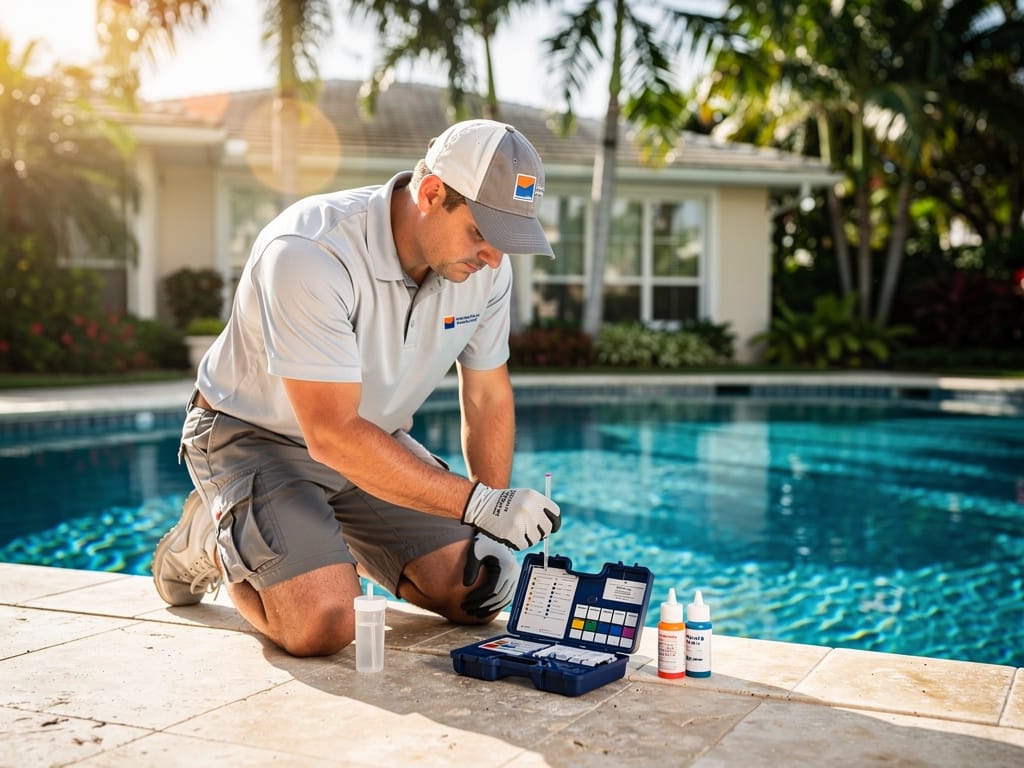
Quick Answer: Pool chemical balancing in Hallandale Beach, FL targets the same parameters as any Florida pool — pH 7.2–7.6, free chlorine 1–3 ppm, total alkalinity 80–120 ppm, calcium hardness 200–400 ppm, CYA 30–50 ppm — but Hallandale Beach’s coastal location adds one real variable: elevated total dissolved solids (TDS) from ocean spray that enters pools near the A1A corridor. High TDS from coastal proximity reduces chemical efficiency and may require partial drain-and-refill to maintain balance.
Pool water chemistry in Hallandale Beach follows Florida standards, but the city’s oceanfront position creates one chemistry challenge that inland Broward cities don’t face to the same degree: coastal TDS accumulation. Understanding how this affects chemical balance — and how to manage it — is what separates coastal-experienced pool service from generic Florida pool service.
The Five Core Parameters and Their Hallandale Beach Context
pH (Target: 7.2–7.6)
pH is the most critical and most frequently out-of-range parameter in any Broward County pool. South Florida’s rainfall is slightly acidic (pH ~5.5–6.0), consistently pulling pool pH down. Bather activity and the introduction of body oils and organics in high-load condo pools also affects pH. The result: pH in Hallandale Beach pools tends to drift low (acidic) and requires upward adjustment (sodium carbonate or sodium bicarbonate) more often than downward adjustment. Low pH is aggressively corrosive to pool equipment — particularly in Hallandale Beach’s coastal environment where equipment is already under salt air pressure.
Free Chlorine (Target: 1–3 ppm; Commercial Pools ≥ 1 ppm Free plus ≤ 3 ppm Combined)
Chlorine efficacy in Hallandale Beach is driven by UV intensity. UV index 10–11 in summer destroys unstabilized chlorine within hours. CYA (cyanuric acid) is the stabilizer that extends chlorine’s UV resistance — but CYA must be managed carefully, as CYA that climbs above 80 ppm (the “stabilizer lock” threshold) reduces chlorine’s disinfection power even though the ppm readings look correct. For condo pools, Florida DOH standards set specific free chlorine and combined chlorine limits for compliance.
Total Alkalinity (Target: 80–120 ppm)
Total alkalinity is the buffer that keeps pH stable between service visits. Low TA allows pH to swing wildly — a particular problem in Hallandale Beach where frequent rain events (June–September) and high bather loads in condo pools put consistent downward pressure on pH. High TA makes pH sluggish to adjust. The goal is to maintain TA in range so that the weekly pH correction is a small adjustment, not a major rescue.
Calcium Hardness (Target: 200–400 ppm)
Hallandale Beach draws from South Florida’s municipal water supply, which is moderately hard. Calcium hardness below 200 ppm produces corrosive water that leaches calcium from pool plaster — accelerating surface deterioration that is already under some pressure from coastal exposure. Above 400 ppm, calcium scaling on surfaces and equipment becomes a concern. In long-running pools — particularly snowbird properties that haven’t had a partial drain-and-refill in years — calcium hardness can creep up through evaporation concentration.
CYA (Target: 30–50 ppm)
CYA accumulates in outdoor pools through granular trichlor additions and doesn’t dissipate except by dilution (rain or partial drain). In Hallandale Beach snowbird properties that receive heavy rain all summer without service, CYA can actually be diluted below effective range by summer rainfall — the opposite of the stabilizer-lock problem. Regular CYA testing at the start of service is the correct approach.
The Hallandale Beach Coastal TDS Variable
Total dissolved solids (TDS) measure the cumulative load of all dissolved material in pool water — chemicals added, rain dilution and evaporation concentration cycles, organic matter from bathers, and in Hallandale Beach’s near-coastal environment, chloride ion accumulation from salt air aerosol that settles into pool water.
This coastal TDS contribution is real but modest for most Hallandale Beach properties — it compounds over years in pools without periodic partial drain-and-refill. High TDS has two consequences:
- Reduced efficiency of chemical additions (more chemical needed to achieve the same parameter change)
- Salt-like water feel that some pool users find objectionable
For oceanfront A1A corridor properties and coastal waterfront communities like Golden Isles and Three Islands, TDS testing every 12–18 months is appropriate. Partial drain-and-refill (30–40% of pool volume) when TDS climbs above 1,500 ppm is the standard management approach.
For professional pool chemical balancing in Hallandale Beach, FL — residential, condo HOA, and coastal properties from Golden Isles to Gulfstream Park — call Fort Lauderdale Pool Service at (954) 501-2754 or see our Hallandale Beach service page.
Frequently Asked Questions
What pool chemical parameters need to be balanced in Hallandale Beach?
The five core parameters: pH (target 7.2–7.6), free chlorine (1–3 ppm residential; Florida DOH minimums for condo and HOA pools), total alkalinity (80–120 ppm), calcium hardness (200–400 ppm), and CYA (30–50 ppm). In Hallandale Beach, total dissolved solids should also be tested annually on coastal and near-oceanfront properties due to salt air aerosol contribution over time.
Does ocean proximity affect pool chemistry in Hallandale Beach?
Yes, but indirectly. Salt air from the Atlantic doesn’t dramatically change pH or chlorine behavior — its main chemistry impact in Hallandale Beach pools is gradual TDS accumulation from chloride ions in salt air aerosol settling into the water over years. This effect is most pronounced on A1A corridor properties and waterfront communities like Golden Isles. Annual TDS testing is recommended; partial drain-and-refill when TDS exceeds 1,500 ppm is the management approach.
Why does my Hallandale Beach pool need more chlorine in summer?
South Florida’s summer UV intensity (UV index 10–11) degrades chlorine rapidly through photolysis. Higher CYA stabilizer levels extend chlorine’s UV resistance, but this is carefully balanced — CYA above 80 ppm reduces chlorine’s disinfection power. In summer, pools in Hallandale Beach also receive more rainfall, diluting all chemistry simultaneously. More frequent chemistry testing and adjustment may be appropriate during peak summer months, particularly for high-bather-load condo pools.
What Florida DOH chemical requirements apply to Hallandale Beach condo pools?
Florida’s pool regulations require: free chlorine ≥ 1.0 ppm (or 3.0 ppm bromine as alternative), combined chlorine (chloramines) ≤ 0.2 ppm per 1.0 ppm free chlorine, pH 7.2–7.8, and documented chemistry logs. The Broward County Health Department (which implements Florida DOH standards) may inspect condo pools unannounced. Non-compliant chemistry requires the pool to close until corrected. Consult your pool service company and Broward County Health Department for current standards.
Should a Hallandale Beach snowbird pool be shocked before the owner returns in fall?
Yes. When seasonal owners return to Hallandale Beach in fall, their pool should receive a full chemistry assessment and often a prophylactic shock treatment regardless of whether the water appears green. Pools that have been under weekly service all summer are typically in balance — but a thorough service visit immediately before or shortly after the owner’s arrival, including a 5-point chemistry test and equipment inspection, confirms the pool is ready for use. Ask your service company to schedule a fall startup visit coordinated with your arrival date.