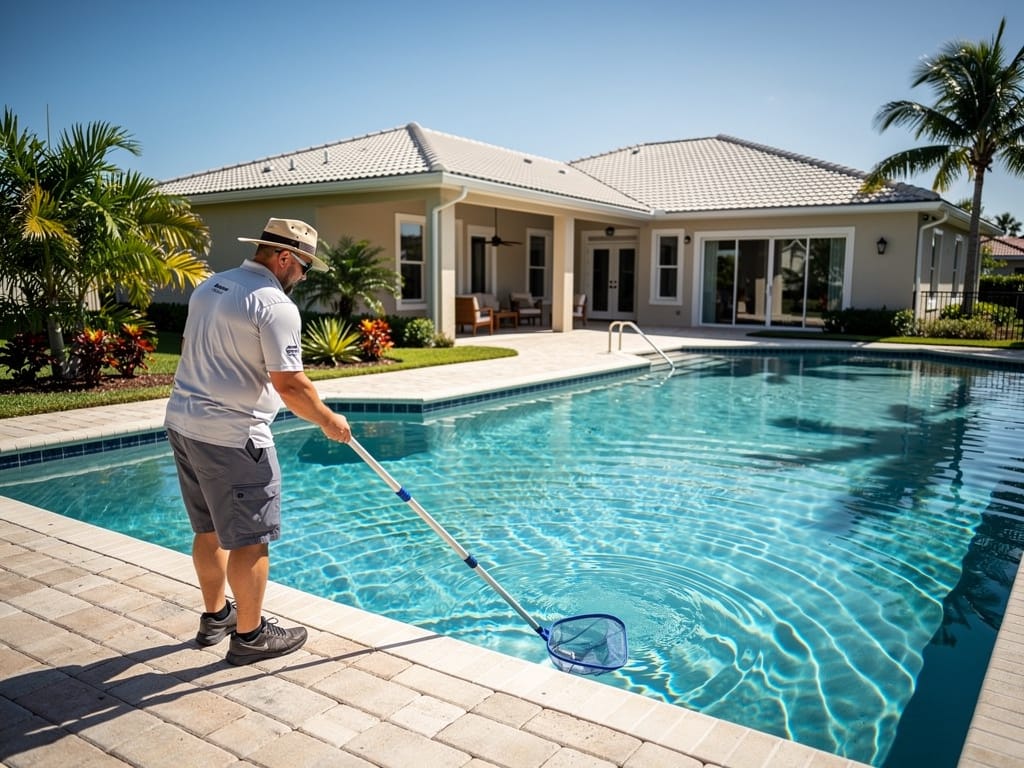
Quick Answer: In Deerfield Beach, FL, your pool needs professional service every 7 days without exception. The combination of South Florida heat (85–91°F pool water in summer), year-round UV, and 60″+ annual rainfall keeps chemistry volatile week-to-week. Older pools in Cypress Bend and Deer Run — with less efficient filtration equipment — are particularly sensitive to extended service intervals.
Deerfield Beach homeowners sometimes ask whether bi-weekly service is acceptable or whether winter service frequency can be reduced. The answer is more nuanced here than in some Broward cities — because Deerfield Beach’s older housing stock and canal-adjacent properties introduce factors that make consistent weekly service even more important, not less.
The Case for Weekly Service in Deerfield Beach
South Florida Climate: The Universal Argument
Every pool in Broward County shares the same climate pressure: algae grows exponentially above 78°F water temperature, and Deerfield Beach pool water exceeds this threshold roughly 300+ days per year. UV intensity of 10–11 (Extreme) in summer burns chlorine rapidly. Heavy rainfall June–September dilutes pool chemistry weekly. These aren’t theoretical risks — they’re predictable, seasonal facts that determine what a safe service interval looks like.
Weekly service in Deerfield Beach isn’t a luxury option. It’s the minimum interval that reliably prevents algae growth, maintains safe chemistry, and catches equipment issues before they escalate.
Older Equipment Pools: The Deerfield Beach Argument
Pools built in the 1970s and 1980s — common in Cypress Bend, Deer Run, and central Deerfield Beach — typically have less efficient filtration systems than modern pools. Older single-speed pumps run at fixed flow rates rather than adjusting to demand. Sand filters with aged media have reduced filtration efficiency. Older plumbing has more potential leak points.
What this means practically: older Deerfield Beach pools are less tolerant of extended service intervals than newer pools with modern variable-speed pumps and efficient filtration. A 14-day service gap that a well-equipped 2015 pool might weather without incident can result in visible algae or a chemistry correction job on a 1982 pool with a reduced-efficiency filter.
Snowbird Properties: A Deerfield Beach-Specific Risk
A significant share of Deerfield Beach homeowners spend summers away — the 55+ and retiree demographic in Deer Creek and western Deerfield communities is well-established. An unoccupied pool in a Deerfield Beach summer is not a low-maintenance pool. It’s still exposed to the same UV, heat, and rain as an occupied pool — but without an owner present to notice that the water is clouding, the pump is making a new sound, or the chemistry has drifted.
Weekly professional service on a vacant property is essential. The alternative — letting service lapse during summer absence — typically produces one of two outcomes: a green pool emergency that costs $200–$400 to correct, or an undetected equipment failure that causes additional damage while the owner is unreachable. Neither outcome is cheaper than the weekly service visits that would have prevented it.
Wet Season and Post-Rain Recovery
Deerfield Beach receives substantial rainfall June through September — the same months when algae pressure is highest. A single 2-inch rain event can drop free chlorine by 1–2 ppm, pushing a well-maintained pool toward the danger threshold within hours. In a bi-weekly service schedule, the post-rain chemistry drop is not addressed until the next scheduled visit — which may be 12 more days away, in 90°F heat.
For canal-front properties in Deerfield Isle and The Cove, post-rain events can also introduce groundwater minerals through pool walls, shifting calcium hardness and alkalinity. Weekly service catches this pattern; bi-weekly service consistently misses it.
What Deerfield Beach “Winter” Pool Chemistry Really Looks Like
December through March is as close as Deerfield Beach gets to a lower-demand season. Pool water temperatures drop to 65–74°F — cooler, but still above the 60°F threshold below which algae growth is genuinely slow. Rain continues year-round. Equipment runs continuously. Deer Creek snowbird properties are in use as owners have returned from the north.
Some pool companies offer modest winter pricing adjustments (10–15% off) while maintaining weekly frequency. Reducing frequency — not price — is not the right tradeoff for Deerfield Beach pools, regardless of season.
For professional weekly pool service in Deerfield Beach — including Deer Creek, Deerfield Isle, Cypress Bend, Deer Run, and the Quiet Waters Park corridor — call Fort Lauderdale Pool Service at (954) 501-2754 or see our Deerfield Beach service page.
Frequently Asked Questions
Can I get bi-weekly pool service in Deerfield Beach?
Bi-weekly service in Deerfield Beach reliably results in algae problems, chemical correction costs, and missed equipment issues during the April–November warm season. The math doesn’t work: a single green pool treatment ($150–$325) typically costs more than the months of savings from bi-weekly service. This is especially true for older Deerfield Beach pools with less efficient filtration systems.
Should I stop pool service when I leave Deerfield Beach for the summer?
No. An unoccupied Deerfield Beach pool in summer requires the same chemistry maintenance and equipment monitoring as an occupied one — there’s no “rest mode” for pool chemistry in South Florida heat. Stopping service during summer absence virtually guarantees a significant correction cost when you return, plus any equipment damage that occurred undetected while the property was empty.
How fast can a Deerfield Beach pool turn green?
In peak summer heat (July–September), a pool with depleted chlorine can show visible algae growth within 36–72 hours. Older Deerfield Beach pools with reduced filtration efficiency may trend green faster than newer pools with higher-volume circulation. A pool left without service for 10–14 days during summer almost always needs some level of shock treatment to restore clarity.
How does rain affect pool service frequency in Deerfield Beach?
Significant rain events (1.5″+ in 24 hours) dilute pool chemicals — dropping free chlorine by 1–2 ppm in a single event during peak summer. This alone doesn’t necessarily require an emergency service call, but it underscores why weekly service is the minimum interval for Deerfield Beach: if your last service was 14 days ago and it just rained 2 inches, your pool chemistry may have experienced two disruption events before the next scheduled visit.
Do I need more frequent service for an older pool in Deerfield Beach?
Weekly service is the same frequency for older and newer pools. The difference is in what happens during each visit: older Deerfield Beach pools need more careful equipment inspection, closer attention to filtration efficiency, and more proactive communication about aging components. A weekly service frequency with thorough inspection is the appropriate standard for any Deerfield Beach pool, regardless of age.