Plantation is one of Broward County’s most established and desirable communities — a planned city built out from the 1950s through the 1980s with wide boulevards, mature canopy streets, and some of the most well-maintained residential properties in the county. It’s also a city where the pool stock runs older than Broward’s average, where a significant portion of homes have pools that have been in service for 30–50 years, and where the combination of mature landscaping and inland chemistry conditions creates a maintenance environment that rewards experienced, attentive service providers and exposes the shortcuts taken by inattentive ones. This guide covers the conditions Plantation pool owners face: local water chemistry, neighborhood-specific maintenance profiles, seasonal dynamics, and what separates good pool service from adequate pool service in this market.
Plantation Pool Chemistry: The Local Conditions
Plantation’s water supply draws from Broward County’s municipal system, with chemistry characteristics similar to central Broward broadly: calcium hardness typically in the 240–310 ppm range, alkalinity at the high end of ideal pool range, and a water profile that trends toward scale formation under South Florida’s evaporation rates. As an inland community — sitting roughly 8 miles from the coast — Plantation doesn’t benefit from the mild coastal buffering that moderates chemistry swings in beachside markets.
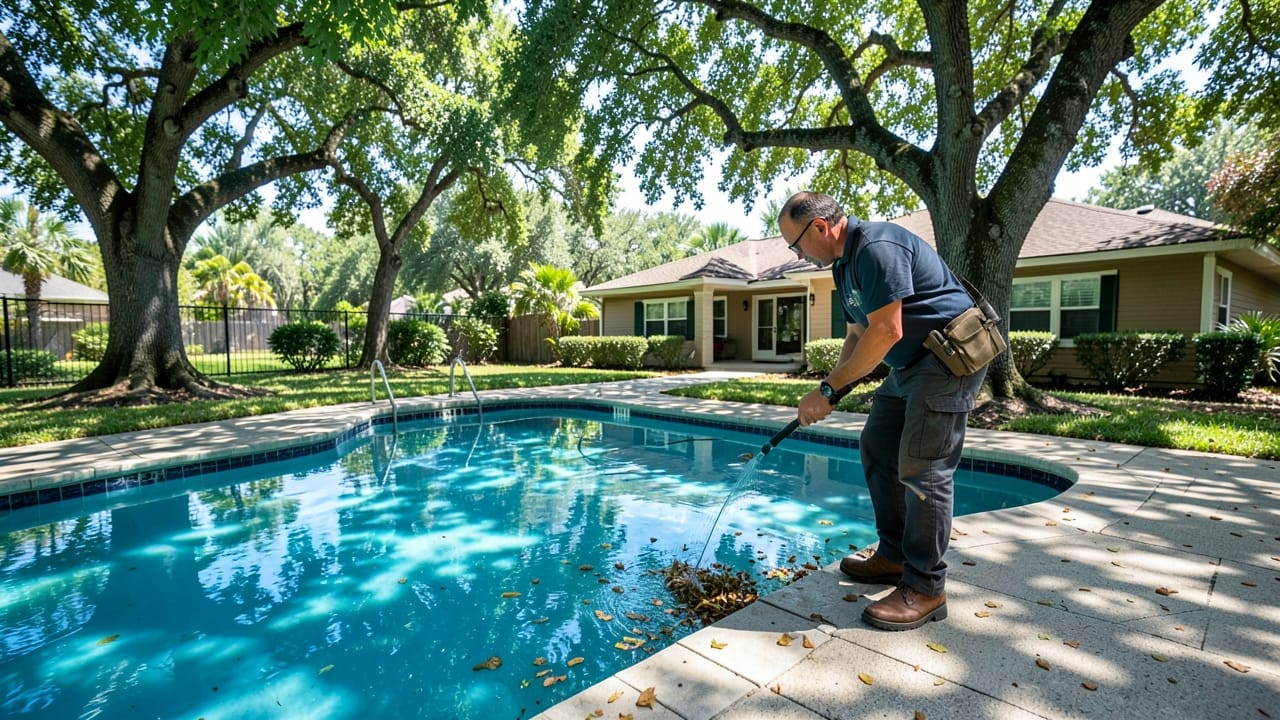
Plantation’s signature pool chemistry challenge is its tree canopy. The city’s street tree program and its decades of residential landscaping maturity have produced one of the densest urban canopies in Broward County. Large live oaks, royal poincianas, and mature tropical specimen trees line the residential streets and overhang pools in proportions that would be unusual in newer suburban developments. This canopy contributes organic material year-round — pollen in spring, leaf debris in fall, and the constant soft drop of live oak material that never fully stops regardless of season. Pools in Plantation’s heavily canopied neighborhoods accumulate organic load faster than the chemistry assumptions built into most service programs, and the phosphate levels that result from that organic input create algae pressure that exceeds what a standard central Broward service calibration anticipates.
The Langelier Saturation Index management approach that applies throughout inland Broward is fully relevant in Plantation: active acid additions to keep calcium scale formation in check, regular calcium hardness and alkalinity monitoring, and a service program that treats the full chemistry panel rather than just pH and chlorine. For Plantation’s older pool stock especially, where surface porosity has increased over decades of use, maintaining correct LSI is the difference between a manageable maintenance situation and a surface that requires increasingly aggressive intervention.
Plantation Neighborhoods and Pool Service Profiles
Jacaranda and the Planned Communities
Jacaranda is Plantation’s largest master-planned community — developed in phases from the 1970s through the 1990s, it encompasses thousands of homes with a range of pool ages and equipment generations. Pools in Jacaranda’s earlier phases (built 1970s–early 1980s) are approaching or past 40 years, with the plaster condition, equipment age, and maintenance history that comes with that timeline. Pools in the later phases (late 1980s–1990s) are in better structural condition but still old enough to have equipment that has cycled through multiple replacement generations. Jacaranda also includes community amenities — the Jacaranda Country Club and HOA community pools — that have their own commercial maintenance requirements separate from the residential pool service needs of individual homeowners.
Plantation Acres and the Western Equestrian Zone
Plantation Acres, in the western part of the city, shares characteristics with Davie’s equestrian areas — large lots, agricultural zoning adjacency, and pools that deal with organic load from surrounding land use. While less intensely equestrian than southwest Davie, Plantation Acres properties on larger lots with mature landscaping see elevated phosphate inputs and debris loads that require adjusted service protocols. Some properties in the western sections are on well water rather than municipal supply, introducing the same metal chemistry management considerations that apply in Davie’s well-water zones.
Central Plantation: Lauderdale West, Villas of Plantation, and Established Subdivisions
The central residential core of Plantation — the subdivisions built along Broward Boulevard, Peters Road, and the corridors between Flamingo Road and University Drive — is where the 1960s and 1970s construction is most concentrated. These are Plantation’s oldest pools: original plaster surfaces that have been resurfaced multiple times, plumbing that’s experienced decades of calcium cycling, and original single-speed pump motors that have been replaced piecemeal. The tree canopy here is Plantation’s densest — streets that were lined with young trees in the 1960s now have 60-year-old specimens with root systems that in some cases have affected pool decking and underground plumbing.
East Plantation and the Newer Developments
Eastern Plantation closer to I-95 and the Fort Lauderdale border includes more recent development — 1990s and 2000s construction with pools that are newer, better equipped, and less likely to have the structural age-related issues of the western sections. These pools tend to have variable-speed pumps, saltwater chlorination, and in some cases automation systems. The service profile is closer to a standard central Broward residential account, without the deep historical complexity of the older western neighborhoods.
Seasonal Pool Maintenance in Plantation
Dry Season (November–April)
Plantation’s dry season is the window for equipment assessment and surface work, as throughout Broward. What’s worth noting for Plantation specifically: the city’s canopy means that even during the dry season, basket cleaning doesn’t slow down to the same degree it might in lower-canopy neighborhoods. Live oak debris is year-round, and the organic input during winter months — while lower than summer peaks — is higher than comparable neighborhoods with less mature landscaping.
Dry season is also when Plantation’s older pool stock needs the most diagnostic attention. The lower chemistry pressure of winter creates the best window for identifying slow leaks, assessing plaster condition, inspecting equipment connections that have been running under load all summer, and catching structural issues that might become expensive problems in the heat and use intensity of summer.
Spring (March–May): Pollen and Transition
Spring in Plantation is the most demanding transition period in the service calendar. The city’s exceptional tree canopy produces one of the most intense pollen seasons of any residential community in Broward County — pools under mature live oaks and royal poincianas accumulate yellow-green pollen films that consume chlorine, feed algae, and spike filter pressure with a speed that catches homeowners off guard. We pre-treat Plantation accounts with phosphate remover ahead of peak pollen season and increase filter inspection frequency in March and April for accounts under heavy canopy. Water temperature climbing through the algae-growth threshold in April while pollen load is at its peak creates a compounding pressure that requires proactive rather than reactive chemistry management.
Rainy Season (June–October)
Rainy season in Plantation follows the central Broward pattern: weekly rainfall of 3–6 inches dilutes chemistry, drops CYA over successive weeks, and introduces organic material from the surrounding landscape. For Plantation’s older pool stock on single-speed pumps, rainy season is when the inadequacy of aging circulation systems becomes most apparent — a pump running at reduced capacity due to a partially worn impeller or aging motor can’t keep up with the elevated turnover demand of peak summer conditions. We flag these situations at annual equipment assessments rather than discovering them in the middle of a rainy season algae event.
Pool Services Available in Plantation
Fort Lauderdale Pool Service provides full-service pool maintenance throughout Plantation. Our Fort Lauderdale Pool Service team understands the specific conditions of this market — the canopy organic load, the aging pool stock in the western neighborhoods, the chemistry dynamics of central Broward water, and the higher diagnostic demands that come with Plantation’s older equipment profiles. Full service details are available on our Plantation pool service page.
Weekly Pool Maintenance
Our weekly program covers the full chemistry panel, chemical adjustment, brushing, basket emptying, equipment inspection, and digital service reporting. For Plantation accounts with heavy canopy coverage — particularly in the central and western neighborhoods — we calibrate chemical dosing and basket service frequency to the actual organic load the environment produces rather than a generic baseline.
Equipment Repair and Replacement
Plantation’s older housing stock means equipment diagnostics are a meaningful part of our service profile here. We service all major brands, handle variable-speed pump installation and programming (a high-value upgrade for older Plantation pools still on single-speed), salt cell descaling and replacement, filter media service, and automation system diagnostics. For the oldest Plantation pools, we provide honest assessments of when patch-and-repair approaches no longer make economic sense and coordinated equipment replacement makes more sense than continued individual component repairs.
Phosphate Treatment and Canopy Management
Plantation’s exceptional canopy makes phosphate management a higher-priority service here than in most Broward markets. We test phosphate quarterly at minimum for all Plantation accounts and more frequently for pools under heavy tree coverage. Pre-season phosphate treatment before pollen peak in March significantly reduces the algae pressure that follows high-pollen periods.
Green Pool Remediation and Algae Treatment
Green pool events in Plantation during rainy season — especially in canopy-heavy accounts — can develop quickly given the combination of phosphate-rich runoff and the chlorine dilution that follows heavy rain. Our remediation protocol addresses the visible bloom and diagnoses the root cause to prevent recurrence: phosphate management, CYA adjustment, cell output calibration, or circulation improvement.
Common Pool Problems in Plantation
Persistent Organic Staining on Older Surfaces
Plantation’s older pools with thinning plaster surfaces develop organic staining — brown or green tints that bond to the increasingly porous surface and resist standard chemical treatment. This is the intersection of surface age and canopy organic load: the pool needs both chemistry correction and an honest assessment of whether the plaster surface has reached the point where staining is structurally embedded rather than surface-level. We diagnose the difference between staining that responds to chemical treatment and staining that indicates a resurfacing need.
Root Intrusion Near Older Pools
Plantation’s 60-year-old street trees have produced root systems that in some cases have affected pool decking, coping, and underground plumbing in the older central neighborhoods. Raised or cracked pool deck sections adjacent to mature trees warrant structural evaluation — we flag these observations during service visits rather than treating them as outside our scope, because identifying root intrusion early allows less invasive remediation than addressing it after it’s compromised plumbing or structural elements.
Single-Speed Pump Inefficiency
A meaningful number of Plantation pools in the older sections still operate on original or first-replacement single-speed pumps. These run constant high-speed cycles that are inefficient for standard filtration, create higher wear on downstream equipment than variable-speed alternatives, and often run 24 hours because the homeowner was told “it needs to run constantly” without anyone re-evaluating that instruction for variable-speed era filtration standards. The energy savings from variable-speed upgrades in Plantation — where pools run year-round — typically produce an 18–24 month payback period.
Pollen Season Chemistry Spikes
March and April in Plantation produce chemistry spikes that catch homeowners and even some service providers off guard. Chlorine demand can double within a week of peak pollen deposition, filter pressure can spike from baseline to warning-level within days, and phosphate levels can rise sharply enough to support algae growth even when chlorine levels look adequate on a basic test strip. Proactive pre-season treatment — phosphate remover, elevated salt cell output calibration, filter inspection — before the pollen arrives is significantly more effective than reactive intervention after chemistry has already shifted.
Choosing a Pool Service Provider in Plantation
Plantation’s competitive pool service market includes providers ranging from individual operators to large-volume companies. The city’s older pool stock makes equipment diagnostic capability more important here than in newer markets — a provider who can only do chemistry maintenance and basic cleaning isn’t adequate for Plantation’s 40-year-old pool infrastructure. Key evaluation criteria:
- Equipment diagnostic depth: Can they service and diagnose older single-speed systems, aging automation panels, and equipment combinations that predate current-generation platforms?
- Canopy-specific service calibration: Do they adjust chemical dosing and filter service frequency for high-canopy accounts, or apply a one-size residential baseline to every pool?
- Full chemistry panel: pH, free chlorine, total chlorine, alkalinity, calcium hardness, cyanuric acid, salt level, and phosphate testing — not just the quick two-point check.
- Honest surface assessment: Will they tell you when a pool needs replastering rather than continuing to service a surface that’s past the point where maintenance can deliver good results?
- Licensing: Florida CPO certification and CPC licensing for repair work — verify both.
Frequently Asked Questions About Pool Service in Plantation
How often does a Plantation pool need professional service?
Weekly service is the standard. Plantation’s combination of South Florida’s year-round climate, rainy season chemistry dilution, and dense urban canopy organic load means pool chemistry shifts meaningfully within seven days during most of the year. Pools in the most heavily canopied sections of the city may benefit from twice-weekly basket service during spring pollen season even when weekly chemistry visits are adequate for chemistry management.
What does pool service cost in Plantation?
Weekly full-service maintenance in Plantation typically runs $120–$170/month for standard residential pools, in line with the central Broward market. Pools in the heavily canopied western and central neighborhoods may see slightly higher pricing to account for the additional basket service and phosphate management the canopy environment demands. Equipment repairs are billed separately.
My Plantation pool is 40+ years old — what should I realistically expect?
A 40+ year old Plantation pool with sound structure can absolutely be maintained in excellent condition — but it requires an honest assessment of current plaster condition, equipment status, and plumbing integrity. Plaster that’s thinning and developing porosity will hold staining and algae more aggressively than it once did; single-speed equipment operating beyond its design life creates hidden risk. Professional service extends the useful life of aging pool infrastructure significantly — but it works best when paired with honest assessment of what needs upgrading rather than continued patching of components past their service life.
Does Fort Lauderdale Pool Service cover Plantation?
Yes. We service residential pools throughout Plantation — from the older established neighborhoods in central and western Plantation to the newer developments in eastern Plantation. Our technicians are familiar with Plantation’s canopy chemistry conditions, older equipment profiles, and the specific maintenance demands of this market.
Get Professional Pool Service in Plantation
Fort Lauderdale Pool Service provides weekly maintenance, equipment repair, and specialty services for residential pools throughout Plantation. We understand the specific conditions this market produces — the exceptional canopy organic load, the aging infrastructure in the established western neighborhoods, and the chemistry dynamics of central Broward water. Whether you’re dealing with persistent organic staining, pollen-season chemistry spikes, aging equipment, or simply want service calibrated to Plantation’s specific environment rather than a generic south Florida template, we’re ready to help.
Contact us today for a free water quality assessment and a quote for Plantation pool service.