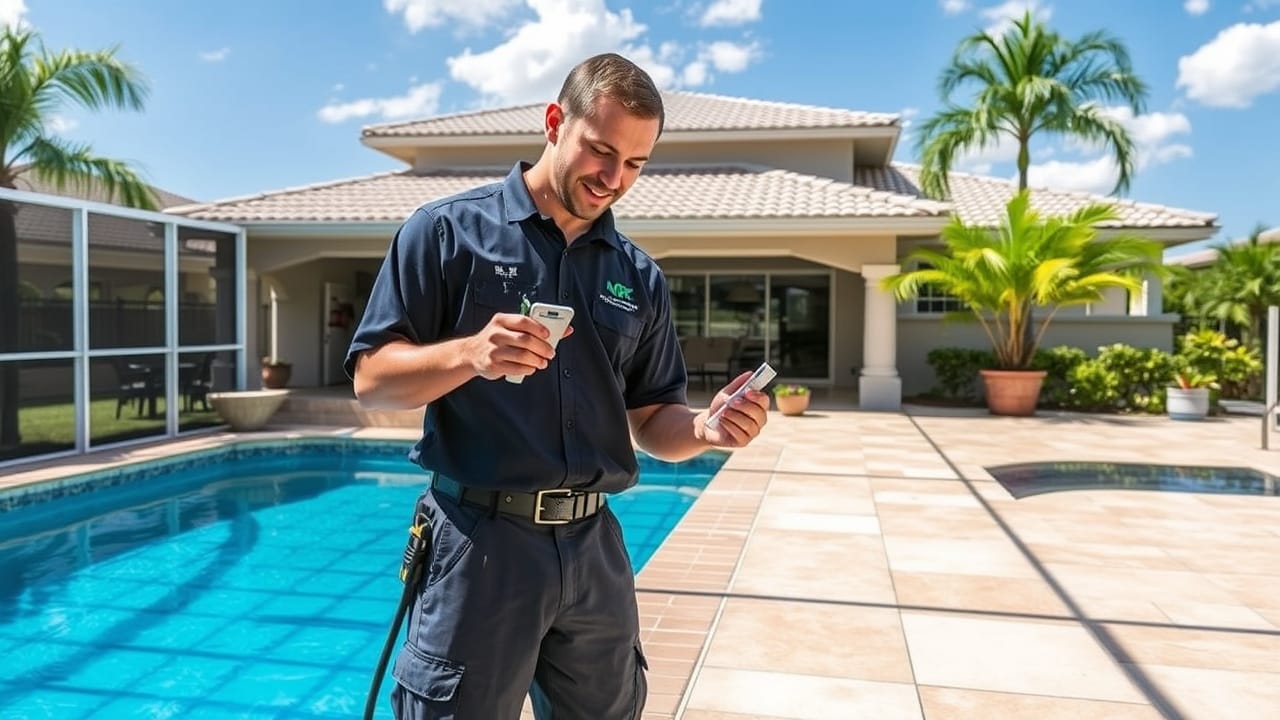
Pembroke Pines is one of the largest cities in Broward County by population — and one of the most pool-dense. With tens of thousands of residential pools spread across master-planned communities, gated subdivisions, and townhome complexes, Pembroke Pines has more pools per square mile than most Florida markets. That density creates a competitive pool service landscape, but it also means many homeowners end up with providers who are stretched thin, rotating technicians, and treating every pool the same regardless of neighborhood, water chemistry, or equipment age. This guide gives Pembroke Pines homeowners the context they need to make better decisions about their pool maintenance — and to know what good service actually looks like in this market.
Pembroke Pines Pool Chemistry: What Makes This Market Different
Pembroke Pines sits in south-central Broward County, and its municipal water supply has characteristics that matter directly for pool chemistry. Like most of northwest and central Broward, Pembroke Pines tap water runs moderately hard — calcium hardness in the 240–320 ppm range is typical — and alkalinity tends to run on the higher end of ideal pool range (100–120 ppm) straight from the tap. These two factors combined push pools toward a positive Langelier Saturation Index, meaning the water chemistry favors depositing calcium rather than dissolving it. Left unmanaged, this manifests as white scale on waterline tile, calcium buildup in salt chlorinator cells, and mineral deposits on plaster surfaces.
Pembroke Pines also sits further from the coast than communities like Hollywood or Hallandale Beach, which means lower ambient salt content in the air, but also less of the natural pH buffering effect that coastal proximity can provide. Inland pools in south Broward tend to experience wider pH swings in response to rainfall and bather load than their coastal counterparts. This is particularly relevant during the June–October rainy season, when weekly rainfall of 2–5 inches dilutes chemicals and drops cyanuric acid levels steadily over time, reducing the stabilizer protection that keeps chlorine active under South Florida’s UV intensity.
The practical takeaway for Pembroke Pines pool owners: chemistry management here requires consistent monitoring of a full parameter set — not just pH and chlorine. Calcium hardness, total alkalinity, cyanuric acid, and (for saltwater pools) salt level all need regular testing and adjustment. A service provider who only checks the basics is leaving your pool vulnerable to the specific failure modes this market produces.
Pembroke Pines Neighborhoods and What They Mean for Your Pool
Pembroke Pines was largely built out between the 1970s and the early 2000s, and different eras of development created distinct pool service profiles across its neighborhoods.
Chapel Trail, Silver Lakes, and the Western Communities
The westernmost communities in Pembroke Pines — Chapel Trail, Silver Lakes, and the neighborhoods approaching the Everglades Conservation Area boundary — were developed in the 1990s and early 2000s. Pools in this area tend to be larger lots with mature landscaping, many with screened enclosures. The proximity to the conservation areas means these pools experience more organic material input — pollen, airborne debris from the adjacent natural areas, and occasional wildlife-related issues during nesting seasons. Phosphate levels in these pools trend higher than in more densely built neighborhoods, and we adjust our treatment protocols accordingly. High phosphates are the fertilizer algae needs; managing them proactively prevents the bloom events that catch homeowners off guard after a week of heavy summer rain.
Pembroke Isles, Grand Palms, and Gated Communities
Pembroke Pines has a substantial concentration of gated HOA communities — Pembroke Isles, Grand Palms, Walnut Creek, and others — many of which include both community pool amenities and individual residential pools. The community pools in these developments are subject to Broward County Health Department commercial pool regulations: documented chemistry logs, turnover rate compliance, and operational standards that go beyond residential pool requirements. We service both the HOA community pools in these developments and individual residential pools within them, understanding the dual compliance context these neighborhoods operate in.
Individual pools within gated communities often have HOA landscape requirements that affect pool chemistry indirectly. Many Pembroke Pines HOAs mandate specific grass types, fertilization schedules, and irrigation systems that increase phosphate and nitrogen runoff into residential pools during the rainy season. We account for this when calibrating treatment for pools in these communities.
Century Village and Older Established Sections
Century Village and the established residential sections along Pines Boulevard represent the older housing stock in Pembroke Pines — 1970s and 1980s construction with pools that may have 30–40 years of history. These pools commonly have original plaster surfaces (possibly resurfaced once), older single-speed pump motors that were never upgraded, and filtration systems that have been maintained on a patch-and-repair basis rather than systematically replaced. Service in these areas often involves more equipment diagnostics than chemistry management alone. A pool that turns green despite regular service in an older section of Pembroke Pines is sometimes a circulation problem — an impeller that’s partially blocked, a filter bypass, or a return line with reduced flow — rather than a chemistry failure.
Pembroke Falls, Cobblestone Creek, and Newer Developments
Newer communities in the northern part of Pembroke Pines, built in the late 1990s through 2000s, feature pools with more modern equipment — variable-speed pumps, saltwater chlorination, LED lighting, and in some cases automation systems. These pools generally require less corrective intervention but more sophisticated diagnostic work when problems arise. A Hayward OmniLogic or Jandy AquaLink automation system that’s throwing fault codes requires someone who understands the platform, not just someone who can balance water chemistry.
Seasonal Pool Maintenance in Pembroke Pines
Like all of Broward County, Pembroke Pines pools run year-round. But the seasonal variation in maintenance requirements is real and significant.
Dry Season (November–April): Lower Pressure, Higher Stakes for Inspection
Broward’s dry season brings cooler temperatures, lower UV intensity, and dramatically reduced algae pressure. Pool chemistry holds longer between service visits, and chlorine demand drops. This is the season when attentive service providers use the chemistry stability window to focus on equipment — inspecting heat exchangers before the occasional January cold snap pushes homeowners toward actually using their heater, descaling salt cells, checking automation panel connections for corrosion, and identifying equipment that’s approaching end of service life before it fails in the middle of summer.
Dry season is also the best window for surface work — replastering, tile cleaning, and waterline bead blasting. The cooler, drier conditions allow plaster to cure more evenly, and removing calcium deposits during winter prevents the accelerated scale accumulation that occurs when temperatures rise in spring.
Spring Transition (March–May): The Surge Window
March and April represent the most unpredictable period for Pembroke Pines pool chemistry. Water temperatures climb above 80°F — the threshold where algae growth accelerates significantly. Pollen loads from local oak and pine trees peak in March and April, depositing organic material that feeds algae and spikes filter pressure. Afternoon thunderstorm activity begins earlier than most homeowners expect, with isolated cells rolling through south Broward from March onward.
We adjust chemical dosing upward for Pembroke Pines accounts starting in mid-March, calibrating chlorine feed rates on saltwater systems to account for the approaching demand increase before it arrives. A reactive approach — adjusting after the pool turns cloudy or green — is always more expensive and disruptive than proactive calibration ahead of the seasonal shift.
Rainy Season (June–October): Maximum Demand
South Florida’s rainy season turns pool chemistry management into a constant balancing act. In Pembroke Pines, rainy season rainfall averages 7–10 inches per month from June through September. Each significant rain event dilutes chlorine, drops cyanuric acid, and can introduce phosphates and organic material from surrounding landscaping. A pool that’s correctly balanced on a Monday can be significantly out of range by Thursday after three afternoon thunderstorms.
Weekly service visits are the minimum for rainy season chemistry management in Pembroke Pines. Pools with heavy bather loads — vacation rentals, homes with children home from school — may benefit from twice-weekly visits during June and July specifically. Salt chlorinator output needs to be set higher during rainy season to compensate for the dilution and organic load; we calibrate cell output at the beginning of rainy season and adjust again as patterns develop through summer.
Hurricane season overlaps rainy season entirely. Pre-storm preparation involves balancing chemistry to the high end of acceptable ranges (knowing dilution is coming), removing or securing removable equipment accessories, and ensuring automation systems are set appropriately. Post-storm, we prioritize debris removal to prevent stressing filtration, re-balance chemistry after dilution, and check that automation panels weathered the storm without moisture intrusion.
The Real Cost of Pool Ownership in Pembroke Pines
Pembroke Pines has one of the most competitive pool service markets in Broward County — low-cost providers are common, and the pricing pressure creates a race to the bottom that ultimately costs homeowners more than premium service would have. Here’s the actual cost math:
- Weekly professional service: $120–$170/month in the Pembroke Pines market for full-service weekly maintenance — chemistry, brushing, skimming, basket emptying, equipment inspection, and digital reporting.
- Low-cost service consequences: Providers operating below $80/month are typically cutting corners — skipping full chemistry panels, not brushing walls, or skipping equipment inspections. The savings of $40–$50/month compound into equipment damage and surface deterioration within 2–3 years.
- Single green pool event: $250–$550 in chemicals and labor to remediate an algae bloom, plus the loss of pool use during the week-long recovery process. One bloom per year erases the savings from the cheapest service plan on the market.
- Deferred equipment maintenance: A salt cell that’s never descaled will fail early — replacement costs $300–$600. A filter that’s never serviced damages the pump — pump replacement runs $400–$900. A heater running in unbalanced chemistry corrodes internally — heat exchanger replacement is $600–$1,500. These costs accumulate silently over 3–5 years of inadequate service.
The Pembroke Pines pool service market rewards patience and thoroughness. The lowest-cost option almost always produces the highest long-term cost.
Pool Services Available in Pembroke Pines
Fort Lauderdale Pool Service provides comprehensive pool care throughout Pembroke Pines and southern Broward County. Our Fort Lauderdale Pool Service team understands the specific chemistry, equipment patterns, and neighborhood conditions that define this market. Full service details and coverage information are available on our Pembroke Pines pool service page.
Weekly Pool Maintenance
Our weekly maintenance program covers the full chemistry panel — pH, free chlorine, total chlorine, alkalinity, calcium hardness, cyanuric acid, and salt level for saltwater pools — plus chemical adjustment, surface brushing, basket emptying, and equipment inspection. For Pembroke Pines accounts, we specifically include calcium hardness monitoring and LSI management as part of the standard service, not as an add-on. The water chemistry in south-central Broward makes this a baseline requirement, not an optional extra.
Equipment Repair and Replacement
We service and repair all major equipment brands operating in Pembroke Pines pools — Hayward, Pentair, Jandy, Zodiac, and Sta-Rite. Common service calls include variable-speed pump programming and repair, salt chlorinator cell cleaning and replacement, filter media replacement across sand, DE, and cartridge types, automation system diagnostics, and heat pump service. We carry common parts on service trucks to reduce return visit frequency on straightforward repairs.
Green Pool Remediation
A green pool in Pembroke Pines during rainy season can progress from tinted to opaque in 48–72 hours when phosphate levels are elevated and chlorine demand outpaces salt system output. Our remediation protocol involves shock treatment scaled to the severity of the bloom, algaecide application, physical brushing to break algae off surfaces, and filter cycling to remove dead organic material. We follow up within 48–72 hours to verify clearance and confirm filter pressure has returned to baseline before restoring the standard maintenance schedule.
Community and HOA Pool Service
We service multiple HOA community pools throughout Pembroke Pines, providing the commercial-grade documentation and compliance support that Broward County Health Department requirements demand. Our community pool service includes chemistry logs formatted for health department review, turnover rate verification, and coordination with HOA property management for access and scheduling.
Salt Cell Descaling and Pool Tile Cleaning
Given the moderate-hard water supply in Pembroke Pines, salt cell descaling and waterline tile cleaning are services we perform on a scheduled basis for most accounts — not as emergency interventions. We use muriatic acid descaling for salt cells and bead blasting or acid washing for tile calcium deposits, calibrating approach to the severity of accumulation and the tile type.
Common Pool Problems in Pembroke Pines
These are the issues that come up most consistently across our Pembroke Pines service accounts:
Recurring Algae Despite Regular Service
The most common complaint from homeowners switching to us from another provider is recurring algae despite paying for weekly service. The diagnostic starting point is always phosphate levels — pools in Pembroke Pines near landscaped common areas, golf courses, or conservation area boundaries frequently accumulate phosphates from runoff, and a pool with 800+ ppb phosphate will turn green even with correct chlorine chemistry. The second diagnostic is salt cell output — a cell that’s scaling up internally reduces chlorine generation without triggering an obvious error, leaving the pool under-chlorinated while the automation panel shows normal status.
Cloudy Water After Rain Events
Cloudy water following a significant rain event is typically a chemistry dilution problem — pH has shifted, alkalinity has dropped, and the combined effect is water that’s slightly out of balance in multiple parameters simultaneously. In Pembroke Pines, this happens more frequently than in coastal markets because the inland location means less natural dilution correction from sea breeze effects. We treat rain-event cloudiness systematically rather than just shocking and hoping — addressing each out-of-range parameter in the correct order to avoid creating secondary imbalances.
Variable-Speed Pump Speed Errors
Many Pembroke Pines pools were retrofitted with variable-speed pumps from single-speed originals as Florida energy code requirements took effect. A VSP that was improperly programmed during installation — or that has drifted from its original settings due to power outages resetting automation panels — often runs at the wrong speed for the pool’s filtration requirements. Common symptoms: persistent cloudy water despite correct chemistry, elevated filter pressure, or unusually high electricity bills for a variable-speed pump. We audit VSP programming on all new accounts and during annual equipment inspections.
Calcium Scale on Waterline Tile
Pembroke Pines pools on the older end — 1970s through 1990s construction — that have never had professional tile descaling often present with heavy calcium deposits on waterline tile. Beyond being visually unappealing, heavy calcium scale traps algae and makes it harder to maintain clean tile even with correct chemistry. We assess scale severity and recommend bead blasting for heavy accumulation (non-destructive, removes scale without damaging tile grout) and acid washing for lighter surface deposits.
Heater Performance Issues
Pembroke Pines is far enough inland that heaters actually get used — the occasional January cold snap that drops nighttime temps into the 50s is real, and homeowners with year-round pool use want the water warm. Heat pump heaters and gas heaters in pools with chronically unbalanced chemistry develop internal corrosion and calcium fouling on heat exchanger surfaces faster than pools in properly maintained chemistry. We include heater inspection as part of our annual equipment assessment for Pembroke Pines accounts before the dry season window when cold snaps are most likely.
Choosing a Pool Service Provider in Pembroke Pines
With the density of pool service companies operating in Pembroke Pines, differentiation matters. Here’s what to evaluate:
Licensing and Insurance
Florida requires CPO (Certified Pool/Spa Operator) certification for pool chemical maintenance and a Certified Pool Contractor (CPC) license for repair and construction work. Verify both. An unlicensed operator performing repairs creates homeowner liability exposure that most people don’t discover until they file an insurance claim and find it denied.
Full Chemistry Testing vs. Spot Checks
Ask any prospective service provider what they test at each visit. The correct answer for a Pembroke Pines pool is: pH, free chlorine, total chlorine, total alkalinity, calcium hardness, cyanuric acid, and salt level (for saltwater pools). A provider who tests only pH and chlorine is leaving the parameters most relevant to Pembroke Pines’ hard-water challenges unmeasured. Calcium hardness and alkalinity drive the scale and LSI issues this market produces — if they’re not being tested, they’re not being managed.
Digital Service Reports
Reputable providers leave a digital or written service report after each visit documenting what was tested, the results, what was added, and what was observed. This creates accountability on both sides — you know what was done, and they have documentation of their work. In HOA communities, these reports often feed into required maintenance logs. If a company can’t produce service reports, they can’t demonstrate accountability.
Dedicated Technician Assignments
High-volume service companies in Pembroke Pines rotate technicians frequently — different person each week, no continuity, no accumulation of account-specific knowledge. Ask whether your account will have a dedicated technician or a rotating pool. A technician who services your pool every week builds familiarity with its equipment quirks, typical chemistry patterns, and seasonal responses that a rotating tech never develops. That familiarity catches problems early.
Frequently Asked Questions About Pool Service in Pembroke Pines
How often should a Pembroke Pines pool be serviced professionally?
Weekly service is the standard for residential pools in Pembroke Pines. South Florida’s year-round heat and humidity — combined with the rainy season’s chemistry dilution effects — means pool chemistry shifts meaningfully within 7 days during most of the year. Monthly service is not adequate to maintain proper water balance in this climate. During peak rainy season (June–August), pools with high bather loads may benefit from twice-weekly chemistry checks.
Why does my Pembroke Pines pool keep turning green?
Recurring algae in a Pembroke Pines pool that’s receiving regular service usually points to one of three causes: high phosphate levels (common near landscaped areas and conservation area boundaries), a scaling salt cell that’s producing less chlorine than the automation panel indicates, or inadequate cyanuric acid causing rapid chlorine breakdown under Florida’s UV intensity. We test for all three when diagnosing recurring algae complaints.
What does weekly pool service cost in Pembroke Pines?
Full-service weekly maintenance in Pembroke Pines typically runs $120–$170/month depending on pool size, equipment complexity, and whether the account requires additional services like phosphate treatment or more frequent salt cell descaling. This covers chemistry testing and adjustment, brushing, basket emptying, equipment inspection, and digital reporting after each visit. Equipment repairs are billed separately.
Does Fort Lauderdale Pool Service cover Pembroke Pines?
Yes. We maintain residential and community pools throughout Pembroke Pines and the surrounding south Broward communities. Our technicians are familiar with the specific water chemistry conditions, equipment patterns, and neighborhood characteristics across Pembroke Pines’ diverse housing stock — from 1970s established neighborhoods to 2000s gated communities.
Can you service the community pool in my HOA?
Yes. We service HOA community pools throughout Pembroke Pines and provide the commercial documentation required for Broward County Health Department compliance, including chemistry logs and service records formatted for regulatory review.
When is the best time to resurface a Pembroke Pines pool?
November through February — Broward’s dry season — is the optimal window. Cooler temperatures allow new plaster to cure more evenly, and lower rainfall probability reduces the risk of interruption during the plastering process. Homeowners also sacrifice less swimming time during the months when the pool sees its lightest use. We can connect you with licensed pool contractors for resurfacing work and coordinate the service transition around a resurfacing project.
Get Professional Pool Service in Pembroke Pines
Fort Lauderdale Pool Service provides weekly pool maintenance, equipment repair, and specialty services for residential and community pools throughout Pembroke Pines. We understand the specific chemistry challenges of south-central Broward County’s water supply, the equipment patterns common across Pembroke Pines’ diverse housing stock, and what it takes to keep a pool consistently clean in South Florida’s demanding climate. Whether you’re dealing with recurring algae, aging equipment, or simply looking for a service provider who actually shows up every week and does the full job, we’re ready to help.
Contact us today for a free water quality assessment and quote for Pembroke Pines pool service.